


The core derivative rules are: constant ( frac{d}{dx}c = 0 ); power ( frac{d}{dx}x^n = nx^{n-1} ); constant multiple ( (cf)’ = cf’ ); sum ( (f pm g)’ = f’ pm g’ ); product ( (uv)’ = u’v + uv’ ); quotient ( left(frac{u}{v}right)’ = frac{u’v – uv’}{v^2} ); and chain ( frac{d}{dx}f(g(x)) = f'(g(x)),g'(x) ). With the derivatives of ( sin x ), ( cos x ), ( e^x ) and ( ln x ), these rules differentiate any elementary function.
A derivative measures how fast a function changes: it’s the slope of the tangent line to the graph at each point. This page collects every differentiation formula you need, explains where each rule comes from, and shows a worked example for each. Every answer here was checked with the step-by-step solver further down the page.
Definition of the derivative
The derivative of ( f ) at ( x ) is the limit of the slopes of secant lines:
$$f'(x) = lim_{hto0}frac{f(x + h) - f(x)}{h}$$
It’s written ( f'(x) ), ( frac{dy}{dx} ), ( frac{d}{dx}f(x) ) or ( Df ). Differentiation is the process of finding it.
Example 1: from the definition. For ( f(x) = x^2 ):
$$f'(x) = lim_{hto0}frac{(x + h)^2 - x^2}{h} = lim_{hto0}frac{2xh + h^2}{h} = lim_{hto0}(2x + h) = 2x$$
The rules below are shortcuts that give the same answers without computing a limit every time.
The basic differentiation rules
| Rule | Formula | Example |
|---|---|---|
| Constant | ( frac{d}{dx}c = 0 ) | ( frac{d}{dx}7 = 0 ) |
| Power | ( frac{d}{dx}x^n = nx^{n-1} ) | ( frac{d}{dx}x^5 = 5x^4 ) |
| Constant multiple | ( frac{d}{dx}[cf] = cf’ ) | ( frac{d}{dx}4x^3 = 12x^2 ) |
| Sum and difference | ( (f pm g)’ = f’ pm g’ ) | ( frac{d}{dx}(x^2 – 3x) = 2x – 3 ) |
| Product (uv rule) | ( (uv)’ = u’v + uv’ ) | ( frac{d}{dx}x^2e^x = 2xe^x + x^2e^x ) |
| Quotient | ( left(frac{u}{v}right)’ = frac{u’v – uv’}{v^2} ) | ( frac{d}{dx}frac{x}{x + 1} = frac{1}{(x + 1)^2} ) |
| Chain | ( frac{d}{dx}f(g(x)) = f'(g(x)),g'(x) ) | ( frac{d}{dx}(3x^2 + 1)^4 = 24x(3x^2 + 1)^3 ) |
Power rule
The power rule works for any real exponent, including negatives and fractions, once you rewrite roots and reciprocals as powers:

$$frac{d}{dx}sqrt{x} = frac{d}{dx}x^{1/2} = tfrac12x^{-1/2} = frac{1}{2sqrt{x}}, qquad frac{d}{dx}frac{1}{x^2} = frac{d}{dx}x^{-2} = -2x^{-3} = -frac{2}{x^3}$$
Full guide: power rule.
Product rule (the uv rule)
For a product ( ucdot v ), differentiate one factor at a time and add: ( (uv)’ = u’v + uv’ ). A common memory aid is “first times derivative of the second, plus second times derivative of the first”.
Example 2. ( frac{d}{dx}[x^2sin x] = 2xsin x + x^2cos x ).
Full guide: product rule.
Quotient rule
$$frac{d}{dx}left[frac{u}{v}right] = frac{u'v - uv'}{v^2}$$
The order in the numerator matters: “low d-high minus high d-low, over low squared.”
Example 3. ( frac{d}{dx}frac{x^2 + 1}{x – 3} = frac{2x(x – 3) – (x^2 + 1)}{(x – 3)^2} = frac{x^2 – 6x – 1}{(x – 3)^2} ).
Full guide: quotient rule.
Chain rule
For a function inside another function, differentiate the outside (leaving the inside alone), then multiply by the derivative of the inside.
Example 4. ( frac{d}{dx}e^{3x} = e^{3x}cdot 3 = 3e^{3x} ).
Example 5. ( frac{d}{dx}sin(x^2) = cos(x^2)cdot 2x ).
Full guide: chain rule.
Derivatives of common functions
Exponential and logarithmic
| Function | Derivative |
|---|---|
| ( e^x ) | ( e^x ) |
| ( a^x ) | ( a^xln a ) |
| ( ln x ) | ( frac1x ) |
| ( log_a x ) | ( frac{1}{xln a} ) |
So ( frac{d}{dx}2^x = 2^xln 2 ), and ( frac{d}{dx}ln(5x) = frac{5}{5x} = frac1x ). See the derivative of ln x and the derivative of e^(2x).
Trigonometric
| Function | Derivative |
|---|---|
| ( sin x ) | ( cos x ) |
| ( cos x ) | ( -sin x ) |
| ( tan x ) | ( sec^2 x ) |
| ( cot x ) | ( -csc^2 x ) |
| ( sec x ) | ( sec xtan x ) |
| ( csc x ) | ( -csc xcot x ) |
These hold only in radians. For example, proofs: derivative of sin x, derivative of tan x, derivative of sec x.
Inverse trigonometric
| Function | Derivative |
|---|---|
| ( arcsin x ) | ( frac{1}{sqrt{1 – x^2}} ) |
| ( arccos x ) | ( -frac{1}{sqrt{1 – x^2}} ) |
| ( arctan x ) | ( frac{1}{1 + x^2} ) |
See inverse trig functions, the derivative of arcsin x and the derivative of arctan x.
Derivative calculator
Type any function to see which rules apply, in order. For example, the example is the product ( x^2e^x ).
The full derivative calculator also gives second and third derivatives.
Special techniques
- Implicit differentiation: for curves like ( x^2 + y^2 = 25 ), differentiate both sides and solve for ( frac{dy}{dx} ): ( frac{dy}{dx} = -frac{x}{y} ).
- Logarithmic differentiation: for functions like ( x^x ), take ln first. See the derivative of x^x.
- Higher derivatives: differentiate again. ( frac{d^2}{dx^2}x^4 = 12x^2 ). The second derivative tells you concavity; see inflection points.
- Partial derivatives: for functions of several variables, differentiate in one variable while holding the others constant.
How to choose the right rule
- Simplify first. Rewrite ( frac{x^3 + x}{x} ) as ( x^2 + 1 ) before differentiating.
- Look at the outermost operation. A sum: differentiate term by term. A product: product rule. A quotient: quotient rule (or rewrite as a product with a negative power). Also, a function of a function: chain rule.
- Work inward. Inside a product or quotient, each piece may need the chain rule.
Example 6: several rules at once. ( y = xsin(2x) ). Outermost is a product, and the second factor needs the chain rule:
$$y' = 1cdotsin(2x) + xcdot 2cos(2x) = sin(2x) + 2xcos(2x)$$
What derivatives are used for
- Slopes and tangent lines: see the equation of a tangent line.
- Rates of change: velocity is the derivative of position; see velocity and acceleration.
- Maximum and minimum values: set ( f'(x) = 0 ); see critical points and optimization problems.
- Approximations: see linear approximation and Newton’s method.
Common mistakes
- Product of derivatives. ( (uv)’ neq u’v’ ). For ( xcdot x ), that would give 1 instead of ( 2x ).
- Quotient rule sign. It’s ( u’v – uv’ ), not ( uv’ – u’v ).
- Forgetting the chain rule. ( frac{d}{dx}cos(5x) = -5sin(5x) ).
- Power rule on exponentials. ( frac{d}{dx}2^x neq xcdot 2^{x-1} ); the variable is in the exponent, so use ( a^xln a ).
- Degrees. Trig derivative formulas assume radians.
Printable formula sheet
Every derivative and integral formula from this guide is on a one-page printable table.
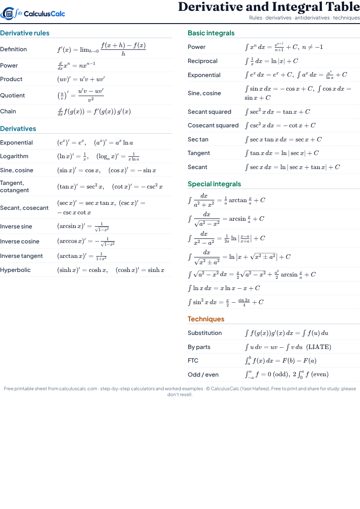
Derivative and Integral Table
Every standard derivative and antiderivative, plus the rules and techniques.
Download the Derivative and Integral Table (PDF) Open in browserPractice problems
- ( frac{d}{dx}(6x^4 – 2x + 9) )
- ( frac{d}{dx}frac{3}{x} )
- ( frac{d}{dx}(x^3ln x) )
- ( frac{d}{dx}frac{sin x}{x} )
- ( frac{d}{dx}sqrt{4x + 1} )
- ( frac{d}{dx}e^{x^2} )
Answers: (1) ( 24x^3 – 2 ); (2) ( -frac{3}{x^2} ); (3) ( 3x^2ln x + x^2 ); (4) ( frac{xcos x – sin x}{x^2} ); (5) ( frac{2}{sqrt{4x + 1}} ); (6) ( 2xe^{x^2} ).
FAQ
What are the basic derivative rules?
The constant, power, constant multiple, sum, product, quotient and chain rules, together with the derivatives of ( e^x ), ( ln x ) and the trig functions.
What is the uv rule in differentiation?
Another name for the product rule: ( frac{d}{dx}(uv) = ufrac{dv}{dx} + vfrac{du}{dx} ).
What is the definition of a derivative?
( f'(x) = lim_{hto0}frac{f(x + h) – f(x)}{h} ), the limit of the average rate of change as the interval shrinks to zero.
What is the difference between a derivative and differentiation?
The derivative is the result (a function giving the slope at each point). Differentiation, however, is the process of finding it.
What is the derivative of a constant?
Zero. A constant function is a horizontal line, which has slope 0 everywhere.
Further reading
- Derivatives of Trig Functions (Paul’s Online Math Notes) — proofs of the trig derivative formulas with worked examples.
- Differentiation rules (Wikipedia) — a complete reference of derivative formulas.
- 3.3 Differentiation Rules (OpenStax Calculus Volume 1) — the power, sum, product and quotient rules derived from the definition.
Calculators for this topic
Keep learning
Inverse Trig Functions: Arcsin, Arccos and Arctan
Arcsin, arccos and arctan explained: domains and ranges, how to evaluate them, graphs, derivatives, and the integrals that give inverse trig answers.
Derivative of sin x: Proof, Examples and Trig Derivatives
The derivative of sin x is cos x. See the limit proof, chain rule examples like sin(3x) and sin²x, and the table of all six trig derivatives.