

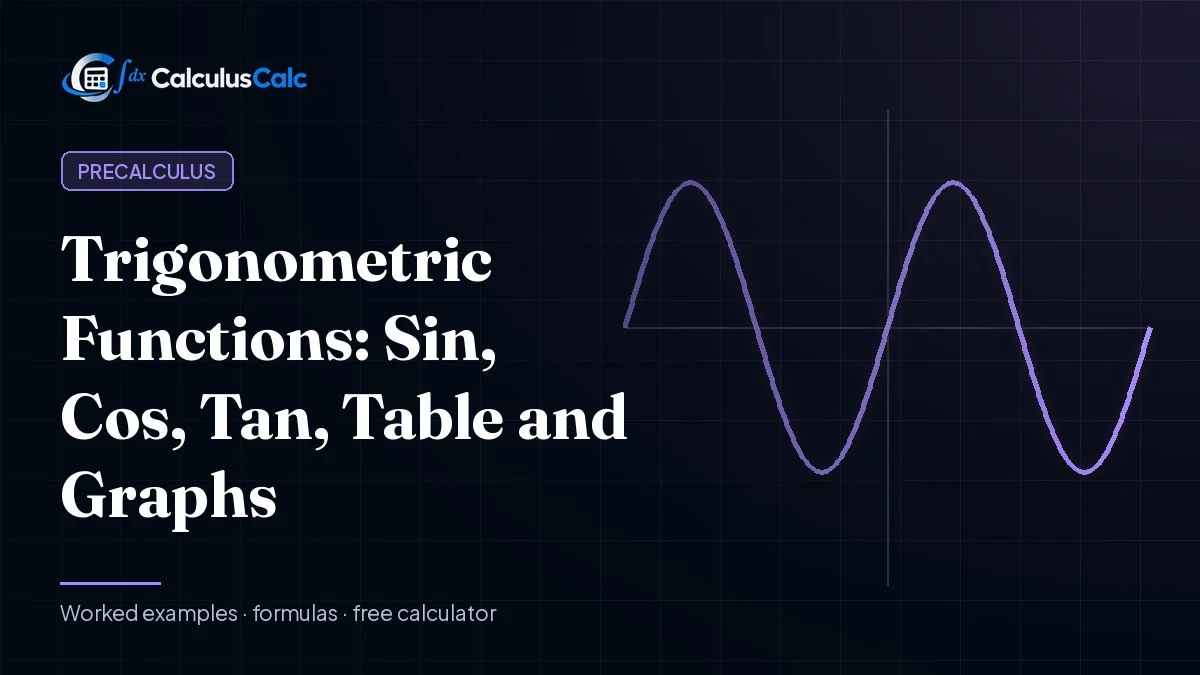
The trigonometric functions relate an angle to side ratios in a right triangle: ( sintheta = frac{text{opposite}}{text{hypotenuse}} ), ( costheta = frac{text{adjacent}}{text{hypotenuse}} ), ( tantheta = frac{text{opposite}}{text{adjacent}} ), and their reciprocals csc, sec and cot. Key values: ( sin 0 = 0 ), ( cos 0 = 1 ), ( sin 30^circ = frac12 ), ( tan 45^circ = 1 ), ( sec 45^circ = sqrt2 ) and ( cos 180^circ = -1 ).
The trigonometric functions relate an angle to ratios of side lengths. There are six: sine, cosine, tangent, and their reciprocals cosecant, secant and cotangent. They describe triangles, circles, waves, rotation and anything periodic. Because of this, trigonometry runs through physics, engineering and calculus.
Right-triangle definitions: SOH-CAH-TOA
In a right triangle with an acute angle ( theta ), name the sides relative to that angle: the opposite side, the adjacent side, and the hypotenuse (the longest side, across from the right angle).

| Function | Ratio | Memory aid |
|---|---|---|
| ( sintheta ) | ( frac{text{opposite}}{text{hypotenuse}} ) | SOH |
| ( costheta ) | ( frac{text{adjacent}}{text{hypotenuse}} ) | CAH |
| ( tantheta ) | ( frac{text{opposite}}{text{adjacent}} ) | TOA |
| ( csctheta ) | ( frac{text{hypotenuse}}{text{opposite}} = frac{1}{sintheta} ) | |
| ( sectheta ) | ( frac{text{hypotenuse}}{text{adjacent}} = frac{1}{costheta} ) | |
| ( cottheta ) | ( frac{text{adjacent}}{text{opposite}} = frac{1}{tantheta} ) |
Example 1
A right triangle has legs 3 and 4 and hypotenuse 5. For the angle ( theta ) opposite the side of length 3:
$$sintheta = frac35, quad costheta = frac45, quad tantheta = frac34, quad csctheta = frac53, quad sectheta = frac54, quad cottheta = frac43$$
Example 2: finding a side
A ladder 6 m long leans against a wall at ( 70^circ ) to the ground. How high does it reach? The height is opposite the angle and the ladder is the hypotenuse, so
$$h = 6sin 70^circ approx 6(0.9397) approx 5.64 text{ m}$$
Example 3: finding an angle
A ramp rises 1 m over a horizontal run of 12 m. Its angle is ( theta = arctanfrac{1}{12} approx 4.76^circ ). Undoing a trig function like this uses the inverse trig functions.
Unit-circle definitions
Right triangles only handle angles between ( 0^circ ) and ( 90^circ ). To define trig functions for any angle, however, use the unit circle: rotate counterclockwise by ( theta ) from the positive x-axis, and the point you land on is
$$(x, y) = (costheta, sintheta)$$
Then ( tantheta = frac{y}{x} ). This works for every angle, including obtuse, negative and larger than ( 360^circ ), and the signs come out automatically: in Quadrant II, x is negative, so cosine is negative.
Trigonometry table (sin cos tan chart) of exact values
These come from the 30-60-90 and 45-45-90 special right triangles.

| Angle | ( sin ) | ( cos ) | ( tan ) | ( csc ) | ( sec ) | ( cot ) |
|---|---|---|---|---|---|---|
| ( 0^circ ) | 0 | 1 | 0 | undefined | 1 | undefined |
| ( 30^circ ) | ( frac12 ) | ( frac{sqrt3}{2} ) | ( frac{sqrt3}{3} ) | 2 | ( frac{2sqrt3}{3} ) | ( sqrt3 ) |
| ( 45^circ ) | ( frac{sqrt2}{2} ) | ( frac{sqrt2}{2} ) | 1 | ( sqrt2 ) | ( sqrt2 ) | 1 |
| ( 60^circ ) | ( frac{sqrt3}{2} ) | ( frac12 ) | ( sqrt3 ) | ( frac{2sqrt3}{3} ) | 2 | ( frac{sqrt3}{3} ) |
| ( 90^circ ) | 1 | 0 | undefined | 1 | undefined | 0 |
| ( 180^circ ) | 0 | ( -1 ) | 0 | undefined | ( -1 ) | undefined |
| ( 270^circ ) | ( -1 ) | 0 | undefined | ( -1 ) | undefined | 0 |
So, for example, ( sin 30^circ = frac12 ), ( cos 180^circ = -1 ) and ( sec 45^circ = sqrt2 ).
A pattern helps you remember the sines of ( 0^circ, 30^circ, 45^circ, 60^circ, 90^circ ): they are ( frac{sqrt0}{2}, frac{sqrt1}{2}, frac{sqrt2}{2}, frac{sqrt3}{2}, frac{sqrt4}{2} ). Cosines, on the other hand, run the same list backwards.
Trig calculator
Enter any angle in degrees or radians for all six values, exact where possible, plus the quadrant and reference angle.
Open the full trig calculator for more examples.
Quick values people look up
| Value | Exact | Why |
|---|---|---|
| ( sin 0 ) | 0 | the point at ( 0^circ ) is ( (1, 0) ); sine is the y-coordinate |
| ( cos 0 ) | 1 | cosine is the x-coordinate of ( (1, 0) ) |
| ( sin 30^circ ) | ( frac12 ) | half of the equilateral triangle: opposite 1, hypotenuse 2 |
| ( cos 30^circ ) | ( frac{sqrt3}{2} approx 0.8660 ) | adjacent ( sqrt3 ), hypotenuse 2 |
| ( tan 45^circ ) | 1 | both legs equal |
| ( sec 45^circ ) | ( sqrt2 approx 1.4142 ) | ( frac{1}{cos 45^circ} = frac{2}{sqrt2} ) |
| ( sin 90^circ ) | 1 | the point ( (0, 1) ) |
| ( cos 180^circ ) | ( -1 ) | the point ( (-1, 0) ) |
| ( tan 90^circ ) | undefined | ( cos 90^circ = 0 ) in the denominator |
In radians the same angles are ( 0 ), ( frac{pi}{6} ), ( frac{pi}{4} ), ( frac{pi}{2} ) and ( pi ); see degrees to radians for converting.
What does “tangent” mean?
The word has two related meanings. A tangent line touches a curve at one point and has the same direction as the curve there; its slope is the derivative (see the equation of a tangent line). Also, the tangent function, ( tantheta = frac{sintheta}{costheta} ), is the opposite side over the adjacent side. They’re connected: on the unit circle, ( tantheta ) is the length of the segment of the tangent line at ( (1, 0) ) cut off by the radius at angle ( theta ).

Signs in each quadrant
| Quadrant | Angles | Positive functions |
|---|---|---|
| I | ( 0^circ ) to ( 90^circ ) | all |
| II | ( 90^circ ) to ( 180^circ ) | sin, csc |
| III | ( 180^circ ) to ( 270^circ ) | tan, cot |
| IV | ( 270^circ ) to ( 360^circ ) | cos, sec |
“All Students Take Calculus” gives the order. To evaluate any angle, find its reference angle (the acute angle to the x-axis), take the value from the table, and attach the sign for the quadrant. For example, ( cos 210^circ ): reference angle ( 30^circ ), Quadrant III where cosine is negative, so ( cos 210^circ = -frac{sqrt3}{2} ).

Graphs of the trig functions
- ( y = sin x ) is a wave starting at 0, rising to 1 at ( frac{pi}{2} ), back to 0 at ( pi ), down to ( -1 ) at ( frac{3pi}{2} ), and repeating every ( 2pi ).
- ( y = cos x ) is the same wave shifted left by ( frac{pi}{2} ); it starts at 1.
- ( y = tan x ) repeats every ( pi ), passes through 0 at multiples of ( pi ), and has vertical asymptotes where ( cos x = 0 ), at ( x = frac{pi}{2} + kpi ).
Amplitude, period and shifts
For ( y = Asin(B(x – C)) + D ):
| Parameter | Effect |
|---|---|
| ( lvert Arvert ) | amplitude (half the height from peak to trough) |
| ( frac{2pi}{lvert Brvert} ) | period (length of one cycle) |
| ( C ) | horizontal (phase) shift |
| ( D ) | vertical shift (the midline) |
Example 4. ( y = 3sin(2x) + 1 ) has amplitude 3, period ( frac{2pi}{2} = pi ), and midline ( y = 1 ), so it oscillates between ( -2 ) and 4.
Graphs of sec, csc and cot
- ( y = sec x ) is ( frac{1}{cos x} ): U-shaped branches that never get between ( -1 ) and 1, with vertical asymptotes where ( cos x = 0 ) (( x = frac{pi}{2} + kpi )). It touches 1 where cosine peaks and ( -1 ) where cosine bottoms out.
- ( y = csc x ) is ( frac{1}{sin x} ): the same shape shifted, with asymptotes at multiples of ( pi ).
- ( y = cot x ) is ( frac{cos x}{sin x} ): decreasing branches with period ( pi ) and asymptotes at multiples of ( pi ).
| Graph | Period | Range | Asymptotes |
|---|---|---|---|
| ( sin x ), ( cos x ) | ( 2pi ) | ( [-1, 1] ) | none |
| ( tan x ) | ( pi ) | all reals | ( x = frac{pi}{2} + kpi ) |
| ( sec x ) | ( 2pi ) | ( (-infty, -1] cup [1, infty) ) | ( x = frac{pi}{2} + kpi ) |
| ( csc x ) | ( 2pi ) | ( (-infty, -1] cup [1, infty) ) | ( x = kpi ) |
| ( cot x ) | ( pi ) | all reals | ( x = kpi ) |
Plot any of them in the graphing calculator.
Degrees and radians
A full turn is ( 360^circ = 2pi ) radians, so
$$text{radians} = text{degrees} times frac{pi}{180}, qquad text{degrees} = text{radians} times frac{180}{pi}$$
( 60^circ = frac{pi}{3} ) and ( frac{3pi}{4} = 135^circ ). Calculus uses radians, because only then is ( frac{d}{dx}sin x = cos x ) (see the derivative of sin x).
Key relationships
The most important identity comes from the Pythagorean theorem on the unit circle:
$$sin^2theta + cos^2theta = 1$$
Dividing by ( cos^2theta ) gives ( tan^2theta + 1 = sec^2theta ). These and the double-angle formulas are collected in trig identities. For triangles without a right angle, use the law of sines and cosines.
Common mistakes
- Calculator in the wrong mode. ( sin 30 ) in radian mode is about ( -0.988 ).
- Opposite vs adjacent. They depend on which angle you’re using; relabel for each angle.
- ( sin^2 x ) vs ( sin(x^2) ). ( sin^2 x ) means ( (sin x)^2 ).
- Wrong sign outside Quadrant I. Always check the quadrant after using the reference angle.
Printable formula sheet
The definitions, exact values and identities are collected on a one-page sheet.
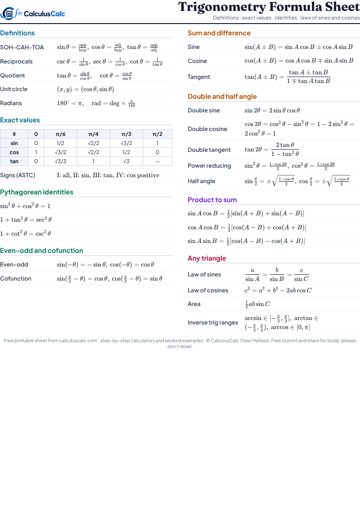
Trig Identities Formula Sheet
Pythagorean, sum and difference, double-angle, half-angle and product identities, exact values and the laws of sines and cosines.
Download the Trig Identities Formula Sheet (PDF) Open in browserPractice problems
- Find ( sintheta ) and ( tantheta ) if the opposite side is 5 and the hypotenuse is 13.
- Evaluate ( cos 60^circ + sin 30^circ ).
- Evaluate ( tan 225^circ ).
- Evaluate ( sinfrac{5pi}{6} ).
- Convert ( 150^circ ) to radians.
- State the amplitude and period of ( y = 4cos(3x) ).
Answers: (1) ( sintheta = frac{5}{13} ), ( tantheta = frac{5}{12} ); (2) 1; (3) 1; (4) ( frac12 ); (5) ( frac{5pi}{6} ); (6) amplitude 4, period ( frac{2pi}{3} ).
FAQ
What are the six trigonometric functions?
Sine, cosine, tangent, cosecant, secant and cotangent. The last three are reciprocals of the first three.
What is SOH-CAH-TOA?
A memory aid: Sine = Opposite/Hypotenuse, Cosine = Adjacent/Hypotenuse, Tangent = Opposite/Adjacent.
What is sin 30?
( sin 30^circ = frac12 ).
What is cos 180?
( cos 180^circ = -1 ), since the point at ( 180^circ ) on the unit circle is ( (-1, 0) ).
What does tangent mean in trigonometry?
( tantheta = frac{sintheta}{costheta} ), the opposite side over the adjacent side. On the unit circle it’s also the slope of the line from the origin at angle ( theta ).
Further reading
- Trigonometric functions (Wikipedia) — definitions, graphs, identities and history.
- Calculus I Review chapter (Paul’s Online Math Notes) — the trig facts calculus students need, with examples.
Calculators for this topic
Keep learning

The Unit Circle: Angles, Coordinates and Trig Values
The unit circle explained: why the coordinates are cos and sin, every special angle in degrees and radians, tangent on the unit circle, and memory tricks.

Trig Identities: Full List with Double Angle Formulas
Every trig identity you need: Pythagorean, reciprocal, sum and difference, double angle and half angle formulas, with proofs and worked examples.