
Trig Calculator (Sin, Cos, Tan)
- Free
- No sign-up
- Works on phones
- Shows the working
 By Yasir Hafeez · Updated
This trig calculator evaluates all six trigonometric functions of an angle: sine, cosine, tangent, cosecant, secant and cotangent. For the special angles (multiples of \( 30^\circ \) and \( 45^\circ \)) it gives exact values such as \( \frac{\sqrt3}{2} \) rather than 0.8660254, and for other angles it gives decimals. It also reports the quadrant, the reference angle, the conversion between degrees and radians, and the point on the unit circle.
Think of it as a sin cos tan calculator and a trigonometry table that you never have to memorize. Also, it’s free and needs no sign-up.
How to use the trig calculator
- Enter the angle \( \theta \). Degrees can be any number, such as
135or-60. Radians acceptpi, for example5pi/3orpi/4. - Choose Degrees or Radians in the Unit menu.
- Press Evaluate.
- Read the six values. “Undefined” appears where a function divides by zero, such as \( \tan 90^\circ \).
Definitions
On the unit circle, the angle \( \theta \) measured counterclockwise from the positive x-axis lands on the point \( (\cos\theta, \sin\theta) \). The other four functions follow from those two:

$$\tan\theta = \frac{\sin\theta}{\cos\theta}, \quad \csc\theta = \frac{1}{\sin\theta}, \quad \sec\theta = \frac{1}{\cos\theta}, \quad \cot\theta = \frac{\cos\theta}{\sin\theta}$$
In a right triangle this is the familiar SOH-CAH-TOA: sine is opposite over hypotenuse, cosine is adjacent over hypotenuse, tangent is opposite over adjacent.
Exact values table
| \( \theta \) | \( \sin\theta \) | \( \cos\theta \) | \( \tan\theta \) |
|---|---|---|---|
| \( 0^\circ = 0 \) | 0 | 1 | 0 |
| \( 30^\circ = \frac{\pi}{6} \) | \( \frac12 \) | \( \frac{\sqrt3}{2} \) | \( \frac{\sqrt3}{3} \) |
| \( 45^\circ = \frac{\pi}{4} \) | \( \frac{\sqrt2}{2} \) | \( \frac{\sqrt2}{2} \) | 1 |
| \( 60^\circ = \frac{\pi}{3} \) | \( \frac{\sqrt3}{2} \) | \( \frac12 \) | \( \sqrt3 \) |
| \( 90^\circ = \frac{\pi}{2} \) | 1 | 0 | undefined |
| \( 180^\circ = \pi \) | 0 | \( -1 \) | 0 |
Worked example: an angle in Quadrant II
Evaluate the trig functions of \( 135^\circ \).
Quadrant and reference angle. \( 135^\circ \) is between \( 90^\circ \) and \( 180^\circ \), so it’s in Quadrant II. Its reference angle is \( 180^\circ - 135^\circ = 45^\circ \).
Signs. In Quadrant II, x is negative and y is positive, so sine is positive and cosine is negative.
Values. \( \sin 135^\circ = \frac{\sqrt2}{2} \), \( \cos 135^\circ = -\frac{\sqrt2}{2} \), \( \tan 135^\circ = -1 \). Also, the unit-circle point is \( \left( -\frac{\sqrt2}{2}, \frac{\sqrt2}{2} \right) \), and \( 135^\circ = \frac{3\pi}{4} \) radians.
Worked example: an angle in radians
Evaluate \( \theta = \frac{5\pi}{3} \). That’s \( 300^\circ \), in Quadrant IV, with reference angle \( 60^\circ \). Cosine is positive there and sine is negative:
$$\sin\tfrac{5\pi}{3} = -\tfrac{\sqrt3}{2}, \qquad \cos\tfrac{5\pi}{3} = \tfrac12, \qquad \tan\tfrac{5\pi}{3} = -\sqrt3$$
Tips and common mistakes
- Wrong mode. \( \sin 30 \) in radians is about \( -0.988 \), not \( 0.5 \). Always check the unit.
- Signs by quadrant. “All Students Take Calculus”: all positive in I, sine in II, tangent in III, cosine in IV.
- Undefined values. \( \tan\theta \) and \( \sec\theta \) are undefined where \( \cos\theta = 0 \) (\( 90^\circ, 270^\circ \)); \( \cot\theta \) and \( \csc\theta \) where \( \sin\theta = 0 \).
- Rationalized forms. \( \frac{1}{\sqrt3} \) and \( \frac{\sqrt3}{3} \) are the same number; the calculator shows the rationalized version.
Why calculus uses radians
The derivative rule \( \frac{d}{dx}\sin x = \cos x \) is only true when x is in radians. In degrees an extra factor of \( \frac{\pi}{180} \) appears. That’s why every calculus formula on this site, from the derivative of sin x to the limit of sin x / x, assumes radians.
Signs in each quadrant
Which functions are positive depends on the quadrant of the angle:
| Quadrant | Angles | Positive |
|---|---|---|
| I | 0° to 90° | sin, cos, tan |
| II | 90° to 180° | sin only |
| III | 180° to 270° | tan only |
| IV | 270° to 360° | cos only |
A memory aid is “All Students Take Calculus”. However, the value itself comes from the reference angle: \( \cos 150° = -\cos 30° = -\frac{\sqrt{3}}{2} \).
Degrees and radians
Multiply degrees by \( \frac{\pi}{180} \) to get radians and radians by \( \frac{180}{\pi} \) to get degrees. So \( 135° = \frac{3\pi}{4} \approx 2.356 \) and 2 radians \( \approx 114.59° \). Most errors on calculators come from the wrong mode. See degrees to radians.
Worked example: measuring a height
From a point 50 m from the base of a tower, the angle of elevation to the top is 32°. So, the height is
$$h = 50 \tan 32° \approx 31.24 \text{ m}$$
Add the height of your eyes above the ground if you measured the angle standing up.
Graphs: amplitude and period
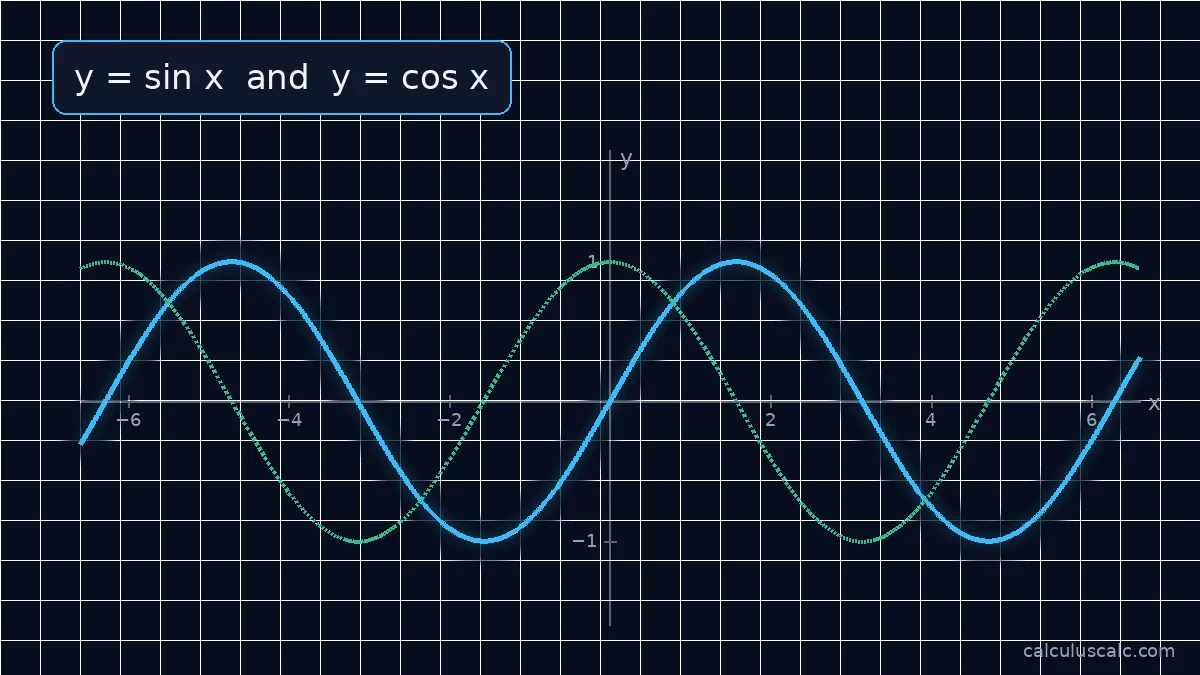
For \( y = A\sin(Bx) \), the amplitude is \( |A| \) and the period is \( \frac{2\pi}{|B|} \). So \( y = 3\sin 2x \) swings between −3 and 3 and repeats every \( \pi \). Tangent has period \( \pi \) and vertical asymptotes where \( \cos x = 0 \). Explore them in the graphing calculator.
Identities that simplify calculations
- \( \sin^2 x + \cos^2 x = 1 \)
- \( \tan x = \frac{\sin x}{\cos x} \)
- \( \sin 2x = 2\sin x\cos x \), \( \cos 2x = \cos^2 x - \sin^2 x \)
If \( \sin x = \frac{3}{5} \) and \( x \) is in Quadrant II, then \( \cos x = -\frac{4}{5} \) and \( \tan x = -\frac{3}{4} \). See trig identities.
Common mistakes
- Wrong calculator mode: \( \sin 30 \) is 0.5 in degree mode but about −0.988 in radian mode.
- Writing \( \sin^{-1}x \) as \( \frac{1}{\sin x} \): \( \sin^{-1} \) means arcsin; the reciprocal is \( \csc x \).
- Forgetting the sign from the quadrant when using a reference angle.
- Assuming \( \sin(a + b) = \sin a + \sin b \): use the addition formula instead.
Exact or decimal?
For special angles the calculator gives exact forms, such as \( \sin 60° = \frac{\sqrt{3}}{2} \), which keep answers precise in later steps. For other angles it gives decimals; round only at the end.
Practice problems
- \( \sin 210° \)
- Convert \( \frac{5\pi}{6} \) to degrees.
- Period of \( y = \cos(4x) \).
Answers: 1. \( -\frac{1}{2} \). 2. 150°. 3. \( \frac{\pi}{2} \).
Understanding the Output
After entering your angle and unit, press "Evaluate". The trig calculator displays six function values. It also shows the angle's quadrant and its reference angle. This helps confirm your input and provides useful context. The coordinate point on the unit circle is also given.
Exact values, like "sqrt(3)/2", appear for special angles. For other angles, decimal approximations are shown. Round decimal answers only at the final step of a larger problem. "Undefined" means the function's denominator was zero, which is not allowed in mathematics.
When to Use a Different Tool
This trig calculator focuses on evaluating trigonometric functions for a given angle. However, sometimes you need to find the angle itself. This is where inverse trigonometric functions are useful. For example, if you know sin(x) = 0.5, you use arcsin(0.5) to find x.
Similarly, for graphing trigonometric equations like y = 3sin(2x), a dedicated graphing calculator is more suitable. These tools visualize the function's behavior. They show amplitude, period, and phase shifts clearly. Use this calculator for quick evaluations of specific angles.
Related guides
- Trigonometric Functions: Ratios, Values and Graphs
- The Unit Circle
- Special Right Triangles
- Trig Identities
Further reading
- Trigonometric functions (Wikipedia) — right-triangle and unit-circle definitions, graphs and history.
- Calculus I Review chapter (Paul’s Online Math Notes) — the unit circle, exact values and the trig facts needed for calculus.
FAQ
How do I find sin, cos and tan of an angle?
Enter the angle, choose degrees or radians and press Evaluate. As a result, the calculator gives all six functions, exactly for special angles.
What is sin 30 degrees?
\( \sin 30^\circ = \frac12 \). In radians that angle is \( \frac{\pi}{6} \).
Why is tan 90 undefined?
\( \tan 90^\circ = \frac{\sin 90^\circ}{\cos 90^\circ} = \frac{1}{0} \), and division by zero is undefined.
What is a reference angle?
The acute angle between the terminal side and the x-axis. Trig values of any angle equal those of its reference angle, up to a sign set by the quadrant.