
Inverse Trig Calculator (Arcsin, Arccos, Arctan)
- Free
- No sign-up
- Works on phones
- Shows the working
 By Yasir Hafeez · Updated
This inverse trig calculator finds \( \arcsin x \), \( \arccos x \) and \( \arctan x \). It returns the principal angle in radians, exactly when the answer is a standard angle (such as \( \frac{\pi}{6} \)) and as a decimal otherwise, plus the angle in degrees, the range the answer is taken from, and a check that applies the original function.
It’s useful for solving trig equations, finding angles in triangles, and checking the integrals and derivatives that produce inverse trig functions. It’s free and needs no sign-up.
How to use the inverse trig calculator
- Enter x. Fractions such as
-1/2, roots such assqrt(3)/2, and decimals are accepted. - Pick arcsin, arccos or arctan.
- Press Evaluate.
- Read the angle in radians and degrees. If x is outside the allowed domain (for arcsin and arccos, \( -1 \le x \le 1 \)), the calculator says so.
Domains and ranges
Sine, cosine and tangent repeat forever, so each inverse picks one interval, the principal range, where the original function takes every value exactly once:
| Function | Domain (x) | Range (angle) |
|---|---|---|
| \( \arcsin x \) | \( [-1, 1] \) | \( \left[ -\frac{\pi}{2}, \frac{\pi}{2} \right] \) |
| \( \arccos x \) | \( [-1, 1] \) | \( [0, \pi] \) |
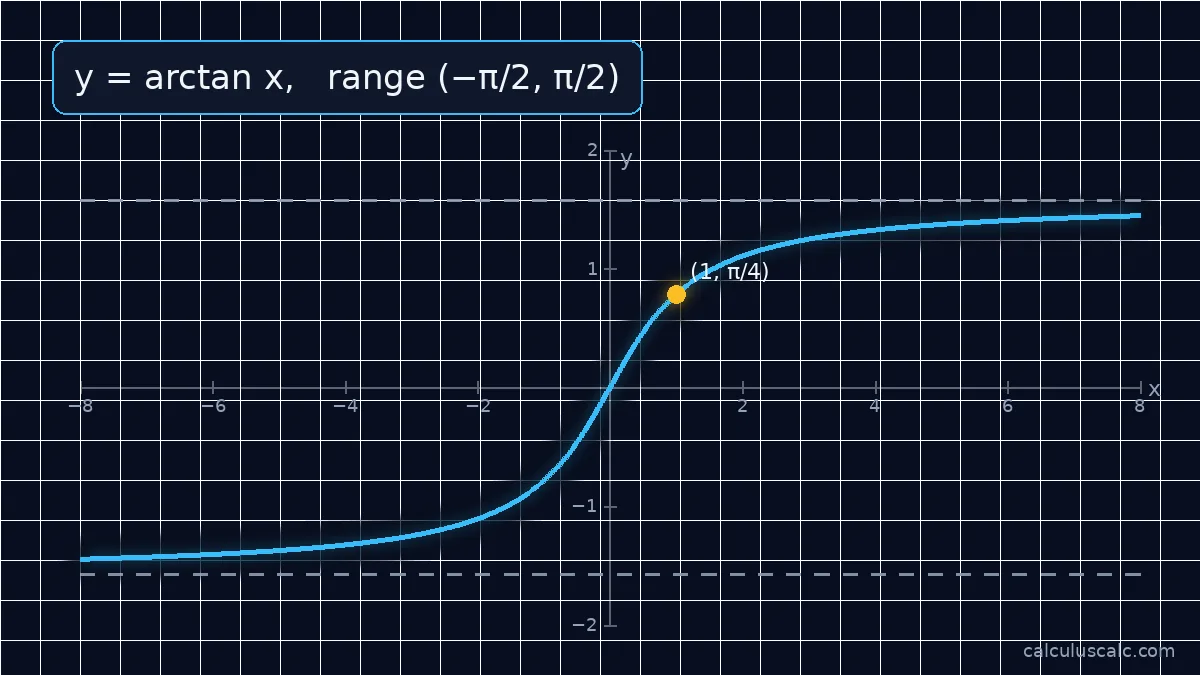
| \( \arctan x \) | all real numbers | \( \left( -\frac{\pi}{2}, \frac{\pi}{2} \right) \) |
So \( y = \arcsin x \) means \( \sin y = x \) and \( y \) lies in \( \left[ -\frac{\pi}{2}, \frac{\pi}{2} \right] \).
Worked example: arcsin(1/2)
Which angle in \( \left[ -\frac{\pi}{2}, \frac{\pi}{2} \right] \) has sine \( \frac12 \)? From the 30-60-90 triangle, \( \sin\frac{\pi}{6} = \frac12 \), so

$$\arcsin\tfrac12 = \tfrac{\pi}{6} \approx 0.5236 \text{ rad} = 30^\circ$$
Note that \( \sin\frac{5\pi}{6} = \frac12 \) as well, but \( \frac{5\pi}{6} \) is outside the range, so it isn’t the arcsin.
Worked example: arccos of a negative number
\( \arccos\left(-\frac12\right) \): The arccos range is \( [0, \pi] \). A negative input gives a Quadrant II angle. The reference angle is \( \frac{\pi}{3} \). Use an inverse trig calculator for the answer.
$$\arccos\left(-\tfrac12\right) = \pi - \tfrac{\pi}{3} = \tfrac{2\pi}{3} = 120^\circ$$
Worked example: arctan(−1) and a non-standard value
The inverse trig calculator shows \( \arctan(-1) = -\frac{\pi}{4} = -45^\circ \). This is because arctan returns angles between \( -90^\circ \) and \( 90^\circ \). For a value like \( \arcsin 0.3 \), the calculator gives \( 0.30469 \) rad. This is about \( 17.458^\circ \).
Tips and common mistakes
- \( \sin^{-1}x \) is not \( \frac{1}{\sin x} \). The \( -1 \) means inverse function. The reciprocal of sine is \( \csc x \).
- Only one answer. An equation like \( \sin\theta = \frac12 \) has infinitely many solutions; arcsin gives only the principal one. Add the others yourself: \( \theta = \frac{\pi}{6} + 2k\pi \) or \( \frac{5\pi}{6} + 2k\pi \).
- Out of domain. \( \arcsin 2 \) has no real value, since sine never exceeds 1.
- Undoing in the wrong order. \( \sin(\arcsin x) = x \) for every allowed x, but \( \arcsin(\sin x) = x \) only when x is already in the principal range.
Inverse trig in calculus
Inverse trig functions appear when you differentiate and integrate. The key results are
$$\frac{d}{dx}\arcsin x = \frac{1}{\sqrt{1 - x^2}}, \qquad \frac{d}{dx}\arctan x = \frac{1}{1 + x^2}$$
so \( \int \frac{dx}{1 + x^2} = \arctan x + C \). The full derivations are in the derivative of arcsin x and derivative of arctan x guides.
Solving trig equations with inverse functions
An inverse trig function gives one angle, but a trig equation usually has more. Solve \( \sin x = 0.6 \) for \( 0° \le x < 360° \):
- \( x = \arcsin 0.6 \approx 36.87° \) (the calculator’s answer, in Quadrant I).
- Sine is also positive in Quadrant II, so the second solution is \( 180° - 36.87° = 143.13° \).
For cosine, the second solution is \( 360° - x \); for tangent, add \( 180° \). Over all real numbers, add whole turns: \( x = 36.87° + 360°k \) or \( 143.13° + 360°k \).
Finding angles in right triangles
Inverse trig turns side lengths into angles:
- A ramp rising 1 m over a 12 m slope makes an angle of \( \arcsin(1/12) \approx 4.78° \) with the ground.
- A right triangle with opposite side 5 and adjacent side 12 has angle \( \arctan(5/12) \approx 22.62° \).
- Use arcsin with opposite and hypotenuse, arccos with adjacent and hypotenuse, arctan with opposite and adjacent.
Undoing and redoing: composition rules
\( \sin(\arcsin x) = x \) for every \( x \) from −1 to 1. The inverse trig calculator shows the other order only works inside the principal range: \( \arcsin(\sin x) = x \) only when \( -\frac{\pi}{2} \le x \le \frac{\pi}{2} \). For example, \( \arcsin\left(\sin\frac{2\pi}{3}\right) = \frac{\pi}{3} \), not \( \frac{2\pi}{3} \), because \( \frac{2\pi}{3} \) is outside the range of arcsin.
Derivatives and integrals
| Function | Derivative |
|---|---|
| \( \arcsin x \) | \( \frac{1}{\sqrt{1 - x^2}} \) |
| \( \arccos x \) | \( -\frac{1}{\sqrt{1 - x^2}} \) |
| \( \arctan x \) | \( \frac{1}{1 + x^2} \) |
Read backwards, these give integrals such as \( \int \frac{dx}{1 + x^2} = \arctan x + C \), so \( \int_0^1 \frac{dx}{1 + x^2} = \frac{\pi}{4} \approx 0.7854 \). See the derivative of arcsin and the integral calculator.
Degrees or radians?
The calculator gives both. Calculus and most programming languages use radians: \( \arctan 1 = \frac{\pi}{4} \approx 0.785 \). Geometry and navigation problems usually expect degrees: \( \arctan 1 = 45° \). Convert with \( 1 \text{ rad} = \frac{180°}{\pi} \approx 57.296° \).
Inverse trig in navigation and engineering
A ship sails 30 km east and 40 km north. It has a bearing of \( \arctan(30/40) \approx 36.87° \) east of north. The ship is 50 km from its start. Engineers use an inverse trig calculator for similar calculations. They find roof pitch angles. They also calculate road gradients. It helps them find a force from its horizontal and vertical components.
Practice problems
- Find all angles from 0° to 360° with \( \cos x = -0.5 \).
- A 10 m ladder reaches 8 m up a wall. What angle does it make with the ground?
- Evaluate \( \arctan(\sqrt{3}) \) in radians.
Answers: 1. 120° and 240°. 2. \( \arcsin(0.8) \approx 53.13° \). 3. \( \frac{\pi}{3} \).
Related guides
- Inverse Trig Functions: Graphs, Derivatives and Integrals
- Derivative of arcsin(x)
- Derivative of arctan(x)
- The Unit Circle
Further reading
- Inverse trigonometric functions (Wikipedia) — notation, principal values, identities, derivatives and integrals.
- Inverse Trig Functions (Paul’s Algebra/Trig Review) — how to evaluate inverse trig functions and why the ranges are restricted.
FAQ
What is arcsin?
\( \arcsin x \) is the angle between \( -\frac{\pi}{2} \) and \( \frac{\pi}{2} \) whose sine is x. It’s also written \( \sin^{-1}x \).
Why does arcsin only work between −1 and 1?
Sine only takes values in \( [-1, 1] \), so no angle has a sine of 2 or −3.
How do I get the answer in degrees?
The calculator shows both. To convert by hand, multiply radians by \( \frac{180}{\pi} \).
What is arctan of infinity?
As x grows without bound, \( \arctan x \) approaches \( \frac{\pi}{2} \) but never reaches it. Similarly it approaches \( -\frac{\pi}{2} \) as \( x \to -\infty \).