

Quick answer:
$$\frac{d}{dx}\arcsin x = \frac{1}{\sqrt{1-x^2}}, \qquad -1 < x < 1$$
This guide explains where the square root comes from, why the formula stops working at \( x = \pm1 \), how to handle arcsine of a function with the chain rule, and why arccosine has the same derivative with a minus sign. Along the way you will work through seven examples, from quick drills to an exam-style rate problem.
Why it works: the intuition
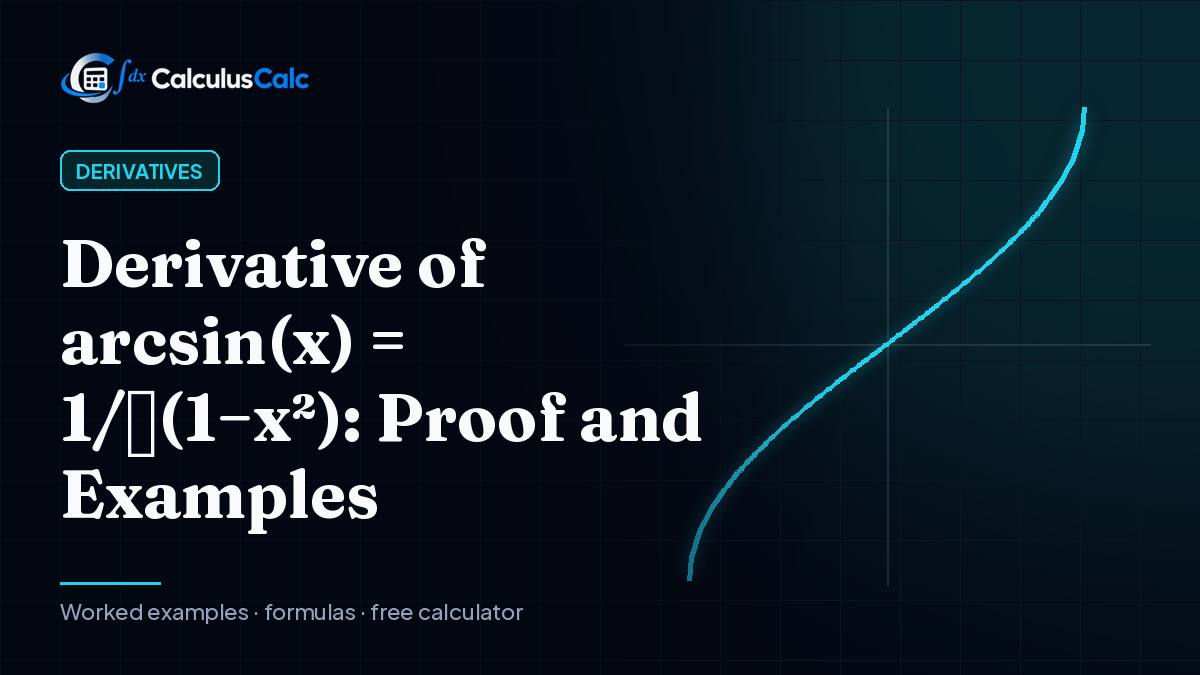
Arcsine answers the question “which angle has this sine?” To make that answer unique, the angle is restricted to \( -\frac{\pi}{2} \le y \le \frac{\pi}{2} \), the stretch where sine rises steadily from \( -1 \) to 1. The graph of \( y = \arcsin x \) is that piece of the sine curve reflected across the line \( y = x \).
Reflection swaps rise and run, so the slope of arcsine is the reciprocal of the slope of sine at the matching point. Sine’s slope is \( \cos y \). In the middle of the interval, \( \cos 0 = 1 \), so arcsine also has slope 1 at the origin. Near the ends, sine flattens out and its slope \( \cos y \) approaches 0. The reciprocal of a number near 0 is huge, so arcsine becomes nearly vertical at \( x = \pm 1 \).
The formula confirms both facts: \( \frac{1}{\sqrt{1 - 0}} = 1 \) at the center, and the denominator shrinks to zero at the edges. Since the square root is never larger than 1 on the interval, the slope of arcsine is always at least 1.
Proof
Let \( y = \arcsin x \), so \( \sin y = x \) with \( -\frac{\pi}{2} \le y \le \frac{\pi}{2} \). Differentiate implicitly:
$$\cos y\,\frac{dy}{dx} = 1 \quad\Longrightarrow\quad \frac{dy}{dx} = \frac{1}{\cos y}$$
Now express \( \cos y \) in terms of \( x \). From \( \sin^2 y + \cos^2 y = 1 \) we get \( \cos y = \pm\sqrt{1 - x^2} \). On the interval \( -\frac{\pi}{2} \le y \le \frac{\pi}{2} \) cosine is never negative, so we take the positive root:
$$\frac{dy}{dx} = \frac{1}{\sqrt{1 - x^2}}$$
At \( x = \pm 1 \) the denominator is zero: the graph of arcsin has vertical tangents at its endpoints.
The same steps are covered in more depth in implicit differentiation. The only step that needs real thought is choosing the sign of the square root, and the restricted range of arcsine is exactly what settles it.
A triangle picture
If you prefer geometry, draw a right triangle with hypotenuse 1 and an angle \( y \) whose opposite side is \( x \). Then \( \sin y = x \), and by Pythagoras the adjacent side is \( \sqrt{1 - x^2} \), which is \( \cos y \). That is why \( \cos(\arcsin x) = \sqrt{1 - x^2} \), the substitution used in the last step of the proof.
Arccos: same size, opposite sign
Because \( \arcsin x + \arccos x = \frac{\pi}{2} \) for every \( x \) in \( [-1, 1] \), their derivatives must add to zero:
$$\frac{d}{dx}\arccos x = -\frac{1}{\sqrt{1-x^2}}$$
The minus sign makes sense on the graph: arccosine falls from \( \pi \) down to 0 as \( x \) goes from \( -1 \) to 1.
Chain rule examples
The chain rule version is
$$\frac{d}{dx}\arcsin\big(g(x)\big) = \frac{g'(x)}{\sqrt{1 - g(x)^2}}$$
Put the derivative of the inside on top and square the inside under the root.
1. \( \frac{d}{dx}\arcsin(2x) = \frac{2}{\sqrt{1 - 4x^2}} \), valid for \( |x| < \frac12 \). The domain shrinks because \( 2x \) must stay between \( -1 \) and 1.
2. \( \frac{d}{dx}\arcsin\frac{x}{3} = \frac{1/3}{\sqrt{1 - x^2/9}} = \frac{1}{\sqrt{9 - x^2}} \). To simplify, multiply the top and bottom by 3 and move the 3 inside the root as 9.
This one is the source of the integral formula \( \int\frac{dx}{\sqrt{a^2 - x^2}} = \arcsin\frac{x}{a} + C \).
3. \( \frac{d}{dx}\arcsin\sqrt{x} = \frac{1}{\sqrt{1-x}}\cdot\frac{1}{2\sqrt x} = \frac{1}{2\sqrt{x}\sqrt{1-x}} \). The inside squared is just \( x \), which keeps the root simple.
4. \( \arcsin(e^x) \) for \( x < 0 \). The inside derivative is \( e^x \), and squaring the inside gives \( e^{2x} \):
$$\frac{d}{dx}\arcsin(e^x) = \frac{e^x}{\sqrt{1 - e^{2x}}}$$
5. \( (\arcsin x)^2 \). Now arcsine is the inside and squaring is the outside, so the answer is \( \frac{2\arcsin x}{\sqrt{1 - x^2}} \).
6. Tangent line at \( x = \frac12 \). Since \( \sin\frac{\pi}{6} = \frac12 \), the point is \( \left(\frac12, \frac{\pi}{6}\right) \). The slope is
$$\frac{1}{\sqrt{1 - 1/4}} = \frac{1}{\sqrt{3/4}} = \frac{2}{\sqrt3}$$
so the tangent line is \( y - \frac{\pi}{6} = \frac{2}{\sqrt3}\left(x - \frac12\right) \).
7 (exam level): a sliding ladder. A 10 ft ladder leans against a wall, and its top is sliding down at 1 ft/s. How fast is the angle between the ladder and the ground changing when the top is 6 ft high? The angle is \( \theta = \arcsin\frac{h}{10} \). By the chain rule (see Example 2 with 10 in place of 3),
$$\frac{d\theta}{dt} = \frac{1}{\sqrt{100 - h^2}}\,\frac{dh}{dt}$$
With \( h = 6 \) and \( \frac{dh}{dt} = -1 \), you get \( \frac{-1}{\sqrt{64}} = -\frac18 \) radians per second. The negative sign says the angle is shrinking, as it should. Problems like this are the bread and butter of related rates.
Inverse trig derivatives table
| Function | Derivative | Domain of formula |
|---|---|---|
| \( \arcsin x \) | \( \frac{1}{\sqrt{1-x^2}} \) | \( \lvert x\rvert < 1 \) |
| \( \arccos x \) | \( -\frac{1}{\sqrt{1-x^2}} \) | \( \lvert x\rvert < 1 \) |
| \( \arctan x \) | \( \frac{1}{1+x^2} \) | all \( x \) |
Arcsine or arctangent? Spotting the pattern
On integration problems you often have to recognize which inverse trig function produced a given derivative. The two patterns look similar, so focus on the details:
- A square root with the variable subtracted from a constant, as in \( \sqrt{a^2 - x^2} \), points to arcsine.
- No root and the variable added to a constant, as in \( a^2 + x^2 \), points to arctangent.
- A root with the constant subtracted from the variable, as in \( \sqrt{x^2 - a^2} \), belongs to neither; it usually calls for a secant substitution or a logarithm.
Getting the pattern right before you start saves a lot of wasted algebra. A quick check is to differentiate your final answer and see whether you get back the integrand, which takes only a few seconds with the formulas on this page. It is also worth checking the domain: an arcsine answer only makes sense where the expression under the root is positive, so if your interval of integration leaves that region, something has gone wrong earlier in the work.
Common mistakes
- Reading \( \sin^{-1}x \) as a reciprocal. It means arcsine, the inverse function. \( \frac{1}{\sin x} \) is \( \csc x \), a completely different function.
- Squaring only part of the inside. For \( \arcsin(2x) \) the root is \( \sqrt{1 - 4x^2} \), not \( \sqrt{1 - 2x^2} \). The whole inside gets squared.
- Forgetting the minus sign for arccosine. Arcsine and arccosine have derivatives of the same size but opposite sign.
- Using the formula at \( x = \pm1 \). Arcsine is defined there, but its derivative is not; the tangent line is vertical.
- Mixing up the arctangent formula. \( \frac{1}{1 + x^2} \) belongs to arctangent. Arcsine has a minus sign and a square root.
Where it’s used
Reading the derivative backwards gives \( \int\frac{dx}{\sqrt{1 - x^2}} = \arcsin x + C \), which means areas under this curve are angles. For example, \( \int_0^{1/2}\frac{dx}{\sqrt{1-x^2}} = \arcsin\frac12 = \frac{\pi}{6} \). The same idea underlies trig substitution with \( x = \sin\theta \), used for the integral of √(1−x²) and for arc length on circles. You can also find the integral of arcsine itself: since \( \frac{d}{dx}\left(x\arcsin x + \sqrt{1-x^2}\right) = \arcsin x \), that expression plus \( C \) is its antiderivative. The product rule handles the first term and the chain rule the second.
Try it yourself
Type any arcsine expression below to see each rule the solver applies, or open the full derivative calculator.
Practice problems
Try these before checking the answers.
- \( \frac{d}{dx}\arcsin(5x) \)
- \( \frac{d}{dx}\arccos(x^2) \)
- \( \frac{d}{dx}\,x\arcsin x \)
- \( \frac{d}{dx}\arcsin(x^2) \)
- \( \frac{d}{dx}\arccos(2x) \)
- \( \frac{d}{dx}\arcsin\frac{x}{10} \)
Answers: (1) \( \frac{5}{\sqrt{1 - 25x^2}} \); (2) \( -\frac{2x}{\sqrt{1 - x^4}} \); (3) \( \arcsin x + \frac{x}{\sqrt{1-x^2}} \); (4) \( \frac{2x}{\sqrt{1 - x^4}} \); (5) \( -\frac{2}{\sqrt{1 - 4x^2}} \); (6) \( \frac{1}{\sqrt{100 - x^2}} \).
FAQ
Why is there a square root?
It comes from rewriting \( \cos(\arcsin x) \) as \( \sqrt{1 - x^2} \) using the Pythagorean identity.
Is arcsin x the same as 1/sin x?
No. \( \arcsin x = \sin^{-1}x \) is the inverse function. The reciprocal \( \frac{1}{\sin x} \) is \( \csc x \), with derivative \( -\csc x\cot x \).
What is the derivative of arcsin x at x = 1?
It does not exist. The formula has a zero denominator there, and the graph has a vertical tangent line at the point \( \left(1, \frac{\pi}{2}\right) \).
What is the second derivative of arcsin x?
Differentiate \( (1 - x^2)^{-1/2} \) with the chain rule to get \( \frac{x}{(1 - x^2)^{3/2}} \). It is negative for \( x < 0 \) and positive for \( x > 0 \), so the origin is an inflection point.
What is the derivative of arccos x?
It is \( -\frac{1}{\sqrt{1 - x^2}} \), the negative of the arcsine derivative, because the two functions always add up to \( \frac{\pi}{2} \).
Related: derivative of arctan x.
Further reading
- Paul’s Online Notes: Derivatives of Inverse Trig Functions — derivations for arcsine, arccosine and arctangent plus the remaining three inverse trig functions.
- Paul’s Online Notes: Implicit Differentiation — more practice with the technique used in the proof.
Calculators for this topic
Keep learning

Implicit Differentiation: Step-by-Step Method with Examples
How to find dy/dx when y isn’t isolated. A 4-step implicit differentiation method with circle, x³+y³=6xy and trig examples, plus tangent lines.

Chain Rule Explained: Formula, Steps and 8 Examples
The chain rule differentiates composite functions: d/dx f(g(x)) = f'(g(x))·g'(x). Clear steps, 8 worked examples and the most common mistakes.