

Quick answer:
$$\int\sqrt{1-x^2}\,dx = \frac12\left(x\sqrt{1-x^2} + \arcsin x\right) + C$$
and \( \int_{-1}^{1}\sqrt{1-x^2}\,dx = \frac{\pi}{2} \), the area of a half-disk of radius 1.
The integral of sqrt(1-x^2) is the standard first example of trigonometric substitution, and it is also secretly a question about the area of a circle. Below you’ll see the substitution step by step, a picture that explains every piece of the answer, a second derivation by parts, and worked examples from quick area shortcuts to shifted circles and ellipses.
Step 1: trig substitution
The expression \( \sqrt{1 - x^2} \) matches the identity \( 1 - \sin^2\theta = \cos^2\theta \). So let
$$x = \sin\theta, \qquad dx = \cos\theta\,d\theta, \qquad -\tfrac{\pi}{2}\le\theta\le\tfrac{\pi}{2}$$
Then \( \sqrt{1 - x^2} = \sqrt{\cos^2\theta} = \cos\theta \) (cosine is non-negative on that interval), and
$$\int\sqrt{1-x^2}\,dx = \int\cos^2\theta\,d\theta$$
Two details deserve attention. First, the \( dx \) must be replaced too; forgetting the factor \( \cos\theta \) from \( dx \) is the most common error. Second, the restriction on \( \theta \) is not decoration. It makes the substitution one-to-one, so you can undo it with \( \theta = \arcsin x \), and it guarantees that \( \sqrt{\cos^2\theta} \) is \( \cos\theta \) rather than \( -\cos\theta \).
Step 2: integrate cos²θ
Use the power-reduction identity (as in integral of sin²x):
$$\begin{aligned} \int\cos^2\theta\,d\theta &= \int\frac{1 + \cos 2\theta}{2}\,d\theta \\ &= \frac{\theta}{2} + \frac{\sin 2\theta}{4} + C \\ &= \frac{\theta}{2} + \frac{\sin\theta\cos\theta}{2} + C \end{aligned}$$
The last line uses the double-angle formula \( \sin 2\theta = 2\sin\theta\cos\theta \), which puts everything in terms of \( \sin\theta \) and \( \cos\theta \), the two quantities you can translate back to \( x \).
Step 3: return to x
Since \( \sin\theta = x \), \( \theta = \arcsin x \) and \( \cos\theta = \sqrt{1 - x^2} \):
$$\frac{\arcsin x}{2} + \frac{x\sqrt{1-x^2}}{2} + C$$
A reference triangle helps if you forget the conversion: draw a right triangle with angle \( \theta \), opposite side \( x \) and hypotenuse 1. The adjacent side is then \( \sqrt{1 - x^2} \) by Pythagoras, so \( \cos\theta = \sqrt{1 - x^2} \).
Check by differentiating
Differentiate the answer term by term. The product rule gives
$$\frac{d}{dx}\,x\sqrt{1-x^2} = \sqrt{1-x^2} - \frac{x^2}{\sqrt{1-x^2}}$$
and the derivative of arcsin x is \( \frac{1}{\sqrt{1-x^2}} \). Adding them, the two fractions combine to \( \frac{1 - x^2}{\sqrt{1-x^2}} = \sqrt{1-x^2} \), so the total is \( 2\sqrt{1-x^2} \). The factor \( \frac12 \) in front brings it back to exactly \( \sqrt{1-x^2} \).
Why the answer looks like this: a picture
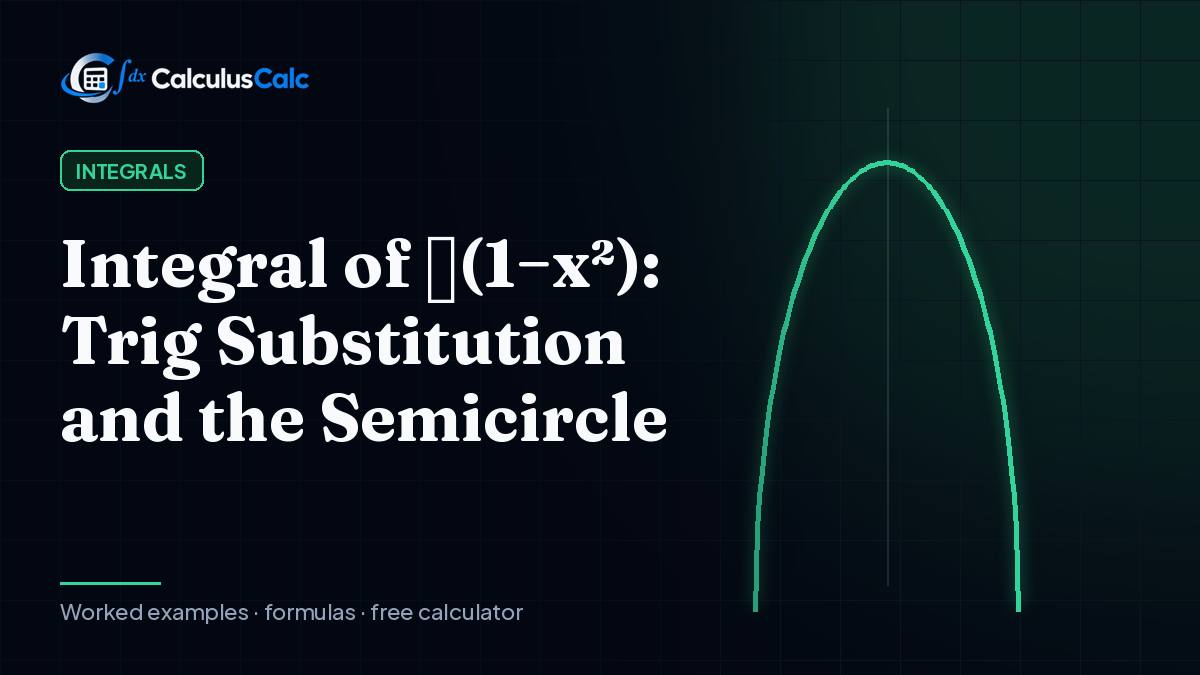
\( y = \sqrt{1 - x^2} \) is the upper half of the unit circle. For \( 0 \le x \le 1 \), the area under the curve from 0 to \( x \) splits into two familiar shapes:
- A right triangle with corners at the origin, \( (x, 0) \) and \( (x, \sqrt{1-x^2}) \). Its area is \( \frac12x\sqrt{1-x^2} \).
- A circular sector between the vertical axis and the radius to \( (x, \sqrt{1-x^2}) \). That radius makes an angle of \( \arcsin x \) with the vertical axis, and a sector of angle \( \alpha \) in a unit circle has area \( \frac{\alpha}{2} \), so its area is \( \frac12\arcsin x \).
Add the two and you get \( \frac12\left(x\sqrt{1-x^2} + \arcsin x\right) \), exactly the antiderivative. The algebraic term is a triangle and the arcsine term is a slice of pie.
A second derivation: integration by parts
If you prefer to avoid trig substitution, integration by parts also works. Call the integral \( I \) and take \( u = \sqrt{1-x^2} \), \( dv = dx \):
$$I = x\sqrt{1-x^2} + \int\frac{x^2}{\sqrt{1-x^2}}\,dx$$
Now write the numerator as \( x^2 = 1 - (1 - x^2) \) and split the fraction:
$$\begin{aligned} \int\frac{x^2}{\sqrt{1-x^2}}\,dx &= \int\frac{dx}{\sqrt{1-x^2}} - \int\sqrt{1-x^2}\,dx \\ &= \arcsin x - I \end{aligned}$$
So \( I = x\sqrt{1-x^2} + \arcsin x - I \). The unknown integral appears on both sides; move it over and divide by 2 to get the same formula.
The geometry shortcut
Because the curve is a semicircle, definite integrals over nice intervals need no calculus at all:
- \( \int_{-1}^{1}\sqrt{1-x^2}\,dx = \frac{\pi}{2} \) (half the disk)
- \( \int_0^1\sqrt{1-x^2}\,dx = \frac{\pi}{4} \) (a quarter disk)
Many exam questions are designed so that recognizing the circle saves a page of algebra. Before you start a substitution on a definite integral, sketch the curve and ask whether the region is a half, a quarter or some other simple slice of a disk. If it is, write down the area directly and use the antiderivative only to double-check.
General radius
For \( a > 0 \), substitute \( x = a\sin\theta \):
$$\int\sqrt{a^2 - x^2}\,dx = \frac{x\sqrt{a^2 - x^2}}{2} + \frac{a^2}{2}\arcsin\frac{x}{a} + C$$
and \( \int_{-a}^{a}\sqrt{a^2-x^2}\,dx = \frac{\pi a^2}{2} \). For \( a = 3 \) that is \( \frac{9\pi}{2} \).
Worked examples
1. A quarter disk with changed limits. Compute \( \int_0^1\sqrt{1-x^2}\,dx \) by substitution. With \( x = \sin\theta \), the limits \( x = 0 \) and \( x = 1 \) become \( \theta = 0 \) and \( \theta = \frac\pi2 \), so
$$\int_0^{\pi/2}\cos^2\theta\,d\theta = \left[\frac{\theta}{2} + \frac{\sin 2\theta}{4}\right]_0^{\pi/2} = \frac{\pi}{4}$$
That agrees with the quarter-disk picture, which is a useful confirmation.
2. An interval that isn’t a nice fraction of the circle. For \( \int_0^{1/2}\sqrt{1-x^2}\,dx \), use the antiderivative. At \( x = \frac12 \), \( \sqrt{1 - \frac14} = \frac{\sqrt3}{2} \) and \( \arcsin\frac12 = \frac{\pi}{6} \):
$$\frac12\left(\frac12\cdot\frac{\sqrt3}{2} + \frac{\pi}{6}\right) = \frac{\sqrt3}{8} + \frac{\pi}{12}$$
Both terms are visible in the picture: a triangle of area \( \frac{\sqrt3}{8} \) and a sector of angle \( \frac\pi6 \).
3. Radius 3. \( \int_0^3\sqrt{9-x^2}\,dx \) is a quarter of a disk of radius 3, so it equals \( \frac{9\pi}{4} \).
4. A shifted circle. \( \int_0^2\sqrt{2x - x^2}\,dx \). Complete the square: \( 2x - x^2 = 1 - (x - 1)^2 \). The curve is the upper half of a unit circle centered at \( (1, 0) \), and the interval \( [0, 2] \) covers the whole semicircle, so the answer is \( \frac{\pi}{2} \).
5. Area of an ellipse. The ellipse \( \frac{x^2}{9} + \frac{y^2}{4} = 1 \) has top half \( y = \frac23\sqrt{9 - x^2} \). By symmetry the total area is four times the first-quadrant piece:
$$4\cdot\frac23\int_0^3\sqrt{9-x^2}\,dx = \frac83\cdot\frac{9\pi}{4} = 6\pi$$
In general an ellipse with semi-axes \( a \) and \( b \) has area \( \pi ab \), and this integral is how you prove it.
Which substitution for which root?
| Expression | Substitute | Identity used |
|---|---|---|
| \( \sqrt{a^2 - x^2} \) | \( x = a\sin\theta \) | \( 1 - \sin^2 = \cos^2 \) |
| \( \sqrt{a^2 + x^2} \) | \( x = a\tan\theta \) | \( 1 + \tan^2 = \sec^2 \) |
| \( \sqrt{x^2 - a^2} \) | \( x = a\sec\theta \) | \( \sec^2 - 1 = \tan^2 \) |
Common mistakes
- Forgetting to convert \( dx \). Writing \( \int\cos\theta\,d\theta \) instead of \( \int\cos^2\theta\,d\theta \) drops the factor from \( dx = \cos\theta\,d\theta \).
- Leaving the answer in \( \theta \). An indefinite integral in \( x \) needs an answer in \( x \). Use \( \theta = \arcsin x \) and the reference triangle.
- Mixing limits. If you change to \( \theta \)-limits, don’t go back to \( x \) before evaluating; if you go back to \( x \), use the original limits.
- Confusing half and quarter disks. From \( -1 \) to 1 is half the disk, \( \frac\pi2 \); from 0 to 1 is a quarter, \( \frac\pi4 \).
- Mixing it up with the reciprocal. \( \int\frac{dx}{\sqrt{1-x^2}} = \arcsin x + C \) is a basic formula, while \( \int\sqrt{1-x^2}\,dx \) needs the full substitution.
Where it’s used
This integral is how calculus proves that a circle of radius \( r \) has area \( \pi r^2 \): four quarter-disks give \( 4\int_0^r\sqrt{r^2 - x^2}\,dx = \pi r^2 \). It gives the area of ellipses, the area between curves when one boundary is circular, and it appears in probability as the semicircle distribution. The substitution technique itself returns in arc length problems and in many physics integrals involving circular motion.
Evaluate it with the solver
For step-by-step working on other intervals or radii, try the definite integral calculator or, for the antiderivative, the integral calculator.
Practice problems
Try these before checking the answers.
- \( \int_0^2\sqrt{4 - x^2}\,dx \)
- \( \int x\sqrt{1 - x^2}\,dx \)
- \( \int_{-1}^{1}2\sqrt{1-x^2}\,dx \)
- \( \int_{-2}^{2}\sqrt{4 - x^2}\,dx \)
- \( \int\sqrt{9 - x^2}\,dx \)
- \( \int_0^4\sqrt{8x - x^2}\,dx \)
- \( 4\int_0^5\sqrt{25 - x^2}\,dx \)
Answers: (1) \( \pi \); (2) \( -\frac13(1 - x^2)^{3/2} + C \); (3) \( \pi \); (4) \( 2\pi \); (5) \( \frac{x\sqrt{9-x^2}}{2} + \frac92\arcsin\frac{x}{3} + C \); (6) \( 4\pi \), since \( 8x - x^2 = 16 - (x-4)^2 \) and the interval is a quarter of a disk of radius 4; (7) \( 25\pi \), the area of a disk of radius 5.
FAQ
Can u-substitution solve this?
Not directly: there is no \( x \) outside the root to match \( du = -2x\,dx \). That is why trig substitution is needed. Compare \( \int x\sqrt{1-x^2}\,dx = -\frac13(1-x^2)^{3/2} + C \), which is a simple u-substitution.
What is the integral of sqrt(1-x^2) from 0 to 1?
It is \( \frac{\pi}{4} \), the area of a quarter of the unit disk.
Why does arcsin appear in the answer?
The substitution \( x = \sin\theta \) has to be undone at the end, and \( \theta = \arcsin x \). Geometrically, the arcsine term is the area of a circular sector.
How do I integrate sqrt(a^2 – x^2)?
Substitute \( x = a\sin\theta \). The answer is \( \frac{x\sqrt{a^2-x^2}}{2} + \frac{a^2}{2}\arcsin\frac{x}{a} + C \).
What is the derivative of sqrt(1-x^2)?
By the chain rule it is \( -\frac{x}{\sqrt{1-x^2}} \). Don’t confuse differentiating the root with integrating it: the derivative is a one-line calculation, while the integral needs the substitution above.
Could I use x = cos θ instead?
Yes. The substitution \( x = \cos\theta \) with \( 0 \le \theta \le \pi \) also works and leads to \( -\int\sin^2\theta\,d\theta \). The answer then contains \( -\arccos x \) instead of \( \arcsin x \), which differs only by the constant \( \frac\pi2 \), so both are correct.
Further reading
- Trig Substitutions (Paul’s Online Math Notes) — worked examples of all three substitutions, including completing the square first.
- 3.3 Trigonometric Substitution (OpenStax Calculus Volume 2) — a textbook section that works through \( \int\sqrt{9 - x^2}\,dx \) and more.
Related: derivative of arcsin x, integration by parts.
Calculators for this topic
Keep learning

Fundamental Theorem of Calculus (Parts 1 and 2) Explained
The Fundamental Theorem of Calculus links derivatives and integrals. Both parts explained with intuition, formulas and worked examples.
Improper Integrals: How to Tell If They Converge or Diverge
Improper integrals have infinite limits or infinite integrands. Learn the limit definition, the p-integral test, comparison, and 6 worked examples.