

An inflection point is a point on the graph where the concavity changes: from concave up (cupped like \( \cup \)) to concave down (\( \cap \)), or the reverse.
- Concave up on an interval where \( f''(x) > 0 \): slopes are increasing.
- Concave down where \( f''(x) < 0 \): slopes are decreasing.
Why it works: watching the slope
Imagine driving along the graph from left to right. On a concave up stretch, the road keeps turning left: the slope keeps increasing. On a concave down stretch, it keeps turning right: the slope keeps decreasing. An inflection point is where the steering wheel passes through center and you switch from turning one way to the other.
Since \( f'' \) is the derivative of the slope \( f' \), its sign tells you whether the slope is increasing or decreasing. That is why concavity is read from the second derivative. It also gives a useful reformulation: an inflection point of \( f \) is a place where \( f' \) has a local maximum or minimum. The slope stops growing and starts shrinking, or the reverse. So finding inflection points of \( f \) is the same job as finding critical points of \( f' \).
There is also a tangent-line picture. Where the graph is concave up, it lies above its tangent lines; where it is concave down, it lies below them. At an inflection point the graph crosses from one side of its tangent to the other.
Why \( f'' = 0 \) is the place to look. If \( f'' \) is continuous and changes sign at \( c \), the Intermediate Value Theorem forces \( f''(c) = 0 \). So every inflection point of a twice-differentiable function is a zero of \( f'' \). The reverse is not true, which is the whole reason for the sign check in step 3 below.
Step-by-step method
- Compute the second derivative \( f''(x) \).
- Find candidates: where \( f''(x) = 0 \) or \( f''(x) \) is undefined.
- Make a sign chart for \( f'' \) using test points between candidates.
- Keep only the candidates where \( f'' \) changes sign, and that are in the domain of \( f \).
Finally, give each inflection point as a point \( (c, f(c)) \), plugging \( c \) into the original function, not into \( f'' \). The second derivative calculator can take care of step 1 for messier functions.
Example 1
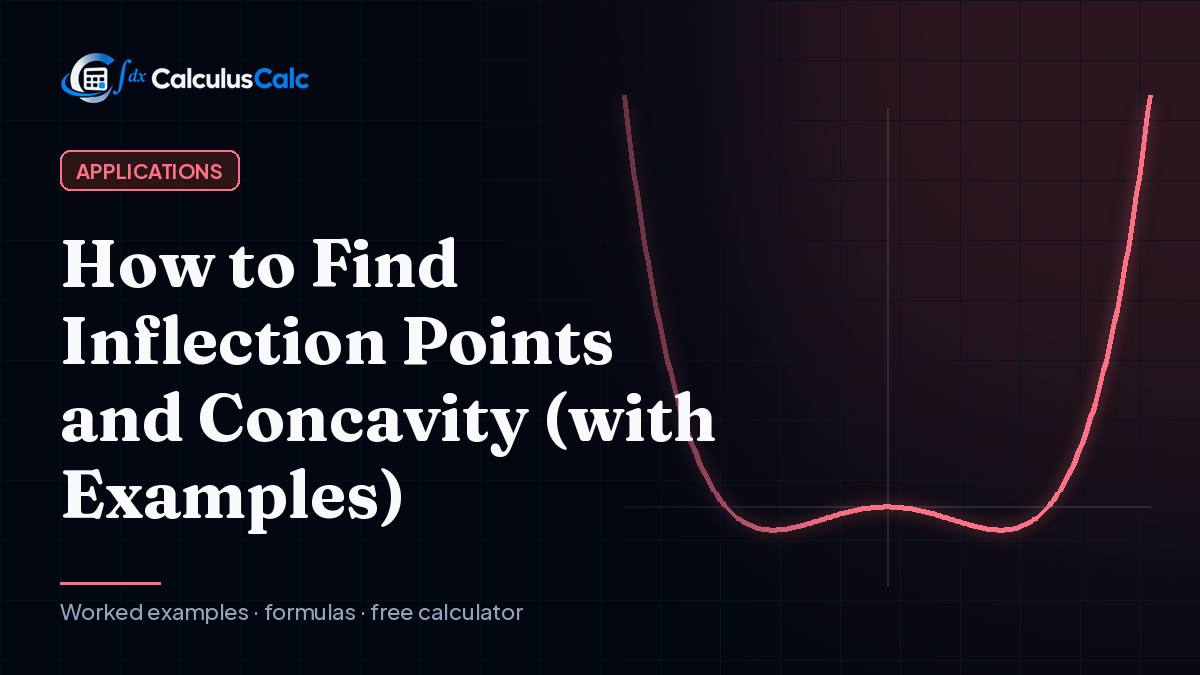
\( f(x) = x^4 - 6x^2 \)
$$f'(x) = 4x^3 - 12x, \qquad f''(x) = 12x^2 - 12 = 12(x-1)(x+1)$$
Candidates: \( x = \pm1 \). Sign chart for \( f'' \):
| Interval | Test point | \( f'' \) | Concavity |
|---|---|---|---|
| \( (-\infty, -1) \) | \( -2 \) | \( + \) | up \( \cup \) |
| \( (-1, 1) \) | \( 0 \) | \( - \) | down \( \cap \) |
| \( (1, \infty) \) | \( 2 \) | \( + \) | up \( \cup \) |
Both candidates change sign, so the inflection points are \( (-1, -5) \) and \( (1, -5) \).
Any test point inside an interval works, because \( f'' \) is continuous and cannot change sign without passing through one of the candidates. Pick the easiest numbers you can, such as 0 and integers. If a question asks for concavity intervals, read them straight off the chart: concave up on \( (-\infty, -1) \) and \( (1, \infty) \), concave down on \( (-1, 1) \). Use open intervals, since concavity describes behavior around points rather than at a single point.
Example 2: f” = 0 is not enough
\( f(x) = x^4 \) has \( f''(x) = 12x^2 \), which is zero at \( x = 0 \). But \( f'' \ge 0 \) on both sides, so the graph is concave up everywhere and there is no inflection point. This is the most common trap on exams.
Example 3: the classic cubic
\( f(x) = x^3 \): \( f''(x) = 6x \) changes sign at 0, so \( (0, 0) \) is an inflection point. It is also a critical point, a “flat” inflection where the tangent line is horizontal.
Example 4: exponential decay times x
\( f(x) = xe^{-x} \). Then \( f''(x) = (x - 2)e^{-x} \), which changes sign only at \( x = 2 \). The inflection point is \( \left(2, \frac{2}{e^2}\right) \).
Here is the reasoning in more detail. The product rule gives \( f'(x) = e^{-x} - xe^{-x} \), and applying it again gives \( f''(x) = -e^{-x} - e^{-x} + xe^{-x} = (x - 2)e^{-x} \). The factor \( e^{-x} \) is always positive, so the sign of \( f'' \) is the sign of \( x - 2 \): concave down to the left of 2, concave up to the right.
Example 5: a logarithm
\( f(x) = \ln(x^2 + 1) \). The chain rule gives \( f'(x) = \frac{2x}{x^2+1} \), and the quotient rule then gives
$$f''(x) = \frac{2 - 2x^2}{(x^2+1)^2} = \frac{2(1-x)(1+x)}{(x^2+1)^2}$$
The denominator is always positive, so the sign comes from \( 1 - x^2 \): negative for \( |x| > 1 \), positive for \( |x| < 1 \). Concavity changes at both \( x = -1 \) and \( x = 1 \), and since \( f(\pm1) = \ln 2 \), the inflection points are \( (-1, \ln 2) \) and \( (1, \ln 2) \).
Example 6: f” undefined
\( f(x) = x^{1/3} \) has \( f'(x) = \frac{1}{3x^{2/3}} \) and \( f''(x) = -\frac{2}{9x^{5/3}} \). The second derivative is never zero, but it is undefined at \( x = 0 \). For \( x < 0 \), \( f'' > 0 \) (concave up); for \( x > 0 \), \( f'' < 0 \) (concave down). Because \( f(0) = 0 \) exists, \( (0, 0) \) is an inflection point, with a vertical tangent line there.
Example 7: a sign change that doesn’t count
\( f(x) = \frac1x \) has \( f''(x) = \frac{2}{x^3} \), which is negative for \( x < 0 \) and positive for \( x > 0 \). Concavity changes across 0, but \( x = 0 \) is not in the domain, so there is no inflection point. The change happens across a vertical asymptote, not at a point on the graph.
Common mistakes
- Stopping at \( f'' = 0 \). As \( x^4 \) shows, you must confirm a sign change.
- Forgetting where \( f'' \) is undefined. Candidates also come from zeros of the denominator and from fractional powers, as in \( x^{1/3} \).
- Keeping points outside the domain. \( \frac1x \) changes concavity across 0 but has no inflection point there.
- Using \( f' \) instead of \( f'' \). A sign change in \( f' \) means a max or min, not a change of concavity.
- Giving only the \( x \)-value. An inflection point is a point on the graph; compute \( f(c) \) as well.
Why inflection points matter
- They mark where a rate of change is fastest or slowest. In a logistic growth curve, the inflection point is when growth is quickest.
- The tangent line crosses the curve there, so linear approximations switch from over- to under-estimates.
For the standard logistic function \( \frac{1}{1 + e^{-x}} \), the inflection point is \( \left(0, \frac12\right) \): the population grows fastest when it is at half its carrying capacity. In economics, the inflection point of a cost curve marks where diminishing returns begin. And the equation of the tangent line at an inflection point is the line that the curve crosses, which you can see clearly in the graph of \( y = x^3 \).
Concavity and inflection calculator
The gadget computes \( f''(x) \), finds real sign changes and lists every interval of concavity:
For longer functions, open the full inflection point calculator.
Practice problems
Try these before checking the answers.
- \( f(x) = x^3 - 6x^2 + 5 \)
- \( f(x) = \ln(x^2 + 1) \)
- \( f(x) = e^{-x^2} \)
- \( f(x) = xe^{x} \)
- \( f(x) = x^4 - 4x^3 \)
Answers: (1) \( (2, -11) \); (2) \( (\pm1, \ln 2) \); (3) \( x = \pm\frac{1}{\sqrt2} \); (4) \( \left(-2, -\frac{2}{e^2}\right) \); (5) \( (0, 0) \) and \( (2, -16) \).
For (4), \( f''(x) = (x + 2)e^x \), which changes sign only at \( -2 \). For (5), \( f''(x) = 12x^2 - 24x = 12x(x - 2) \), which changes sign at both 0 and 2.
FAQ
Can an inflection point be where f” is undefined?
Yes. \( f(x) = x^{1/3} \) has \( f''(x) = -\frac29x^{-5/3} \), undefined at 0, yet concavity changes there and \( f(0) = 0 \) exists.
What is the difference between a critical point and an inflection point?
Critical points come from \( f' \) (possible max/min). Inflection points come from \( f'' \) (change of concavity). See critical points.
Can a point be both a critical point and an inflection point?
Yes. At the origin, \( x^3 \) has \( f'(0) = 0 \), so it is a critical point, and concavity changes there, so it is also an inflection point. Such points are neither maxima nor minima.
Does every cubic have exactly one inflection point?
Yes. The second derivative of a cubic \( ax^3 + bx^2 + cx + d \) is the linear function \( 6ax + 2b \), which has exactly one zero, at \( x = -\frac{b}{3a} \), and always changes sign there.
Further reading
- The Shape of a Graph, Part II (Paul’s Online Math Notes) — concavity, inflection points and the second derivative test with graphs.
- The Shape of a Graph, Part I (Paul’s Online Math Notes) — the first derivative side of the story: increasing, decreasing and local extrema.
Calculators for this topic
Keep learning

Optimization Problems in Calculus: 4 Solved Examples
Solve calculus optimization problems in 6 steps. Worked examples: the largest fenced area, the open box, the cheapest can and the closest point on a curve.

Related Rates: Step-by-Step Strategy and Classic Problems
Solve related rates problems in 6 steps. Worked classics: the sliding ladder, the expanding balloon, the draining cone and the moving shadow.