

A critical point of \( f \) is a number \( c \) in its domain where either
- \( f'(c) = 0 \) (horizontal tangent), or
- \( f'(c) \) does not exist (a corner, cusp or vertical tangent).
Every local maximum or minimum of a function happens at a critical point (Fermat’s theorem), so finding them is the first step of every extrema and optimization problem.
Why it works: the flat-top picture
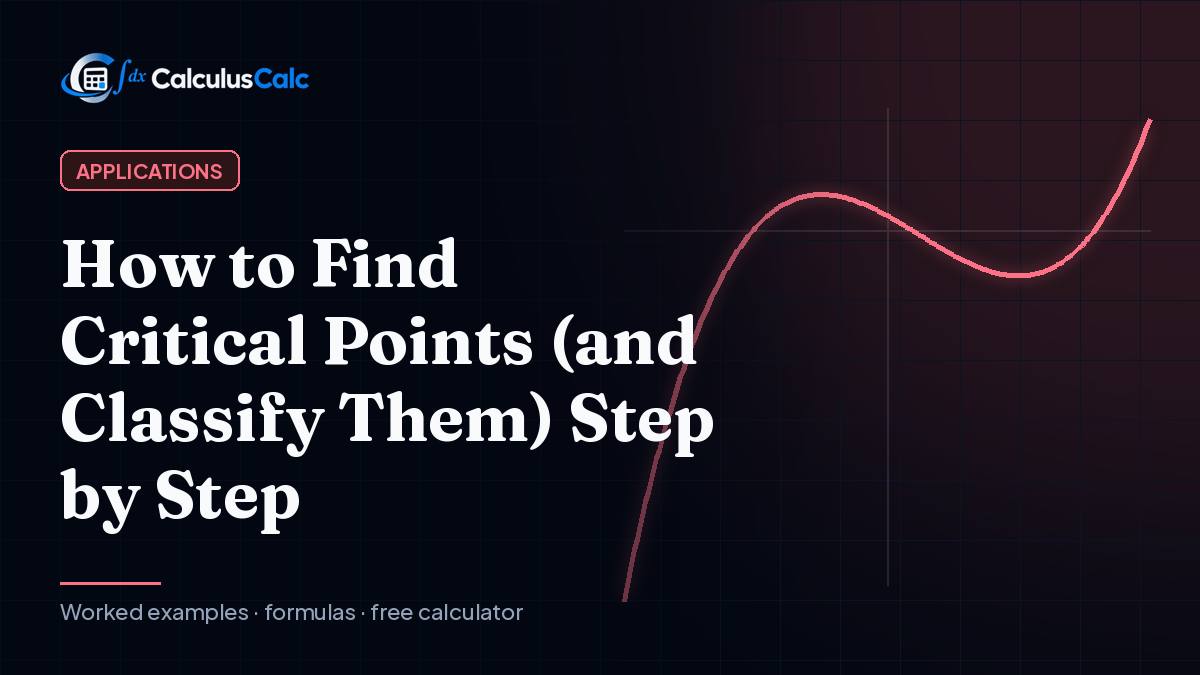
Picture the top of a smooth hill. Just before the peak the graph is rising, so tangent lines have positive slope; just after it the graph is falling, so slopes are negative. Right at the top the slope has to pass from positive to negative, and for a smooth curve that means it is exactly zero there. At the bottom of a valley the same thing happens in reverse.
The only other way a peak or valley can occur is at a sharp point, like the bottom of \( |x| \), where there is no single tangent line and the derivative does not exist. That is why the definition includes both cases.
Why Fermat’s theorem is true. Suppose \( f \) has a local maximum at \( c \) and \( f'(c) \) exists. For small \( h > 0 \), \( f(c + h) \le f(c) \), so the difference quotient \( \frac{f(c+h) - f(c)}{h} \) is less than or equal to 0. For small \( h < 0 \), the numerator is still at most 0 but the denominator is negative, so the quotient is at least 0. The derivative is the limit of these quotients from both sides, so it must be both \( \le 0 \) and \( \ge 0 \). Hence \( f'(c) = 0 \).
The converse is false: \( f'(c) = 0 \) does not guarantee a maximum or minimum. Critical points are candidates, and you still have to test them.
Step by step
- Find the derivative \( f'(x) \).
- Solve \( f'(x) = 0 \).
- Find where \( f'(x) \) is undefined (but \( f \) is defined).
- Classify each point with the first or second derivative test.
The derivative calculator is useful for step 1 if the function is messy; steps 2 to 4 are where the thinking happens.
Example 1: a cubic
\( f(x) = 2x^3 - 3x^2 - 12x + 5 \)
Derivative: \( f'(x) = 6x^2 - 6x - 12 = 6(x - 2)(x + 1) \)
Critical points: \( x = -1 \) and \( x = 2 \).
Second derivative test: \( f''(x) = 12x - 6 \).
- \( f''(-1) = -18 < 0 \): concave down, so a local maximum, \( f(-1) = 12 \).
- \( f''(2) = 18 > 0 \): concave up, so a local minimum, \( f(2) = -15 \).
The two classification tests
Second derivative test (fast): at a critical point with \( f'(c) = 0 \),
| \( f''(c) \) | Conclusion |
|---|---|
| \( > 0 \) | local minimum |
| \( < 0 \) | local maximum |
| \( = 0 \) | test fails, use the first derivative test |
First derivative test (always works): check the sign of \( f' \) on each side of \( c \).
- \( + \) then \( - \): local maximum
- \( - \) then \( + \): local minimum
- same sign on both sides: neither
The first derivative test is really just the flat-top picture made precise: rising then falling is a hilltop. The second derivative test is a shortcut. A positive second derivative means the graph is cupped upward like a valley, so a flat spot there must be a minimum.
Example 2: when the second derivative test fails
\( f(x) = x^4 - 4x^3 \). Then \( f'(x) = 4x^2(x - 3) \), so the critical points are \( x = 0 \) and \( x = 3 \).
At \( x = 0 \): \( f''(0) = 0 \), inconclusive. The sign of \( f' \) is negative on both sides (the \( x^2 \) factor never changes sign), so \( x = 0 \) is neither a max nor a min. It is a flat inflection point.
At \( x = 3 \): \( f' \) changes from \( - \) to \( + \), a local minimum with \( f(3) = -27 \).
Example 3: where the derivative is undefined
\( f(x) = x^{2/3} \) has \( f'(x) = \frac{2}{3x^{1/3}} \), which is never zero but is undefined at \( x = 0 \). Since \( f(0) = 0 \) is defined, \( x = 0 \) is a critical point: a cusp and a local (and absolute) minimum.
Example 4: a trig function
Find the critical points of \( f(x) = \sin x + \cos x \) on \( [0, 2\pi] \). The derivative is \( f'(x) = \cos x - \sin x \), which is zero when \( \sin x = \cos x \), that is when \( \tan x = 1 \). On this interval that happens at \( x = \frac\pi4 \) and \( x = \frac{5\pi}{4} \).
The second derivative is \( f''(x) = -\sin x - \cos x = -f(x) \). At \( \frac\pi4 \), \( f = \sqrt2 > 0 \), so \( f'' < 0 \) and this is a local maximum with value \( \sqrt2 \). At \( \frac{5\pi}{4} \), \( f = -\sqrt2 \), so \( f'' > 0 \) and this is a local minimum with value \( -\sqrt2 \).
Example 5: a rational function
For \( f(x) = \frac{x}{x^2 + 1} \), the quotient rule gives
$$f'(x) = \frac{(x^2+1) - x\cdot2x}{(x^2+1)^2} = \frac{1 - x^2}{(x^2+1)^2}$$
The denominator is never zero, so the only critical points come from the numerator: \( x = \pm1 \). The sign of \( f' \) matches the sign of \( 1 - x^2 \): negative, then positive, then negative. So \( x = -1 \) is a local minimum with \( f(-1) = -\frac12 \), and \( x = 1 \) is a local maximum with \( f(1) = \frac12 \).
Example 6: watch the domain
For \( f(x) = x\ln x \), the product rule gives \( f'(x) = \ln x + 1 \). Setting it to zero gives \( \ln x = -1 \), so \( x = \frac1e \). The domain is \( x > 0 \), and \( f' \) changes from negative to positive there, so this is a minimum with \( f\left(\frac1e\right) = -\frac1e \).
Compare \( g(x) = \frac1x \). Its derivative \( -\frac{1}{x^2} \) is undefined at \( x = 0 \), but \( 0 \) is not in the domain of \( g \), so it is not a critical point. Critical points must be points where the function itself exists.
Absolute extrema on a closed interval
On \( [a, b] \), the absolute max and min occur either at critical points or at the endpoints (the closed interval method). Evaluate \( f \) at all of them and compare.
For \( f(x) = x^3 - 3x \) on \( [-3, 3] \): the candidates are \( f(-3) = -18 \), \( f(-1) = 2 \), \( f(1) = -2 \), \( f(3) = 18 \). So the absolute max is 18 and the absolute min is \( -18 \), both at endpoints.
Common mistakes
- Dividing away a solution. From \( 4x^3 = 12x^2 \), dividing by \( x^2 \) loses \( x = 0 \). Factor instead: \( 4x^2(x - 3) = 0 \).
- Forgetting points where \( f' \) is undefined. Always look at denominators, even roots and absolute values in \( f' \).
- Including points outside the domain. As with \( \frac1x \) at 0, an undefined derivative only counts if \( f \) itself is defined there.
- Treating \( f''(c) = 0 \) as “neither”. It means the test is inconclusive. \( x^4 \) has \( f''(0) = 0 \) and a clear minimum at 0.
- Reporting only the \( x \)-value when asked for the point. A critical point on the graph is \( (c, f(c)) \); compute the \( y \)-value too.
Where it’s used
Critical points drive optimization problems, curve sketching and the Mean Value Theorem, whose special case (Rolle’s theorem) guarantees a critical point between two equal function values. In economics they locate maximum profit and minimum cost; in physics, equilibrium positions are critical points of potential energy.
Critical points calculator
Enter a function and an interval. The gadget solves \( f'(x) = 0 \), classifies every point and reports the absolute extrema:
The full critical points calculator page has more room for longer functions.
Practice problems
Try these before checking the answers.
- \( f(x) = x^3 - 12x \)
- \( f(x) = xe^{-x} \)
- \( f(x) = x^4 - 2x^2 \)
- \( f(x) = x + \frac4x \)
- \( f(x) = |x - 1| \)
Answers: (1) \( x = -2\ (\max),\ x = 2\ (\min) \); (2) \( x = 1\ (\max) \); (3) \( x = 0\ (\max),\ x = \pm1\ (\min) \); (4) \( x = -2\ (\max,\ f = -4),\ x = 2\ (\min,\ f = 4) \); (5) \( x = 1\ (\min) \), where \( f' \) does not exist.
For (4), \( f'(x) = 1 - \frac{4}{x^2} \) is also undefined at 0, but 0 is not in the domain, so it is not a critical point. Notice the local maximum value \( -4 \) is smaller than the local minimum value \( 4 \): “local” really does mean local.
FAQ
Is every critical point a max or min?
No. \( x^3 \) has a critical point at 0 that is neither.
Do endpoints count as critical points?
Not by definition, but you must still check them when looking for absolute extrema on a closed interval.
What is the difference between a critical number and a critical point?
Many books call the \( x \)-value \( c \) a critical number and the point \( (c, f(c)) \) on the graph a critical point. Others use “critical point” for both. Read the question carefully and give the \( y \)-value if a point is asked for.
Can a function have no critical points?
Yes. \( e^x \) has derivative \( e^x \), which is never zero and always defined, so it has no critical points and no local extrema.
Related: inflection points, Newton’s method (for solving \( f'(x) = 0 \) when it won’t factor).
Further reading
- Critical Points (Paul’s Online Math Notes) — seven worked examples across polynomial, rational, root, trig, exponential and log functions.
- Finding Absolute Extrema (Paul’s Online Math Notes) — the closed interval method step by step, with the usual pitfalls.
- The Shape of a Graph, Part I (Paul’s Online Math Notes) — increasing and decreasing intervals and the first derivative test.
Calculators for this topic
Keep learning

Optimization Problems in Calculus: 4 Solved Examples
Solve calculus optimization problems in 6 steps. Worked examples: the largest fenced area, the open box, the cheapest can and the closest point on a curve.

Related Rates: Step-by-Step Strategy and Classic Problems
Solve related rates problems in 6 steps. Worked classics: the sliding ladder, the expanding balloon, the draining cone and the moving shadow.