

The basic integration formulas are: ( int x^n,dx = frac{x^{n+1}}{n+1} + C ) for ( n neq -1 ); ( int frac1x,dx = lnlvert xrvert + C ); ( int e^x,dx = e^x + C ); ( int sin x,dx = -cos x + C ); ( int cos x,dx = sin x + C ); and ( int sec^2 x,dx = tan x + C ). Also, integrals of sums split term by term, constants factor out, and harder integrals use substitution, integration by parts or partial fractions.
Integration is the reverse of differentiation. An indefinite integral ( int f(x),dx ) is the family of all antiderivatives of ( f ) (functions whose derivative is ( f )), so it ends in ( + C ). A definite integral ( int_a^b f(x),dx ) is a number: the signed area under the curve from ( a ) to ( b ). This page lists every formula you need for both, with an example of each, and every result has been checked by differentiating it.
Integral rules (properties)
| Rule | Formula |
|---|---|
| Constant multiple | ( int k,f(x),dx = kint f(x),dx ) |
| Sum and difference | ( int [f pm g],dx = int f,dx pm int g,dx ) |
| Constant | ( int k,dx = kx + C ) |
| No product rule | ( int fg,dx neq int f,dxcdotint g,dx ) (use substitution or parts) |
Example 1. ( int (6x^2 – 4x + 5),dx = 2x^3 – 2x^2 + 5x + C ).
Basic integration formulas
Powers and logarithms
| Integral | Result |
|---|---|
| ( int x^n,dx ) | ( frac{x^{n+1}}{n+1} + C ), ( n neq -1 ) |
| ( int frac1x,dx ) | ( lnlvert xrvert + C ) |
| ( int sqrt{x},dx ) | ( frac23x^{3/2} + C ) |
| ( int frac{1}{x^2},dx ) | ( -frac1x + C ) |
The case ( n = -1 ) is special because the power formula would divide by zero; it gives the natural log instead (see the integral of 1/x).

Exponentials
| Integral | Result |
|---|---|
| ( int e^x,dx ) | ( e^x + C ) |
| ( int e^{kx},dx ) | ( frac1ke^{kx} + C ) |
| ( int a^x,dx ) | ( frac{a^x}{ln a} + C ) |
Example 2. ( int e^{2x},dx = frac12e^{2x} + C ), and ( int 5^x,dx = frac{5^x}{ln 5} + C ).
Trigonometric
| Integral | Result |
|---|---|
| ( int sin x,dx ) | ( -cos x + C ) |
| ( int cos x,dx ) | ( sin x + C ) |
| ( int sec^2 x,dx ) | ( tan x + C ) |
| ( int csc^2 x,dx ) | ( -cot x + C ) |
| ( int sec xtan x,dx ) | ( sec x + C ) |
| ( int csc xcot x,dx ) | ( -csc x + C ) |
| ( int tan x,dx ) | ( lnlvertsec xrvert + C ) |
| ( int sec x,dx ) | ( lnlvertsec x + tan xrvert + C ) |
Example 3. ( int cos(3x),dx = frac13sin(3x) + C ).
Derivations: integral of tan x, integral of sec x, integral of sec²x, integral of sin²x.
Inverse trigonometric
| Integral | Result |
|---|---|
| ( int frac{dx}{sqrt{a^2 – x^2}} ) | ( arcsinfrac{x}{a} + C ) |
| ( int frac{dx}{a^2 + x^2} ) | ( frac1aarctanfrac{x}{a} + C ) |
| ( int frac{dx}{xsqrt{x^2 – a^2}} ) | ( frac1a,text{arcsec}frac{lvert xrvert}{a} + C ) |
With ( a = 1 ), ( int frac{dx}{1 + x^2} = arctan x + C ). More in inverse trig functions.
Integration techniques
u-substitution
Use it when the integrand contains a function and (a multiple of) its derivative. Let ( u ) be the inner function.

Example 4. ( int xsqrt{x^2 + 1},dx ). Let ( u = x^2 + 1 ), ( du = 2x,dx ):
$$int xsqrt{x^2 + 1},dx = frac12intsqrt{u},du = frac13u^{3/2} + C = frac13(x^2 + 1)^{3/2} + C$$
Example 5. ( int frac{2x}{x^2 + 1},dx = ln(x^2 + 1) + C ), because the numerator is the derivative of the denominator.
Full guide: u-substitution.
Integration by parts
$$int u,dv = uv - int v,du$$
It comes from the product rule. Choose ( u ) as the factor that gets simpler when differentiated (the LIATE order: Logs, Inverse trig, Algebraic, Trig, Exponential).
Example 6. ( int xcos x,dx ): ( u = x ), ( dv = cos x,dx ), so ( du = dx ), ( v = sin x ):
$$int xcos x,dx = xsin x - intsin x,dx = xsin x + cos x + C$$
Full guide: integration by parts. Also see the integral of ln x and the integral of xe^x.
Partial fractions
For a rational function whose denominator factors, split it into simpler fractions first:
$$int frac{dx}{x^2 - 1} = intleft(frac{1/2}{x - 1} - frac{1/2}{x + 1}right)dx = frac12lnleftlvertfrac{x - 1}{x + 1}rightrvert + C$$
Full guide: partial fraction decomposition.
Trigonometric substitution
For ( sqrt{a^2 – x^2} ), let ( x = asintheta ). For ( sqrt{a^2 + x^2} ), ( x = atantheta ). Also, for ( sqrt{x^2 – a^2} ), ( x = asectheta ). See the integral of √(1 − x²).
Definite integral rules
| Rule | Formula |
|---|---|
| Fundamental Theorem | ( int_a^b f(x),dx = F(b) – F(a) ), where ( F’ = f ) |
| Same limits | ( int_a^a f(x),dx = 0 ) |
| Reversed limits | ( int_b^a f,dx = -int_a^b f,dx ) |
| Splitting | ( int_a^b f,dx = int_a^c f,dx + int_c^b f,dx ) |
| Odd function | ( int_{-a}^{a} f,dx = 0 ) if ( f(-x) = -f(x) ) |
| Even function | ( int_{-a}^{a} f,dx = 2int_0^a f,dx ) if ( f(-x) = f(x) ) |
Example 7. ( int_1^2 3x^2,dx = big[x^3big]_1^2 = 8 – 1 = 7 ).
Example 8. ( int_{-2}^{2} x^3,dx = 0 ) because ( x^3 ) is odd.
See the Fundamental Theorem of Calculus, Riemann sums and improper integrals.
Integral calculator
Enter an integrand to see which technique the solver picks and every step. For example, the example is ( xcos x ), solved by parts.
The full integral calculator also evaluates definite and improper integrals.
How to choose a method
- Simplify or expand (multiply out, split fractions, use trig identities).
- Check the basic table. Many integrals are a formula in disguise.
- Look for a function and its derivative → u-substitution.
- A product of different types (polynomial times exponential or trig, or a log) → integration by parts.
- A rational function → long division, then partial fractions.
- A square root of a quadratic → trig substitution.
What integrals are used for
- Areas: area between curves.
- Volumes: disk and washer method, shell method.
- Lengths: arc length.
- Averages: average value of a function.
- Physics: displacement from velocity (see velocity and acceleration) and work.
Common mistakes
- Forgetting ( + C ) on indefinite integrals.
- Using the power rule on ( frac1x ). It gives division by zero; the answer is ( lnlvert xrvert ).
- Sign errors with trig. ( int sin x,dx = -cos x ); however, the minus is easy to drop.
- Forgetting to divide by the inner constant. ( int e^{5x},dx = frac15e^{5x} + C ).
- Not changing limits in a substitution. When substituting in a definite integral, change the bounds to ( u )-values or substitute back first.
Printable formula sheet
Every integral and derivative formula from this guide is on a one-page printable table.
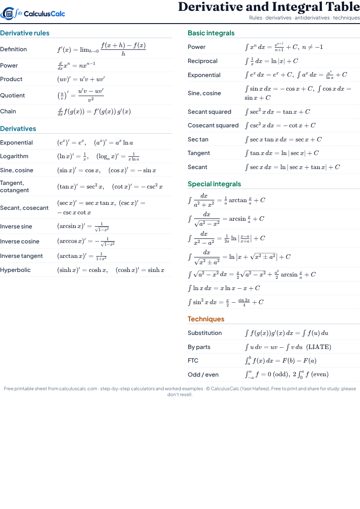
Derivative and Integral Table
Every standard derivative and antiderivative, plus the rules and techniques.
Download the Derivative and Integral Table (PDF) Open in browserPractice problems
- ( int (4x^3 + 2),dx )
- ( int frac{3}{x},dx )
- ( int e^{-x},dx )
- ( int sin(2x),dx )
- ( int x e^{x^2},dx )
- ( int_0^{pi/2}cos x,dx )
Answers: (1) ( x^4 + 2x + C ); (2) ( 3lnlvert xrvert + C ); (3) ( -e^{-x} + C ); (4) ( -frac12cos(2x) + C ); (5) ( frac12e^{x^2} + C ); (6) 1.
FAQ
What are the basic integration formulas?
( int x^n,dx = frac{x^{n+1}}{n+1} + C ), ( int frac1x,dx = lnlvert xrvert + C ), ( int e^x,dx = e^x + C ), ( int sin x,dx = -cos x + C ) and ( int cos x,dx = sin x + C ), plus the sum and constant-multiple rules.
What is the difference between an integral and integration?
An integral is the result (an antiderivative or a number). Integration, however, is the process of finding it.
Why do we add C to an integral?
Because constants differentiate to zero, ( x^2 ), ( x^2 + 5 ) and ( x^2 – 3 ) all have derivative ( 2x ). The ( + C ) stands for every possible constant.
Is there a product rule for integration?
Not directly. However, integration by parts, ( int u,dv = uv – int v,du ), is the product rule run backwards.
Can every function be integrated?
Every continuous function has an antiderivative, but some, like ( e^{-x^2} ), can’t be written with elementary functions. Their definite integrals can still be computed numerically; see the integral of e^(x²).
Further reading
- Lists of integrals (Wikipedia) — an extensive reference table of antiderivatives.
- Calculus II (Paul’s Online Math Notes) — integration techniques with many worked examples.
Calculators for this topic
Keep learning

Integrals Class 12: All Formulas, Methods and Solved Examples
Class 12 Integrals: standard formulas, substitution, partial fractions, integration by parts, special integrals and definite integral properties, solved.
Fundamental Theorem of Calculus (Parts 1 and 2) Explained
The Fundamental Theorem of Calculus links derivatives and integrals. Both parts explained with intuition, formulas and worked examples.