


The Class 12 Integrals chapter covers indefinite integrals (antiderivatives) and definite integrals. The core methods are substitution, trigonometric identities, partial fractions and integration by parts ( int u,v,dx = uint v,dx – intleft(u’int v,dxright)dx ). Key special integrals include ( intfrac{dx}{x^2 + a^2} = frac1atan^{-1}frac{x}{a} + C ) and ( intfrac{dx}{x^2 – a^2} = frac{1}{2a}logleftlvertfrac{x – a}{x + a}rightrvert + C ). Definite integrals are evaluated with ( int_a^b f(x),dx = F(b) – F(a) ) and simplified using their properties.
This guide follows the Integrals chapter of the NCERT Class 12 Mathematics textbook, the same content tested in CBSE board exams and JEE Main. Rather than copying the textbook’s exercise answers, it teaches the method for each question type, so you can solve any exercise yourself and check your answer with the calculator. Every result below was verified by differentiating it.
Note: Indian textbooks write ( log x ) for the natural logarithm ( ln x ); this guide follows that convention.
1. Integration as the inverse of differentiation
If ( frac{d}{dx}F(x) = f(x) ), then ( int f(x),dx = F(x) + C ). The constant C is there because every constant differentiates to zero, so an indefinite integral is a whole family of functions.
2. Standard integration formulas
| Integral | Result |
|---|---|
| ( int x^n,dx ) | ( frac{x^{n+1}}{n+1} + C ), ( n neq -1 ) |
| ( int frac1x,dx ) | ( loglvert xrvert + C ) |
| ( int e^x,dx ) | ( e^x + C ) |
| ( int a^x,dx ) | ( frac{a^x}{log a} + C ) |
| ( int sin x,dx ) | ( -cos x + C ) |
| ( int cos x,dx ) | ( sin x + C ) |
| ( int sec^2 x,dx ) | ( tan x + C ) |
| ( int csc^2 x,dx ) | ( -cot x + C ) |
| ( int sec xtan x,dx ) | ( sec x + C ) |
| ( int csc xcot x,dx ) | ( -csc x + C ) |
| ( int frac{dx}{sqrt{1 – x^2}} ) | ( sin^{-1}x + C ) |
| ( int frac{dx}{1 + x^2} ) | ( tan^{-1}x + C ) |
| ( int tan x,dx ) | ( loglvertsec xrvert + C ) |
| ( int sec x,dx ) | ( loglvertsec x + tan xrvert + C ) |
Example 1. ( intleft(x^2 – frac{1}{x^2}right)dx = frac{x^3}{3} + frac1x + C ).
The full list with explanations is in integration formulas.
3. Integration by substitution
If the integrand contains a function and its derivative, set ( t ) equal to that function.
Example 2. ( int 2xcos(x^2),dx ). Put ( t = x^2 ), ( dt = 2x,dx ): ( intcos t,dt = sin t + C = sin(x^2) + C ).
Example 3. ( inttan^2 x,dx = int(sec^2 x – 1),dx = tan x – x + C ). (This one uses an identity instead of substitution; see section 4.)
Example 4. ( intfrac{(log x)^2}{x},dx ). Put ( t = log x ), ( dt = frac{dx}{x} ): ( int t^2,dt = frac{(log x)^3}{3} + C ).
More: u-substitution.
4. Integration using trigonometric identities
Rewrite powers and products of trig functions with identities before integrating.
- ( sin^2 x = frac{1 – cos 2x}{2} ), ( cos^2 x = frac{1 + cos 2x}{2} )
- ( sin^3 x = frac{3sin x – sin 3x}{4} )
- ( 2sin Acos B = sin(A + B) + sin(A – B) )
Example 5. ( intsin^3 x,dx = int(1 – cos^2 x)sin x,dx ). With ( t = cos x ): ( -int(1 – t^2),dt = -cos x + frac{cos^3 x}{3} + C ).
See trig identities and the integral of sin²x.
5. Integrals of particular functions (special integrals)
| Integral | Result |
|---|---|
| ( intfrac{dx}{x^2 – a^2} ) | ( frac{1}{2a}logleftlvertfrac{x – a}{x + a}rightrvert + C ) |
| ( intfrac{dx}{a^2 – x^2} ) | ( frac{1}{2a}logleftlvertfrac{a + x}{a – x}rightrvert + C ) |
| ( intfrac{dx}{x^2 + a^2} ) | ( frac1atan^{-1}frac{x}{a} + C ) |
| ( intfrac{dx}{sqrt{x^2 – a^2}} ) | ( logleftlvert x + sqrt{x^2 – a^2}rightrvert + C ) |
| ( intfrac{dx}{sqrt{a^2 – x^2}} ) | ( sin^{-1}frac{x}{a} + C ) |
| ( intfrac{dx}{sqrt{x^2 + a^2}} ) | ( logleftlvert x + sqrt{x^2 + a^2}rightrvert + C ) |
| ( intsqrt{a^2 – x^2},dx ) | ( frac{x}{2}sqrt{a^2 – x^2} + frac{a^2}{2}sin^{-1}frac{x}{a} + C ) |
| ( intsqrt{x^2 + a^2},dx ) | ( frac{x}{2}sqrt{x^2 + a^2} + frac{a^2}{2}logleftlvert x + sqrt{x^2 + a^2}rightrvert + C ) |
| ( intsqrt{x^2 – a^2},dx ) | ( frac{x}{2}sqrt{x^2 – a^2} – frac{a^2}{2}logleftlvert x + sqrt{x^2 – a^2}rightrvert + C ) |
Example 6. ( intfrac{dx}{x^2 – 9} = frac16logleftlvertfrac{x – 3}{x + 3}rightrvert + C ) (with ( a = 3 )).

Example 7. ( intfrac{dx}{sqrt{x^2 + 4}} = logleftlvert x + sqrt{x^2 + 4}rightrvert + C ).
Example 8. ( intsqrt{16 – x^2},dx = frac{x}{2}sqrt{16 – x^2} + 8sin^{-1}frac{x}{4} + C ).
Quadratic denominators. For ( intfrac{dx}{ax^2 + bx + c} ), complete the square to reach one of the forms above. For ( intfrac{px + q}{ax^2 + bx + c},dx ), write ( px + q = Afrac{d}{dx}(ax^2 + bx + c) + B ) and split into two integrals.
6. Integration by partial fractions
Split a rational function into simpler fractions, then integrate each.

| Denominator factor | Partial fraction form |
|---|---|
| ( (x – a)(x – b) ) | ( frac{A}{x – a} + frac{B}{x – b} ) |
| ( (x – a)^2 ) | ( frac{A}{x – a} + frac{B}{(x – a)^2} ) |
| ( (x – a)(x^2 + bx + c) ) | ( frac{A}{x – a} + frac{Bx + C}{x^2 + bx + c} ) |
Example 9. ( intfrac{dx}{x(x + 1)} ): ( frac{1}{x(x + 1)} = frac1x – frac{1}{x + 1} ), so the integral is ( loglvert xrvert – loglvert x + 1rvert + C = logleftlvertfrac{x}{x + 1}rightrvert + C ).
Example 10. ( intfrac{x + 1}{x^2 + 3x + 2},dx ). Factor: ( x^2 + 3x + 2 = (x + 1)(x + 2) ), so the integrand simplifies to ( frac{1}{x + 2} ), and the answer is ( loglvert x + 2rvert + C ). Always check for cancellation first.
Full method: partial fraction decomposition.
7. Integration by parts
$$int u,v,dx = uint v,dx - intleft(frac{du}{dx}int v,dxright)dx$$

Choose the first function u by the ILATE order: Inverse trig, Logarithmic, Algebraic, Trigonometric, Exponential.
Example 11. ( int xlog x,dx ): u = ( log x ) (L before A), v = x.
$$int xlog x,dx = frac{x^2}{2}log x - intfrac1xcdotfrac{x^2}{2},dx = frac{x^2}{2}log x - frac{x^2}{4} + C$$
Example 12: applying it twice. ( int x^2e^x,dx = x^2e^x – 2xe^x + 2e^x + C ).
The ( e^x[f(x) + f'(x)] ) shortcut. ( int e^x[f(x) + f'(x)],dx = e^xf(x) + C ).
Example 13. ( int e^x(sin x + cos x),dx = e^xsin x + C ), since ( (sin x)’ = cos x ).
More: integration by parts, the integral of ln x and the integral of xe^x.
Check an integral step by step
Type any integrand to see the method the solver chooses. The example is Example 12.
The full integral calculator also evaluates definite integrals.
8. Definite integrals
Fundamental theorem
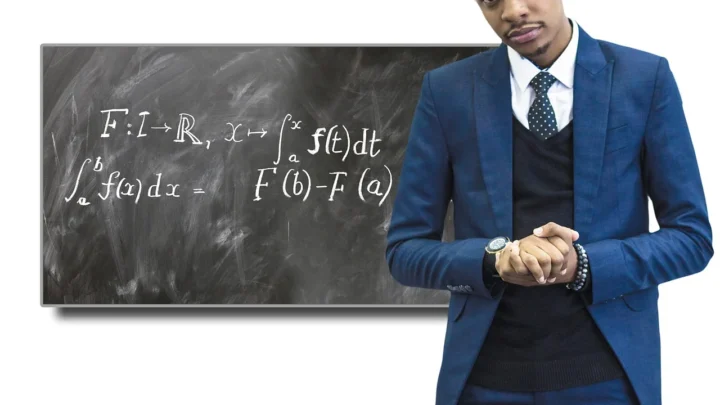
$$int_a^b f(x),dx = F(b) - F(a), qquad F'(x) = f(x)$$

Example 14. ( int_1^2 3x^2,dx = [x^3]_1^2 = 8 – 1 = 7 ).
Example 15 (with substitution, change the limits). ( int_0^1 2x,e^{x^2},dx ): with ( t = x^2 ), the limits become 0 and 1, so ( int_0^1 e^t,dt = e – 1 ).
See the Fundamental Theorem of Calculus.
Definite integral as the limit of a sum
( int_a^b f(x),dx = lim_{ntoinfty}hleft[f(a) + f(a + h) + dots + f(a + (n – 1)h)right] ) with ( h = frac{b – a}{n} ). For example, this gives ( int_0^2 x^2,dx = frac83 ) using ( sum k^2 = frac{n(n + 1)(2n + 1)}{6} ). See Riemann sums and the Riemann sum calculator.
Properties of definite integrals
| Property | Statement |
|---|---|
| P0 | ( int_a^b f(x),dx = int_a^b f(t),dt ) |
| P1 | ( int_a^b f,dx = -int_b^a f,dx ) |
| P2 | ( int_a^b f,dx = int_a^c f,dx + int_c^b f,dx ) |
| P3 | ( int_a^b f(x),dx = int_a^b f(a + b – x),dx ) |
| P4 | ( int_0^a f(x),dx = int_0^a f(a – x),dx ) |
| P5 | ( int_0^{2a} f,dx = 2int_0^a f,dx ) if ( f(2a – x) = f(x) ); 0 if ( f(2a – x) = -f(x) ) |
| P6 | ( int_{-a}^{a} f,dx = 2int_0^a f,dx ) if f is even; 0 if f is odd |
Example 16 (P4, a favourite exam question). ( I = int_0^{pi/2}frac{sin x}{sin x + cos x},dx ). By P4, replacing x with ( frac{pi}{2} – x ) gives ( I = int_0^{pi/2}frac{cos x}{cos x + sin x},dx ). Adding the two forms, ( 2I = int_0^{pi/2}1,dx = frac{pi}{2} ), so ( I = frac{pi}{4} ).
Example 17 (P6). ( int_{-1}^{1}x^3cos x,dx = 0 ), because ( x^3cos x ) is odd.
How to choose the method
- Is it a standard form? Use the table.
- Is there a function and its derivative? Substitute.
- Powers or products of trig functions? Use identities.
- A rational function? Partial fractions (after division if the numerator’s degree is not lower).
- A product of different function types? Integration by parts with ILATE.
- A square root of a quadratic? Complete the square and use a special integral.
Common mistakes
- Dropping + C in indefinite integrals (it costs marks).
- Not changing the limits after substituting in a definite integral.
- Wrong choice of u in parts. Follow ILATE.
- Forgetting to factor or cancel before partial fractions.
- Sign errors with ( intsin x,dx = -cos x ).
Practice questions
- ( int(3x^2 + 2x – 5),dx )
- ( intfrac{dx}{4 – x^2} )
- ( intfrac{e^{tan^{-1}x}}{1 + x^2},dx )
- ( int xsin x,dx )
- ( int_0^{pi/2}cos^2 x,dx )
- ( int_0^1frac{dx}{1 + x^2} )
Answers: (1) ( x^3 + x^2 – 5x + C ); (2) ( frac14logleftlvertfrac{2 + x}{2 – x}rightrvert + C ); (3) ( e^{tan^{-1}x} + C ); (4) ( -xcos x + sin x + C ); (5) ( frac{pi}{4} ); (6) ( frac{pi}{4} ).

FAQ
How many methods of integration are in Class 12?
Three main methods: substitution, partial fractions and integration by parts, supported by trigonometric identities and the table of special integrals.
What is the ILATE rule?
The order for choosing the first function in integration by parts: Inverse trigonometric, Logarithmic, Algebraic, Trigonometric, Exponential.
What is the formula for ( int e^x[f(x) + f'(x)],dx )?
( e^xf(x) + C ).
Which property of definite integrals is used most?
( int_0^a f(x),dx = int_0^a f(a – x),dx ). Adding the original and transformed integrals often cancels the difficult part, as in Example 16.
Why is it log and not ln in the textbook?
Indian school textbooks use ( log x ) to mean the natural logarithm ( ln x ) in calculus.
Further reading
- Lists of integrals (Wikipedia) — a reference table of antiderivatives.
- Calculus II (Paul’s Online Math Notes) — integration techniques explained with many worked examples.
Calculators for this topic
Keep learning
Integration Formulas and Integral Rules: Complete List
Every basic integration formula and integral rule: power, exponential, log, trig and inverse trig integrals, substitution, by parts and definite integrals.
Fundamental Theorem of Calculus (Parts 1 and 2) Explained
The Fundamental Theorem of Calculus links derivatives and integrals. Both parts explained with intuition, formulas and worked examples.