


The exponent rules are: product ( a^mcdot a^n = a^{m+n} ); quotient ( frac{a^m}{a^n} = a^{m-n} ); power of a power ( (a^m)^n = a^{mn} ); power of a product ( (ab)^n = a^nb^n ); power of a quotient ( left(frac{a}{b}right)^n = frac{a^n}{b^n} ); zero exponent ( a^0 = 1 ); negative exponent ( a^{-n} = frac{1}{a^n} ); and fractional exponent ( a^{m/n} = sqrt[n]{a^m} ) (for ( a neq 0 ), and ( a > 0 ) when roots of even order are involved).
An exponent (also called a power or index) tells you how many times to multiply a number by itself: ( 2^5 = 2cdot2cdot2cdot2cdot2 = 32 ). The number being multiplied, 2, is the base. The exponent rules let you simplify expressions with powers quickly, and they’re the foundation for exponential functions, logarithms and the power rule in calculus.
The laws of exponents
| Rule | Formula | Example |
|---|---|---|
| Product | ( a^m a^n = a^{m+n} ) | ( 2^3cdot2^4 = 2^7 = 128 ) |
| Quotient | ( frac{a^m}{a^n} = a^{m-n} ) | ( frac{5^6}{5^2} = 5^4 = 625 ) |
| Power of a power | ( (a^m)^n = a^{mn} ) | ( (3^2)^3 = 3^6 = 729 ) |
| Power of a product | ( (ab)^n = a^nb^n ) | ( (2x)^3 = 8x^3 ) |
| Power of a quotient | ( left(frac{a}{b}right)^n = frac{a^n}{b^n} ) | ( left(frac{x}{3}right)^2 = frac{x^2}{9} ) |
| Zero exponent | ( a^0 = 1 ) (( a neq 0 )) | ( 7^0 = 1 ) |
| Negative exponent | ( a^{-n} = frac{1}{a^n} ) | ( 2^{-3} = frac18 ) |
| Fractional exponent | ( a^{1/n} = sqrt[n]{a} ), ( a^{m/n} = left(sqrt[n]{a}right)^m ) | ( 8^{2/3} = 2^2 = 4 ) |
These rules hold for all real exponents (m) and (n) when the bases (a) and (b) are positive real numbers. If a base is zero, the quotient, negative exponent, and zero exponent rules do not apply because division by zero is undefined. If a base is negative, even roots lead to non-real complex numbers.
Why the rules work
Product rule. ( a^3cdot a^2 = (acdot acdot a)(acdot a) = a^5 ): you’re counting factors, so the exponents add.

Quotient rule. ( frac{a^5}{a^2} = frac{acdot acdot acdot acdot a}{acdot a} = a^3 ): common factors cancel, so the exponents subtract.
Zero exponent. By the quotient rule, ( frac{a^3}{a^3} = a^{3-3} = a^0 ). But anything divided by itself is 1, so ( a^0 = 1 ). You can also see this pattern by dividing by (a) at each step: (a^3), (a^2), (a^1), (a^0 = 1).
Negative exponent. Continuing the division pattern past zero gives ( a^0 / a = a^{-1} = frac{1}{a} ). Similarly, ( frac{a^2}{a^5} = a^{2-5} = a^{-3} ), and cancelling factors directly gives ( frac{1}{a^3} ). A negative exponent means “reciprocal of the positive power”, not a negative numerical output.
Fractional exponent. ( (a^{1/2})^2 = a^{(1/2)cdot2} = a^1 = a ) by the power rule, so ( a^{1/2} ) is the unique positive number whose square is (a): ( sqrt{a} ). Likewise, ( (a^{1/n})^n = a^1 = a ), which defines the (n)-th root ( sqrt[n]{a} ).
Step-by-step order for simplifying exponential expressions
When an algebraic expression combines brackets, fractions, negative powers, and multiple variables, follow this step-by-step sequence to avoid calculation errors:
- Clear outer exponents first: Apply the power of a product rule ( (ab)^n = a^nb^n ) and power of a quotient rule ( left(frac{a}{b}right)^n = frac{a^n}{b^n} ) to clear outer parentheses.
- Apply the power of a power rule: Multiply inner exponents by outer exponents ( (a^m)^n = a^{mn} ).
- Combine identical bases in numerators and denominators: Use the product rule ( a^m a^n = a^{m+n} ) to aggregate terms in the top and bottom separately.
- Apply the quotient rule across the fraction bar: Subtract bottom exponents from top exponents ( frac{a^m}{a^n} = a^{m-n} ).
- Convert negative exponents to positive exponents: Move any term with a negative exponent across the main fraction line ( a^{-n} = frac{1}{a^n} ). Simplify all remaining numerical coefficients.
Worked examples
Example 1. Simplify ( x^5cdot x^{-2}cdot x^4 ). Add the exponents with the product rule: ( x^{5 + (-2) + 4} = x^7 ).

Example 2. Simplify ( frac{12x^7y^3}{4x^2y^5} ). Divide numerical coefficients directly: ( 12 / 4 = 3 ). Subtract exponents for each variable base: ( x^{7-2} = x^5 ) and ( y^{3-5} = y^{-2} ). Rewrite with positive exponents: ( 3x^5y^{-2} = frac{3x^5}{y^2} ).
Example 3. Simplify ( (2a^3b)^4 ). Apply the outer exponent 4 to every factor inside: ( 2^4cdot(a^3)^4cdot b^4 = 16a^{12}b^4 ).
Example 4. Evaluate ( 27^{-2/3} ). Break the fractional exponent into root and power parts. Take the principal cube root first to keep numbers small: ( 27^{1/3} = sqrt[3]{27} = 3 ). Raise to the power 2: ( 3^2 = 9 ). Apply the negative exponent by taking the reciprocal: ( 27^{-2/3} = frac19 ).
Example 5. Simplify ( left(frac{x^{-2}}{y^3}right)^{-2} ). Distribute the outer exponent -2 to both numerator and denominator: ( frac{(x^{-2})^{-2}}{(y^3)^{-2}} = frac{x^4}{y^{-6}} ). Move ( y^{-6} ) from the denominator to the numerator to make its exponent positive: ( x^4y^6 ).
Example 6. Write ( frac{sqrt{x}}{x^3} ) as a single power: Convert radical to rational exponent form ( sqrt{x} = x^{1/2} ). Subtract exponents using the quotient rule: ( x^{1/2 – 3} = x^{1/2 – 6/2} = x^{-5/2} ). This single-power form is necessary before differentiating with the power rule: ( frac{d}{dx}x^{-5/2} = -frac52x^{-7/2} ) (see derivative rules).
Example 7. Simplify ( left(frac{8a^{-3}b^2}{2a^2b^{-4}}right)^{-3} ). Simplify inside the parentheses first: divide numbers ( 8 / 2 = 4 ), apply quotient rules ( a^{-3-2} = a^{-5} ), and ( b^{2 – (-4)} = b^6 ). You get ( (4a^{-5}b^6)^{-3} ). Now distribute -3: ( 4^{-3}a^{15}b^{-18} = frac{a^{15}}{4^3b^{18}} = frac{a^{15}}{64b^{18}} ).
Solving exponential equations
When an equation places variable terms in exponents, choose your method based on whether you can rewrite both sides with identical bases.

Method 1: Matching bases
If ( a^m = a^n ) (with ( a > 0 ), ( a neq 1 )), then ( m = n ). Express both sides as powers of a common prime base, multiply exponents through outer powers, equate the resulting exponent expressions, and solve for the variable.
Example 8. Solve ( 4^{x+1} = 8^x ). Write 4 as ( 2^2 ) and 8 as ( 2^3 ): ( (2^2)^{x+1} = (2^3)^x ). Multiply exponents: ( 2^{2x+2} = 2^{3x} ). Equate exponents: ( 2x + 2 = 3x ), giving ( x = 2 ).
Example 9. Solve ( 9^x = frac{1}{27} ). Express 9 as ( 3^2 ) and ( frac{1}{27} ) as ( 3^{-3} ): ( (3^2)^x = 3^{-3} ), so ( 3^{2x} = 3^{-3} ). Equate exponents: ( 2x = -3 ), giving ( x = -frac32 ).
Method 2: Taking logarithms when bases cannot be matched
When bases cannot be converted to a common integer base, take the natural logarithm (ln) or common logarithm (log) of both sides. The logarithmic power rule brings down the exponent.
For example, to solve ( 3^x = 20 ): take natural logarithms of both sides to get ( ln(3^x) = ln(20) ). Move exponent (x) out front: ( xln(3) = ln(20) ). Divide by (ln(3)): ( x = frac{ln 20}{ln 3} approx 2.727 ). See logarithm rules and the logarithm calculator for deeper logarithmic techniques.
Scientific notation
Scientific notation formats very large or very small real numbers into the standard form ( c times 10^k ), where ( 1 leq |c| < 10 ) and ( k ) is an integer exponent. For example, ( 6{,}020{,}000 = 6.02times10^6 ) and ( 0.00034 = 3.4times10^{-4} ). Exponent laws govern arithmetic operations on scientific notation directly:
Multiplication: Multiply decimal factors and add powers of 10.
$$(3times10^5)(4times10^{-2}) = (3cdot4)times10^{5+(-2)} = 12times10^3 = 1.2times10^4$$
Division: Divide decimal factors and subtract powers of 10.
$$frac{8times10^9}{2times10^3} = left(frac82right)times10^{9-3} = 4times10^6$$
Powers of scientific values: Apply the exponent to both coefficient and base 10.
$$(2times10^4)^3 = 2^3times10^{4cdot3} = 8times10^{12}$$
Exponents in calculus
Calculus operations demand exact single-term exponent form before applying standard formulas:
- Differentiating algebraic functions: The power rule ( frac{d}{dx}x^n = nx^{n-1} ) requires converting radical expressions and fractional denominators into rational power notation first. For example, convert ( frac{3}{sqrt[3]{x^2}} ) to ( 3x^{-2/3} ) before differentiating.
- Integrating algebraic expressions: The power rule for integration ( int x^n,dx = frac{x^{n+1}}{n+1} + C ) (for ( n neq -1 )) relies on identical algebraic preparation (see integration formulas). When ( n = -1 ), ( int x^{-1},dx = int frac{1}{x},dx = ln|x| + C ).
- Exponential models: When the variable resides in the exponent position, as in ( f(x) = a^x ), you have an exponential function rather than a power function. Differentiation requires a different formula: ( frac{d}{dx}a^x = a^xln a ).
When exponent rules do not apply (Limits and edge cases)
Applying exponent rules outside their operational domain causes standard mathematical errors. Exponent laws do not work in these scenarios:
- Sums or differences inside powers: Exponent laws do not distribute over addition or subtraction. ( (a + b)^n neq a^n + b^n ). You must expand using polynomial multiplication or binomial theorem.
- Addition of expressions with identical bases: Product rules multiply terms, they do not add terms. ( x^3 + x^4 ) cannot be simplified into ( x^7 ). You can only factor: ( x^3(1 + x) ).
- Negative bases raised to even rational exponents: Real number arithmetic excludes even roots of negative numbers. For instance, ( (-4)^{1/2} = sqrt{-4} ) has no real solution (it equals ( 2i ) in complex numbers).
- The indeterminate form ( 0^0 ): In standard algebra, ( 0^0 ) is left undefined because ( 0^n = 0 ) conflicts with ( a^0 = 1 ). In calculus limits, ( 0^0 ), ( 1^infty ), and ( infty^0 ) are indeterminate forms requiring L’Hôpital’s Rule.
- Variable bases with variable exponents: Expressions like ( y = x^x ) cannot be simplified using standard power laws or standard exponential derivatives; they require implicit or logarithmic differentiation.
Check with a calculator
Use the scientific calculator for powers and roots: type 8^(2/3) or 27^(-2/3) to confirm Example 4 and table values.
Common mistakes
| Incorrect operation | Why it fails | Correct method |
|---|---|---|
| ( x^3cdot x^4 = x^{12} ) | Multiplies exponents instead of adding them during base multiplication. | ( x^3cdot x^4 = x^{3+4} = x^7 ) |
| ( (a + b)^2 = a^2 + b^2 ) | Fails to include cross terms from foil expansion. | ( (a + b)^2 = a^2 + 2ab + b^2 ) |
| ( 2^{-3} = -8 ) | Treats negative exponent as a negative numerical multiplier. | ( 2^{-3} = frac{1}{2^3} = frac18 ) |
| ( -3^2 = 9 ) | Applies exponent 2 to the negative sign without grouping parentheses. | ( -3^2 = -(3^2) = -9 ); only ( (-3)^2 = 9 ) |
| ( 2^3cdot3^2 = 6^5 ) | Combines terms with different bases and different exponents directly. | Calculate values separately: ( 8cdot9 = 72 ) |
| ( frac{a^6}{a^{-2}} = a^4 ) | Adds negative exponent in denominator instead of subtracting it. | ( frac{a^6}{a^{-2}} = a^{6 – (-2)} = a^8 ) |
Printable formula sheet
The exponent and logarithm rules, factoring patterns and the quadratic formula are on one printable page.
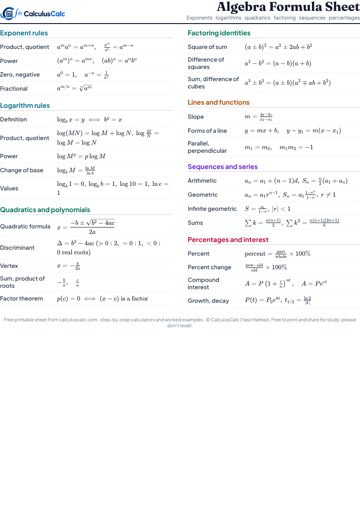
Algebra Formula Sheet
Exponents, logarithms, factoring, the quadratic formula, lines and sequences.
Download the Algebra Formula Sheet (PDF) Open in browserPractice problems
- Simplify ( a^4cdot a^{-7} ).
- Simplify ( frac{x^9}{x^3} ).
- Simplify ( (3x^2)^3 ).
- Evaluate ( 16^{3/4} ).
- Evaluate ( 5^{-2} ).
- Solve ( 2^{3x} = 32 ).
Full Step-by-Step Solutions:
1. Apply product rule: ( a^{4 + (-7)} = a^{-3} ). Express with positive exponent: ( frac{1}{a^3} ).
2. Apply quotient rule: ( x^{9 – 3} = x^6 ).
3. Apply power of product rule: ( 3^3cdot(x^2)^3 = 27x^{2cdot3} = 27x^6 ).
4. Evaluate root first: ( 16^{1/4} = sqrt[4]{16} = 2 ). Raise result to power 3: ( 2^3 = 8 ).
5. Apply negative exponent definition: ( frac{1}{5^2} = frac{1}{25} ).
6. Express 32 as base 2 power: ( 32 = 2^5 ). Equation becomes ( 2^{3x} = 2^5 ). Equate exponents: ( 3x = 5 ), so ( x = frac53 ).
Frequently asked questions
What are the rules of exponents?
Add exponents when multiplying identical bases, subtract exponents when dividing identical bases, and multiply exponents when raising a power to a power. Also, ( a^0 = 1 ), ( a^{-n} = frac{1}{a^n} ), and ( a^{m/n} = sqrt[n]{a^m} ).
Why is any non-zero number to the power 0 equal to 1?
Because ( frac{a^n}{a^n} = a^{n-n} = a^0 ) by quotient rules, and any non-zero quantity divided by itself equals 1.
What does a negative exponent mean?
A negative exponent indicates a reciprocal: ( a^{-n} = frac{1}{a^n} ). It moves the term across the fraction bar and does not change the numeric sign of the output.
What does a fractional exponent mean?
A fractional exponent denotes a radical root: ( a^{1/n} = sqrt[n]{a} ). The denominator represents the root order and the numerator represents the power exponent: ( a^{m/n} = (sqrt[n]{a})^m ).
What is the difference between an exponent and a power?
The exponent is the raised superscript index. The power refers to the entire expression consisting of both base and exponent, or the calculated result. In ( 2^5 = 32 ), 5 is the exponent and 32 is the fifth power of 2.
Further reading
- Exponentiation (Wikipedia) — definitions, the laws of exponents and their extensions.
- Exponential and Logarithm Functions (Paul’s Online Math Notes) — exponents leading into exponential functions.
Calculators for this topic
Keep learning

The Unit Circle: Angles, Coordinates and Trig Values
The unit circle explained: why the coordinates are cos and sin, every special angle in degrees and radians, tangent on the unit circle, and memory tricks.
Trigonometric Functions: Sin, Cos, Tan, Table and Graphs
The six trig functions with SOH-CAH-TOA and the unit circle, a table of exact values (sin 30, cos 180, sec 45), graphs, period and amplitude.