
 By
This fraction calculator adds, subtracts, multiplies and divides fractions, mixed numbers and whole numbers. It shows the working (the common denominator for adding and subtracting, or the reciprocal for dividing), then gives the answer in lowest terms, as a mixed number when it’s more than 1, and as a decimal.
It’s free and needs no sign-up.
How to use it
- Type the first fraction:
3/4, a mixed number like1 1/2(with a space), a whole number like5, or a negative like-2/3. - Choose +, −, × or ÷.
- Type the second fraction and press Calculate.
Using a fraction calculator to understand fraction rules
| Operation | Rule | Example |
|---|---|---|
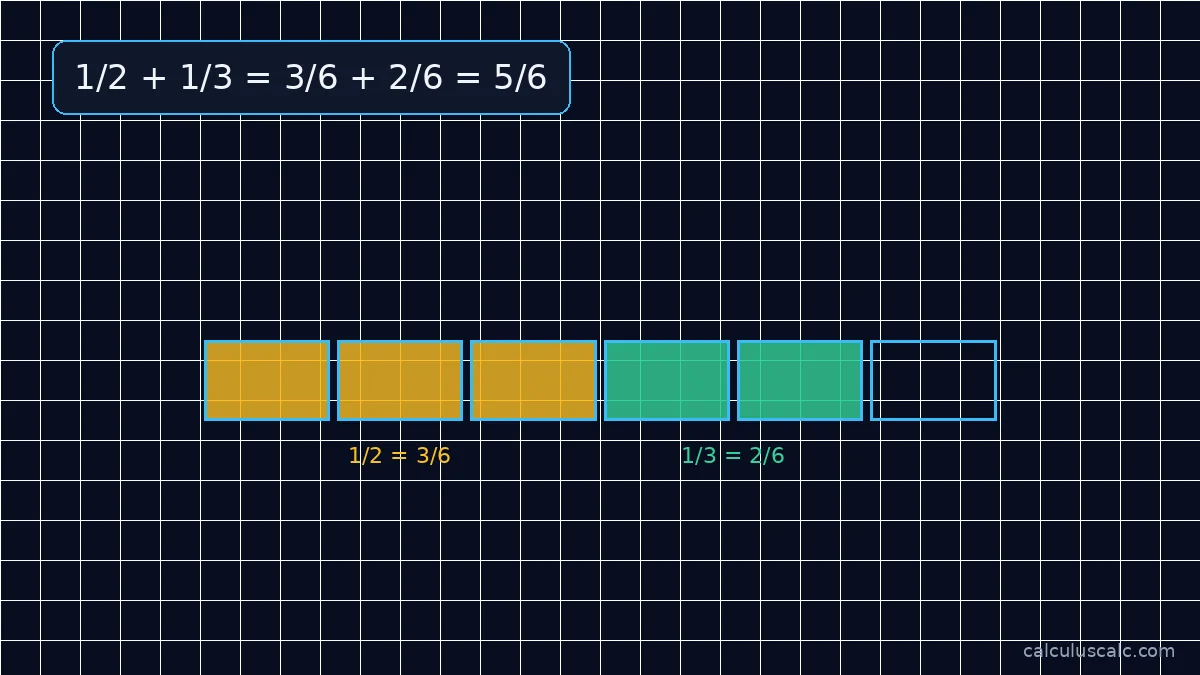
| Add | common denominator, add numerators | ( frac12 + frac13 = frac36 + frac26 = frac56 ) |
| Subtract | common denominator, subtract numerators | ( frac23 – frac14 = frac{8}{12} – frac{3}{12} = frac{5}{12} ) |
| Multiply | multiply tops, multiply bottoms | ( frac35 times frac{10}{9} = frac{30}{45} = frac23 ) |
| Divide | multiply by the reciprocal | ( frac34 div frac56 = frac34 times frac65 = frac{9}{10} ) |
Worked example: adding
( frac12 + frac13 ) (as loaded above). The least common denominator of 2 and 3 is 6, so ( frac12 = frac36 ) and ( frac13 = frac26 ). Adding gives ( frac56 approx 0.833 ).
Worked example: mixed numbers
( 1frac12 times frac23 ). Convert to an improper fraction first: ( 1frac12 = frac32 ). Then ( frac32 times frac23 = frac66 = 1 ).
Worked example: an improper result
( frac53 + frac12 = frac{10}{6} + frac36 = frac{13}{6} = 2frac16 approx 2.167 ).
Simplifying
Divide the numerator and denominator by their greatest common factor: ( frac{30}{45} ), with GCF 15, becomes ( frac23 ). The calculator always simplifies fully.
Common mistakes
- Adding denominators. ( frac12 + frac13 neq frac25 ).
- Forgetting to flip the second fraction when dividing.
- Multiplying mixed numbers directly. Convert to improper fractions first: ( 1frac12 times 2 ) is 3, not ( 2frac12 ).
- Leaving answers unsimplified.
Fractions in algebra and calculus
Variables follow the same rules: ( frac1x + frac1{x + 1} = frac{2x + 1}{x(x + 1)} ). A fraction calculator can reverse this process. Splitting a fraction into simpler ones is partial fraction decomposition. This is a key integration technique.
Finding the least common denominator
To add or subtract fractions with different denominators, rewrite them over the least common denominator (LCD), the smallest number both denominators divide into.

Example: \( \frac{5}{6} + \frac{7}{8} \). The multiples of 8 are 8, 16, 24…, and 24 is the first that 6 also divides, so the LCD is 24.
$$\frac{5}{6} + \frac{7}{8} = \frac{20}{24} + \frac{21}{24} = \frac{41}{24} = 1\tfrac{17}{24}$$
You can multiply the two denominators (6 × 8 = 48) instead. But you must simplify at the end. The GCF and LCM calculator finds the LCD for you. This fraction calculator simplifies that work.
Dividing fractions step by step
Keep the first fraction, flip the second, and multiply:
$$\frac{3}{4} \div \frac{2}{5} = \frac{3}{4} \times \frac{5}{2} = \frac{15}{8} = 1\tfrac{7}{8}$$
Check: \( \frac{15}{8} \times \frac{2}{5} = \frac{30}{40} = \frac{3}{4} \). Dividing by a fraction less than 1 always gives a bigger answer.
Comparing fractions
To see which of two fractions is bigger, cross-multiply. For \( \frac{5}{7} \) and \( \frac{7}{10} \): \( 5 \times 10 = 50 \) and \( 7 \times 7 = 49 \). Since 50 > 49, \( \frac{5}{7} \) is larger (0.714 vs 0.700).
Fractions, decimals and percents
| Fraction | Decimal | Percent |
|---|---|---|
| \( \frac{1}{8} \) | 0.125 | 12.5% |
| \( \frac{3}{8} \) | 0.375 | 37.5% |
| \( \frac{1}{3} \) | 0.333… | 33.3% |
| \( \frac{2}{3} \) | 0.666… | 66.7% |
| \( \frac{5}{4} \) | 1.25 | 125% |
To turn a fraction into a decimal, divide the numerator by the denominator. To turn it into a percent, multiply the decimal by 100. See the percentage calculator.
A fraction of a quantity
“Three fifths of 40” means \( \frac{3}{5} \times 40 = \frac{120}{5} = 24 \). Divide by the denominator, then multiply by the numerator: \( 40 \div 5 = 8 \), \( 8 \times 3 = 24 \).
Step-by-step method for any operation
- Turn mixed numbers into improper fractions.
- Add or subtract: use a common denominator. Multiply: multiply across. Divide: flip the second fraction and multiply.
- Simplify by dividing top and bottom by their greatest common factor.
- Turn an improper answer back into a mixed number if needed.
Complex fractions
A complex fraction has fractions in its numerator or denominator. Simplify the top and bottom first, then divide:
$$\frac{\frac{1}{2} + \frac{1}{3}}{\frac{5}{6}} = \frac{\frac{5}{6}}{\frac{5}{6}} = 1$$
Another way is to multiply top and bottom by the least common denominator of every small fraction (here 6): \( \frac{3 + 2}{5} = 1 \).
Fractions with variables
The same rules work in algebra. To add \( \frac{1}{x} + \frac{1}{x + 1} \), use the common denominator \( x(x + 1) \):
$$\frac{1}{x} + \frac{1}{x + 1} = \frac{(x + 1) + x}{x(x + 1)} = \frac{2x + 1}{x(x + 1)}$$
Note the restrictions: \( x \ne 0 \) and \( x \ne -1 \), where a denominator would be zero. Splitting such expressions back apart is partial fraction decomposition, used in integration.
Fractions in everyday life
- Recipes: halving a recipe that needs \( \frac{3}{4} \) cup of flour means \( \frac{3}{4} \times \frac{1}{2} = \frac{3}{8} \) cup.
- Measurements: a 2 m board cut into pieces \( \frac{3}{8} \) m long gives \( 2 \div \frac{3}{8} = \frac{16}{3} = 5\tfrac{1}{3} \), so 5 whole pieces with \( \frac{1}{8} \) m left over.
- Probability: the chance of two independent events is the product of their fractions, \( \frac{1}{2} \times \frac{1}{6} = \frac{1}{12} \) for heads and a six.
- Discounts: “a third off” a $45 price saves \( \frac{1}{3} \times 45 = \$15 \).
Working with exact fractions keeps answers precise; switch to decimals only for the final answer.

Equivalent fractions
Multiplying or dividing top and bottom by the same non-zero number gives an equal fraction: \( \frac{2}{3} = \frac{4}{6} = \frac{10}{15} \). This is the idea for common denominators and simplifying. A fraction calculator uses this. Two fractions are equal when their cross products match: \( \frac{4}{6} = \frac{10}{15} \) because \( 4 \times 15 = 6 \times 10 = 60 \).
Mixed numbers vs improper fractions
\( 2\tfrac{3}{4} \) and \( \frac{11}{4} \) are the same number. To convert, multiply the whole number by the denominator. Then add the numerator for the improper form (\( 2 \times 4 + 3 = 11 \)). Improper fractions are easier for a fraction calculator to use. Mixed numbers are easier to picture.
Practice problems
- \( \frac{2}{3} + \frac{3}{4} \)
- \( 2\tfrac{1}{2} \times \frac{4}{5} \)
- \( \frac{5}{9} \div \frac{10}{3} \)
Answers: 1. \( \frac{8}{12} + \frac{9}{12} = \frac{17}{12} = 1\tfrac{5}{12} \). 2. \( \frac{5}{2} \times \frac{4}{5} = 2 \). 3. \( \frac{5}{9} \times \frac{3}{10} = \frac{15}{90} = \frac{1}{6} \).
Related guides
- Fractions: How to Add, Subtract, Multiply and Divide
- Percentage Formula
- Exponent Rules
- Partial Fraction Decomposition
Further reading
- Fraction (Wikipedia) — definitions, arithmetic with fractions and history.
FAQ
How do you add fractions with different denominators?
Rewrite both with a common denominator (the least common multiple of the denominators), then add the numerators.
How do you divide fractions?
Multiply the first fraction by the reciprocal of the second: “keep, change, flip”.
How do you simplify a fraction?
Divide top and bottom by their greatest common factor.
How do you turn an improper fraction into a mixed number?
Divide the numerator by the denominator: the quotient is the whole number and the remainder is the new numerator. ( frac{13}{6} = 2frac16 ).