

The main area formulas are: square ( A = s^2 ); rectangle ( A = lw ); triangle ( A = frac12bh ); parallelogram ( A = bh ); trapezoid ( A = frac12(a + b)h ); rhombus ( A = frac12d_1d_2 ); circle ( A = pi r^2 ); and ellipse ( A = pi ab ). Here h is always the perpendicular height, and area is measured in square units such as cm² or m².
Area is the amount of flat space inside a shape, measured by how many unit squares fit inside it. This guide gives the formula for every common shape. It also shows why each one works (most come from the rectangle), and works through examples, including composite shapes and the most common mistakes.
Area formulas at a glance
| Shape | Formula | What the letters mean |
|---|---|---|
| Square | ( A = s^2 ) | side length |
| Rectangle | ( A = lw ) | length, width |
| Triangle | ( A = frac12bh ) | base, perpendicular height |
| Parallelogram | ( A = bh ) | base, perpendicular height |
| Trapezoid (trapezium) | ( A = frac12(a + b)h ) | parallel sides a, b; height |
| Rhombus or kite | ( A = frac12d_1d_2 ) | the two diagonals |
| Circle | ( A = pi r^2 ) | radius |
| Sector | ( A = frac{theta}{360^circ}pi r^2 = frac12r^2theta ) | angle in degrees, or ( theta ) in radians |
| Ellipse | ( A = pi ab ) | semi-major and semi-minor axes |
| Equilateral triangle | ( A = frac{sqrt3}{4}s^2 ) | side length |
| Regular polygon | ( A = frac12 times text{perimeter} times text{apothem} ) | apothem = center to side midpoint |
Square and rectangle
A rectangle 8 units long and 5 wide holds 8 rows of 5 unit squares, so
$$A = lw = 8 times 5 = 40$$
A square is a rectangle with equal sides: ( A = s^2 ). For example, a square of side 7 has area 49. Rectangle area formula and square area formula are among the most searched math formulas in the world, and everything below builds on them.
Triangle
Any triangle is half of a parallelogram (put two copies together). So
$$A = tfrac12bh$$
where h is the height measured perpendicular to the base b. For example, a triangle with base 10 cm and height 6 cm has area ( frac12 times 10 times 6 = 30 ) cm².
If you know all three sides but not the height, use Heron’s formula: with ( s = frac{a + b + c}{2} ), ( A = sqrt{s(s – a)(s – b)(s – c)} ). For sides 5, 6, 7: ( s = 9 ) and ( A = sqrt{9 cdot 4 cdot 3 cdot 2} = sqrt{216} approx 14.70 ).
If you know two sides and the angle between them: ( A = frac12absin C ) (see the law of sines and cosines).
Equilateral triangle: the height is ( frac{sqrt3}{2}s ) (from the 30-60-90 triangle in special right triangles), so ( A = frac{sqrt3}{4}s^2 ). A side of 6 gives ( 9sqrt3 approx 15.59 ).
Parallelogram
Cut a right triangle off one end of a parallelogram and slide it to the other end: you get a rectangle with the same base and height. So
$$A = bh$$
A parallelogram with base 9 and height 4 has area 36. However, note that the slanted side length is not used.
Trapezoid (trapezium)
A trapezoid has two parallel sides, a and b. Its area is the average of the parallel sides times the height:
$$A = tfrac12(a + b)h$$
Two copies of a trapezoid, one flipped, form a parallelogram with base ( a + b ), which is where the formula comes from. For example, parallel sides 6 and 10 with height 4 give ( frac12(16)(4) = 32 ).
Rhombus and kite
The diagonals of a rhombus (or kite) are perpendicular, and the shape is half of the rectangle formed by them:
$$A = tfrac12d_1d_2$$
Diagonals 6 and 8 give area 24. Since a rhombus is also a parallelogram, ( A = bh ) works too.
Circle
$$A = pi r^2$$
A circle of radius 3 has area ( 9pi approx 28.27 ). If you know the diameter d, ( A = frac{pi d^2}{4} ). Why ( pi r^2 )? To illustrate, cut the circle into many thin wedges and arrange them alternately point-up and point-down: they form an almost-rectangle with height r and width half the circumference, ( pi r ). That rectangle has area ( pi r^2 ). Calculus makes this exact; see polar coordinates, where ( A = frac12int_0^{2pi}r^2,dtheta = pi r^2 ).
Sector. A slice with angle ( theta ) is that fraction of the circle: for example, a ( 90^circ ) sector of radius 4 has area ( frac14 cdot 16pi = 4pi approx 12.57 ).
Ellipse. ( A = pi ab ), a circle stretched by different amounts in two directions. For example, with ( a = 5 ), ( b = 3 ), ( A = 15pi approx 47.12 ).
Area calculator
Choose a shape and enter its measurements to check any answer. For example, the trapezoid is above.
The full-page area calculator has more examples, and the circle calculator works from the diameter, circumference or area.
Composite shapes
Split the shape into pieces whose areas you know, then add (or subtract).
Example: an L-shaped room. A 10 m by 6 m rectangle with a 4 m by 3 m corner cut out has area ( 60 – 12 = 48 ) m².
Example: a window. A 2 m by 1 m rectangle topped by a semicircle of diameter 2 m: ( 2 + frac12pi(1)^2 = 2 + frac{pi}{2} approx 3.57 ) m².
Example: a ring (annulus). Outer radius 5, inner radius 3: ( pi(25 – 9) = 16pi approx 50.27 ).
Units
- Area is in square units: if lengths are in centimetres, area is in cm².
- ( 1 text{ m}^2 = 10{,}000 text{ cm}^2 ) (because ( 100 times 100 )), not 100.
- ( 1 text{ ft}^2 = 144 text{ in}^2 ), and 1 acre ( = 43{,}560 text{ ft}^2 ).
- Doubling every length multiplies the area by 4.
Beyond formulas: areas under curves
Shapes bounded by curves, like the region under ( y = x^2 ), have no ready-made formula. Integral calculus finds them by adding up thin rectangles; see Riemann sums, area between curves and the definite integral calculator. For example, the area under ( y = x^2 ) from 0 to 1 is exactly ( frac13 ).
Common mistakes
- Using the slanted side as the height. Height is always perpendicular to the base.
- Forgetting the ( frac12 ) for triangles, trapezoids and rhombuses.
- Diameter in ( pi r^2 ). Halve it first.
- Mixing units (metres and centimetres) in one calculation.
- Confusing area and perimeter. Perimeter is the distance around (a length); however, area is the space inside (square units).
Printable formula sheet
All of these area formulas, plus perimeter, volume and surface area, are on one printable page.
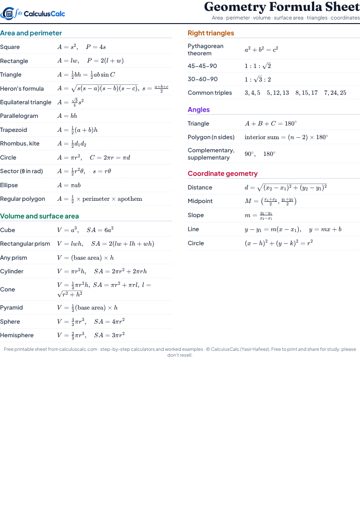
Geometry Formula Sheet
Area, perimeter, volume and surface area of every common shape and solid.
Download the Geometry Formula Sheet (PDF) Open in browserPractice problems
- Find the area of a rectangle 12 cm by 7 cm.
- Find the area of a triangle with base 9 m and height 8 m.
- Find the area of a trapezoid with parallel sides 5 and 11 and height 6.
- Find the area of a circle with diameter 10 (exact and decimal).
- A rhombus has diagonals 14 and 10. Find its area.
- Find the area of an equilateral triangle with side 4.
Answers: (1) 84 cm²; (2) 36 m²; (3) 48; (4) ( 25pi approx 78.54 ); (5) 70; (6) ( 4sqrt3 approx 6.93 ).
FAQ
What is the formula for the area of a rectangle?
( A = text{length} times text{width} ).
What is the formula for the area of a triangle?
( A = frac12 times text{base} times text{height} ), with the height perpendicular to the base.
What is the formula for the area of a trapezoid?
( A = frac12(a + b)h ), where a and b are the parallel sides.
What is the area of a circle?
( A = pi r^2 ).
What is the difference between area and perimeter?
Area measures the surface inside a shape (square units); perimeter measures the length around it (ordinary units).
Further reading
- List of formulas in elementary geometry (Wikipedia) — areas, perimeters and volumes in one reference.
- Area (Wikipedia) — definitions, units and derivations.
Calculators for this topic
Keep learning
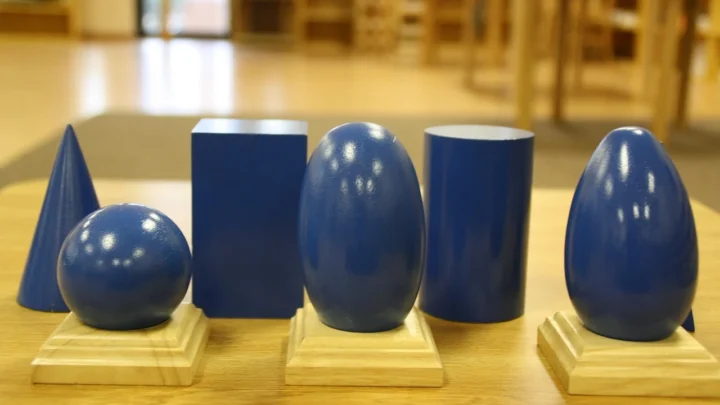
Volume Formulas and Surface Area of 3D Shapes
Volume and surface area formulas for cubes, boxes, cylinders, cones, spheres and pyramids, why they work, unit conversions and examples.

Pythagorean Theorem: Formula, Proof and Examples
The Pythagorean theorem a² + b² = c² explained: finding the hypotenuse or a leg, a visual proof, Pythagorean triples, the converse, 3D and real-world examples.