
Circle Calculator (Area, Circumference, Radius)
- Free
- No sign-up
- Works on phones
- Shows the working
 By Yasir Hafeez · Updated
This circle calculator works from any one measurement. Enter the radius, the diameter, the circumference or the area, and it returns all four. When you start from the radius or diameter, the circumference and area are shown exactly (such as ( 10pi )) and as decimals.
It works as an area of a circle calculator and a circumference calculator in one. Also, it’s free and needs no sign-up.
How to use the circle calculator
- In I know the, choose radius, diameter, circumference or area.
- Enter the value.
- Press Calculate to see r, d, C and A.
Circle formulas
| Quantity | Formula |
|---|---|
| Diameter | ( d = 2r ) |
| Circumference | ( C = 2pi r = pi d ) |
| Area | ( A = pi r^2 = frac{pi d^2}{4} ) |
| Radius from circumference | ( r = frac{C}{2pi} ) |
| Radius from area | ( r = sqrt{frac{A}{pi}} ) |
( pi approx 3.14159 ) is the ratio of every circle’s circumference to its diameter.
Worked example: from the radius
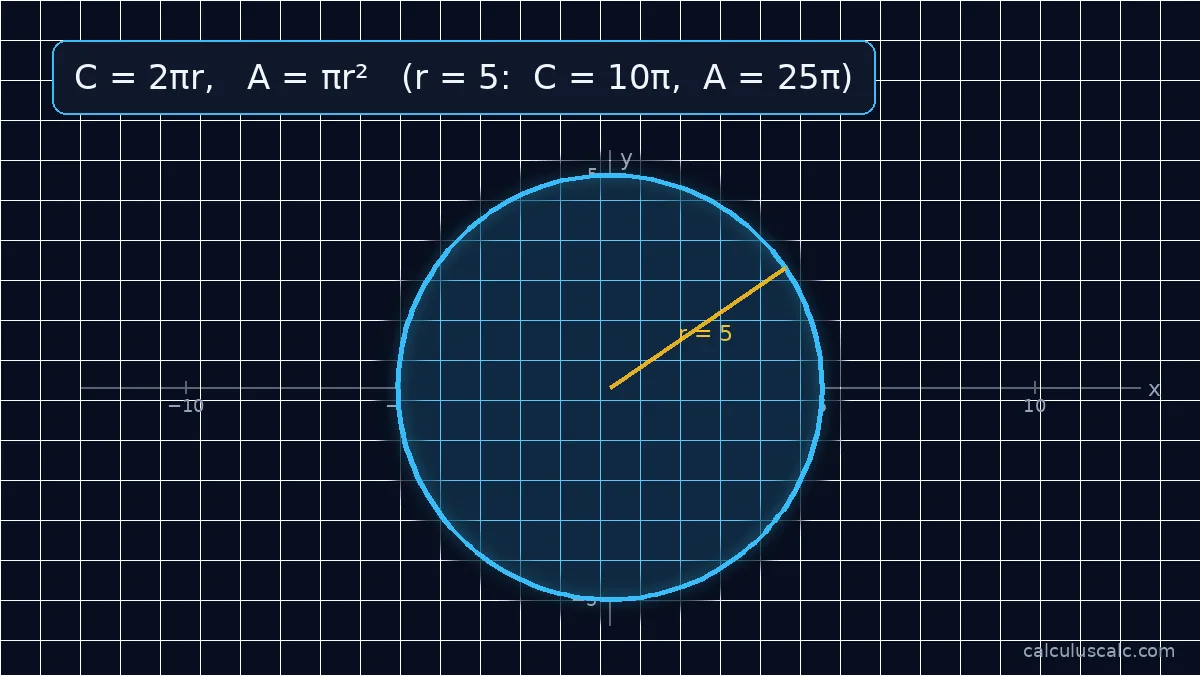
( r = 5 ) (as loaded above): ( d = 10 ), ( C = 10pi approx 31.42 ), ( A = 25pi approx 78.54 ).
Worked example: from the diameter
A pizza 12 inches across has ( r = 6 ), so its area is ( 36pi approx 113.1 ) in² and its crust is ( 12pi approx 37.7 ) inches long. However, a 16-inch pizza has area ( 64pi approx 201 ) in², almost twice as much, because area grows with the square of the radius.
Worked example: from the area
A circular garden has area 50 m². So, ( r = sqrt{50/pi} approx 3.99 ) m, and the fence around it is ( C = 2pi r approx 25.07 ) m.
Arcs and sectors
A sector with angle ( theta ) (in radians) has arc length ( s = rtheta ) and area ( frac12r^2theta ). Convert degrees first with degrees to radians. For a ( 60^circ ) slice of the ( r = 5 ) circle, ( theta = frac{pi}{3} ), so the arc is ( frac{5pi}{3} approx 5.24 ) and the slice’s area is ( frac{25pi}{6} approx 13.09 ).

Tips and common mistakes
- Radius vs diameter. The most common error is using the diameter in ( pi r^2 ).
- Circumference vs area. Circumference is a length (cm); however, area is in square units (cm²).
- Rounding ( pi ). Use the ( pi ) key or the exact answer; 3.14 is fine only for rough work.
The equation of a circle
On a graph, a circle with centre \( (h, k) \) and radius \( r \) is
$$(x - h)^2 + (y - k)^2 = r^2$$
A circle centred at \( (2, -3) \) with radius 5 is \( (x - 2)^2 + (y + 3)^2 = 25 \). If an equation is given expanded, complete the square to find the centre and radius:
$$x^2 + y^2 - 4x + 6y - 12 = 0 \;\Rightarrow\; (x - 2)^2 + (y + 3)^2 = 25$$
so the centre is \( (2, -3) \) and the radius 5. See the completing the square calculator.
Worked example: arc length and sector area
For a circle of radius 10 and a central angle of 72°:
- Arc length: \( 2\pi r \times \frac{72}{360} = 4\pi \approx 12.57 \)
- Sector area: \( \pi r^2 \times \frac{72}{360} = 20\pi \approx 62.83 \)
With the angle in radians the formulas are simpler: \( s = r\theta \) and \( A = \frac{1}{2}r^2\theta \). For \( r = 5 \) and \( \theta = 1.2 \): \( s = 6 \) and \( A = 15 \). See degrees to radians.
Chord length
A chord joins two points on the circle. For a central angle \( \theta \):
$$c = 2r\sin\left(\frac{\theta}{2}\right)$$
With \( r = 10 \) and \( \theta = 60° \): \( c = 20 \sin 30° = 10 \), the same as the radius, because the triangle is equilateral.
How area and circumference scale
Circumference grows in proportion to the radius, but area grows with its square. Doubling the radius doubles the circumference and multiplies the area by 4. A 16-inch pizza has \( (16/12)^2 \approx 1.78 \) times the area of a 12-inch pizza, not 1.33 times.
Where the formulas come from
Cut a circle into thin sectors and rearrange them alternately point-up and point-down. They form a shape close to a rectangle of height \( r \) and width half the circumference, \( \pi r \), so the area is \( \pi r^2 \). In calculus the same result comes from integrating, see the integral calculator.
Tangents and angles in a circle
- A tangent touches the circle at one point and is perpendicular to the radius there. From a point 13 units from the centre of a circle of radius 5, each tangent line has length \( \sqrt{13^2 - 5^2} = 12 \).
- An angle inscribed in a semicircle is always 90°.
- An inscribed angle is half the central angle that cuts off the same arc. So, a central angle of 100° gives inscribed angles of 50°.
These facts turn many circle problems into right-triangle problems solved with the Pythagorean theorem.
Quick reference
| You know | Radius | Then |
|---|---|---|
| Diameter \( d \) | \( r = d/2 \) | \( C = \pi d \), \( A = \pi d^2/4 \) |
| Circumference \( C \) | \( r = C/(2\pi) \) | \( A = C^2/(4\pi) \) |
| Area \( A \) | \( r = \sqrt{A/\pi} \) | \( C = 2\sqrt{\pi A} \) |
Keep \( \pi \) exact (as a symbol) until the last step, then round once.
Worked example: fencing and turf for a round lawn
A round lawn has a diameter of 12 m. The edging around it is the circumference, \( 12\pi \approx 37.7 \) m, and the turf needed is the area, \( \pi \times 6^2 = 36\pi \approx 113.1 \) m². With 5% extra for cutting, order about 119 m² of turf and 40 m of edging.
Why π never changes
For every circle, however large or small, the circumference divided by the diameter is the same number, \( \pi \approx 3.14159 \). Ancient mathematicians measured it; Archimedes trapped it between \( 3\tfrac{10}{71} \) and \( 3\tfrac{1}{7} \) using polygons with 96 sides.
Practice problems
- Circumference 31.4 cm: find the radius.
- Area of a sector with radius 6 and angle 150°.
- Centre and radius of \( x^2 + y^2 + 10x - 2y + 17 = 0 \).
Answers: 1. \( 31.4 / (2\pi) \approx 5 \) cm. 2. \( 36\pi \times \frac{150}{360} = 15\pi \approx 47.12 \). 3. \( (x + 5)^2 + (y - 1)^2 = 9 \): centre \( (-5, 1) \), radius 3.
Checking Your Results
After using the circle calculator, it is wise to quickly check your answers. First, ensure all units match your input. For instance, if you entered meters, your radius will be in meters and area in square meters. Also, notice the relationship between diameter and radius. The diameter should always be exactly twice the radius.
Consider the magnitude of the numbers. A larger radius means a larger circumference and a much larger area. If your radius doubles, the circumference also doubles. However, the area will be four times larger. This quick check helps catch significant calculation errors.
When to Use the Circle Calculator
This tool is ideal for quick calculations when you know only one circle property. For example, use it to find the area of a circular garden from its circumference. Similarly, if you know the area, you can quickly find the radius for design purposes. The circle calculator provides all related values instantly.
It is also helpful for verifying hand calculations. Always double-check critical measurements in engineering or construction. This calculator offers a fast way to confirm your manual work. Use it to check homework problems too, ensuring your understanding of the formulas.
Avoiding Calculation Errors
Many mistakes stem from confusing radius and diameter. Remember that the radius is from the center to the edge. The diameter, however, spans the full width, passing through the center. Always confirm which value you are using in formulas like Area = pi * radius^2.
Another common issue is rounding pi too early. The circle calculator often provides exact answers with pi. Then it gives a decimal approximation. For precision, use the exact value as long as possible. Only round at the very last step of your problem. This ensures greater accuracy in your final result.
Related guides
Further reading
- Circle (Wikipedia) — terminology, formulas and properties.
- Pi (Wikipedia) — what ( pi ) is and how it’s calculated.
FAQ
How do you find the area of a circle?
( A = pi r^2 ). For a radius of 4, ( A = 16pi approx 50.27 ).
How do you find the circumference of a circle?
( C = 2pi r ) or ( C = pi d ).
How do you find the radius from the circumference?
Divide by ( 2pi ): ( r = frac{C}{2pi} ).
How do you find the radius from the area?
( r = sqrt{A/pi} ).