

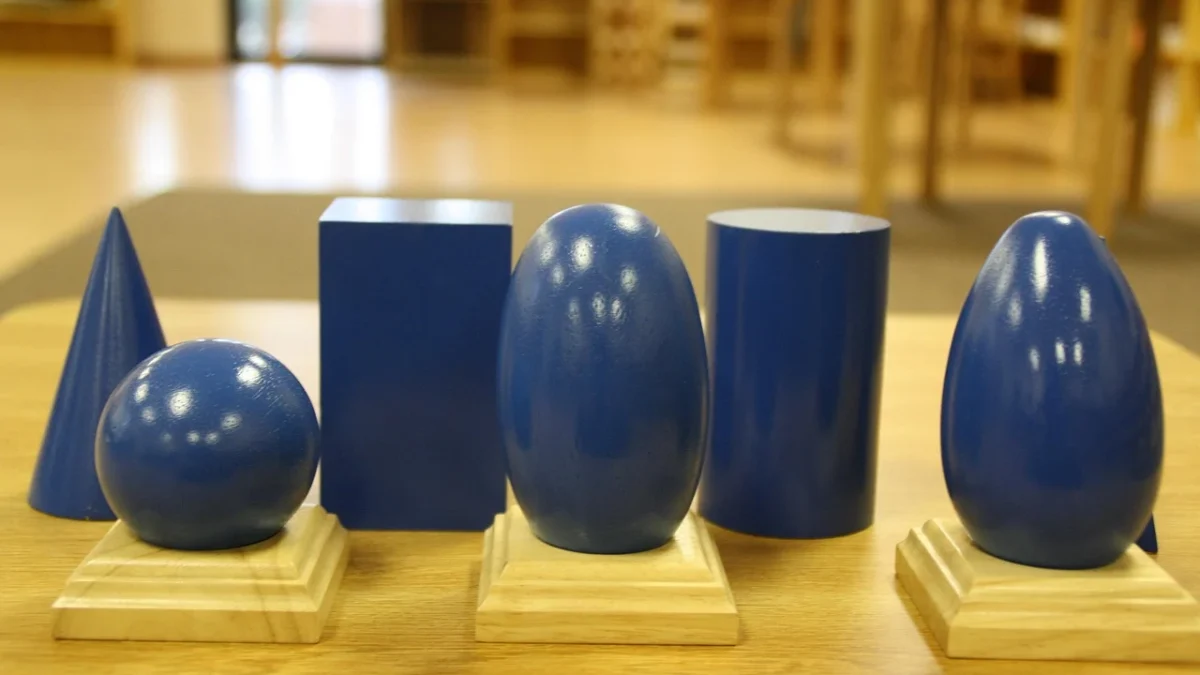
The main volume formulas are: cube ( V = a^3 ); rectangular prism ( V = lwh ); any prism or cylinder ( V = text{base area} times h ), so a cylinder is ( V = pi r^2h ); pyramid ( V = frac13 times text{base area} times h ); cone ( V = frac13pi r^2h ); sphere ( V = frac43pi r^3 ). Volume is measured in cubic units (cm³, m³), and ( 1000 ) cm³ ( = 1 ) litre.
Volume is the amount of space a solid takes up; surface area is the total area of its outside. This guide lists both for every common solid. Also, it explains the two ideas that generate almost every formula, and works through practical examples with unit conversions.
Volume and surface area formulas
| Solid | Volume | Surface area |
|---|---|---|
| Cube (edge a) | ( a^3 ) | ( 6a^2 ) |
| Rectangular prism (box) | ( lwh ) | ( 2(lw + lh + wh) ) |
| Triangular prism | ( frac12bh times text{length} ) | 2 triangles + 3 rectangles |
| Cylinder | ( pi r^2h ) | ( 2pi r^2 + 2pi rh ) |
| Cone | ( frac13pi r^2h ) | ( pi r^2 + pi rl ), with slant ( l = sqrt{r^2 + h^2} ) |
| Square pyramid | ( frac13s^2h ) | ( s^2 + 2sl ), with slant ( l = sqrt{h^2 + (s/2)^2} ) |
| Rectangular pyramid | ( frac13lwh ) | base + 4 triangles |
| Sphere | ( frac43pi r^3 ) | ( 4pi r^2 ) |
| Hemisphere | ( frac23pi r^3 ) | ( 3pi r^2 ) including the flat base |
Idea 1: prisms and cylinders are “base × height”
Any solid with the same cross-section all the way up is a stack of identical slices, so
$$V = (text{area of base}) times h$$
- A box 8 by 5 by 3: base area 40, so ( V = 120 ).
- A cylinder of radius 3 and height 5: base area ( 9pi ). So, ( V = 45pi approx 141.37 ).
- A triangular prism with a triangle of base 4 and height 3, and length 10: ( V = 6 times 10 = 60 ).
The rectangular prism volume and cylinder volume formula are two of the most searched math formulas; both are this one idea.
Idea 2: pointed solids are one third
A pyramid or cone that comes to a point holds exactly one third of the prism or cylinder with the same base and height:

$$V_{text{pyramid}} = tfrac13 times text{base} times h, qquad V_{text{cone}} = tfrac13pi r^2h$$
You can check it by filling a cone with water and pouring it into the matching cylinder: it takes three cones. Calculus also proves it: slicing a cone into discs and integrating gives ( int_0^hpileft(frac{rx}{h}right)^2dx = frac13pi r^2h ), the disk method.
Example. A square pyramid with base 4 by 4 and height 6: ( V = frac13(16)(6) = 32 ). However, the pyramid volume formula is the single most searched volume formula in our research data.
Example. A cone with radius 3 and height 4: ( V = frac13pi(9)(4) = 12pi approx 37.70 ).
Sphere and hemisphere
$$V = tfrac43pi r^3, qquad SA = 4pi r^2$$

A ball of radius 6 cm: ( V = 288pi approx 904.78 ) cm³ and ( SA = 144pi approx 452.39 ) cm². A hemisphere is half the sphere’s volume, ( frac23pi r^3 ); its surface is half the sphere’s (( 2pi r^2 )) plus the flat circle (( pi r^2 )), so ( 3pi r^2 ) in total.
Archimedes discovered that a sphere has two thirds of the volume of the cylinder that just contains it, a result he was proudest of. Both sphere formulas follow from integration. For example, see the shell method.
Surface area
Surface area is the total area of all faces, found by “unfolding” the solid into a flat net.

Box 8 × 5 × 3: ( 2(40 + 24 + 15) = 158 ).
Cylinder r = 3, h = 5: two circles ( 2pi(9) = 18pi ) plus the curved side, which unrolls into a rectangle ( 2pi r ) wide and h tall: ( 30pi ). So the total is ( 48pi approx 150.80 ).
Cone r = 3, h = 4: slant height ( l = 5 ), so ( SA = 9pi + 15pi = 24pi approx 75.40 ).
Square pyramid, base 4, height 6: slant height of each face ( sqrt{36 + 4} = sqrt{40} approx 6.32 ); four triangles ( 4 times frac12 times 4 times 6.32 approx 50.60 ) plus the base 16 gives about 66.60.
Volume calculator
Choose a solid and enter its dimensions for the volume and surface area. For example, the cone above.
The full-page volume calculator has more examples.
Units and conversions
| Conversion | Value |
|---|---|
| 1 cm³ | 1 millilitre (mL) |
| 1000 cm³ | 1 litre |
| 1 m³ | 1000 litres |
| 1 ft³ | about 7.48 US gallons |
| 1 US gallon | 231 in³, about 3.785 litres |
Example: a fish tank 60 cm by 30 cm by 40 cm holds ( 72{,}000 ) cm³ = 72 litres.
Scaling: doubling every dimension multiplies volume by 8 and surface area by 4.
Composite solids
Add or subtract simple solids. A silo made of a cylinder (radius 3 m, height 10 m) topped by a hemisphere holds ( 90pi + 18pi = 108pi approx 339.29 ) m³. Also, a pipe (hollow cylinder) with outer radius 5 cm, inner radius 4 cm and length 100 cm contains ( pi(25 – 16)(100) = 900pi approx 2827 ) cm³ of material.
Common mistakes
- Diameter instead of radius. Halve it first.
- Forgetting the ( frac13 ) for cones and pyramids.
- Slant height in the volume formula. Volume uses the vertical height; however, surface area uses the slant height.
- Square vs cubic units. Volume is cubic, surface area is square.
- Converting cubic units linearly. 1 m³ is ( 100^3 = 1{,}000{,}000 ) cm³, not 100.
Printable formula sheet
All of these volume and surface area formulas, plus the 2D area formulas, are on one printable page.
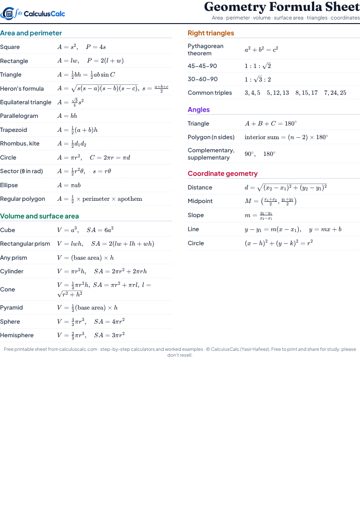
Geometry Formula Sheet
Area, perimeter, volume and surface area of every common shape and solid.
Download the Geometry Formula Sheet (PDF) Open in browserPractice problems
- Find the volume of a cube with edge 5.
- Find the volume of a cylinder with radius 2 and height 7 (exact).
- Find the volume of a cone with radius 6 and height 10 (exact).
- Find the volume and surface area of a sphere of radius 3 (exact).
- A box is 10 cm × 4 cm × 5 cm. How many millilitres does it hold?
- Find the volume of a square pyramid with base side 9 and height 10.
Answers: (1) 125; (2) ( 28pi ); (3) ( 120pi ); (4) ( V = 36pi ), ( SA = 36pi ); (5) 200 mL; (6) 270.

FAQ
What is the formula for volume?
For prisms and cylinders, base area × height. For pyramids and cones, one third of that. However, for a sphere, ( frac43pi r^3 ).
What is the volume of a cylinder?
( V = pi r^2h ).
What is the volume of a cone?
( V = frac13pi r^2h ).
What is the volume of a pyramid?
( V = frac13 times text{base area} times h ).
What is the difference between volume and surface area?
Volume is the space inside (cubic units); surface area is the area covering the outside (square units).
Further reading
- Volume (Wikipedia) — formulas, units and history.
- Surface area (Wikipedia) — surface area formulas and derivations.
Calculators for this topic
Keep learning

Pythagorean Theorem: Formula, Proof and Examples
The Pythagorean theorem a² + b² = c² explained: finding the hypotenuse or a leg, a visual proof, Pythagorean triples, the converse, 3D and real-world examples.
Area Formulas for Every Shape (with Examples)
Area formulas for squares, rectangles, triangles, parallelograms, trapezoids, rhombuses, circles, sectors and ellipses, why each works, and worked examples.