


Velocity measures position change, including direction. The average velocity formula is (= frac{Delta x}{Delta t}), in m/s. Acceleration is how velocity changes. Average acceleration is (= frac{Delta v}{Delta t}), in m/s². Displacement is position change, (= Delta x = x_f – x_i). It’s a straight-line distance with direction. In calculus, velocity is the position derivative, (= v = frac{dx}{dt}). Also, acceleration is the velocity derivative, (= a = frac{dv}{dt}).
These three quantities describe every kind of motion, from a falling apple to a rocket. This guide gives precise definitions, every formula you’ll need (average and instantaneous), how to read motion graphs, and fully worked examples you can check with the calculator below.
Definitions at a glance
| Quantity | Meaning | Formula | SI unit | Vector? |
|---|---|---|---|---|
| Position ( x ) | where the object is | measured from an origin | m | yes |
| Displacement ( Delta x ) | change in position | ( x_f – x_i ) | m | yes |
| Distance | total path length travelled | sum of all path pieces | m | no |
| Velocity ( v ) | rate of change of position | ( frac{Delta x}{Delta t} ) or ( frac{dx}{dt} ) | m/s | yes |
| Speed | how fast, ignoring direction | ( lvert vrvert ) | m/s | no |
| Acceleration ( a ) | rate of change of velocity | ( frac{Delta v}{Delta t} ) or ( frac{dv}{dt} ) | m/s² | yes |
A vector has a direction as well as a size. In one dimension, the direction is simply the sign: positive one way, negative the other.

What is displacement?
Displacement is how far an object ends up from where it started, in a straight line, with a direction:

$$Delta x = x_f - x_i$$
If you walk 3 m east and then 5 m west, your distance is 8 m, but your displacement is ( -2 ) m (2 m west). A runner who completes one lap of a 400 m track has run a distance of 400 m and a displacement of 0.
What is velocity?
Velocity tells you how fast an object’s position changes and in which direction.

Average velocity formula
$$v_{text{avg}} = frac{Delta x}{Delta t} = frac{x_f - x_i}{t_f - t_i}$$
Example 1. A cyclist is at ( x = 20 ) m at ( t = 2 ) s and at ( x = 80 ) m at ( t = 8 ) s. Her average velocity is ( frac{80 – 20}{8 – 2} = frac{60}{6} = 10 ) m/s.
Average velocity is displacement over time, while average speed is distance over time. For the walk above (8 m of walking that took 10 s), average speed is 0.8 m/s but average velocity is ( -0.2 ) m/s.
Instantaneous velocity
The speedometer reading at one moment is the instantaneous velocity. You get it by shrinking the time interval to zero, which is exactly the definition of the derivative:
$$v(t) = lim_{Delta tto0}frac{x(t + Delta t) - x(t)}{Delta t} = frac{dx}{dt}$$
On a position-time graph, average velocity is the slope of a secant line and instantaneous velocity is the slope of the tangent line (see the equation of a tangent line).
What is acceleration?
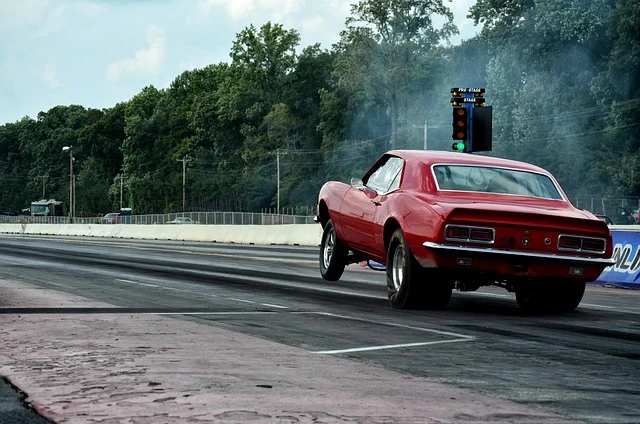
Acceleration is how quickly velocity changes. For example, speeding up, slowing down and changing direction are all acceleration.
Average acceleration formula
$$a_{text{avg}} = frac{Delta v}{Delta t} = frac{v_f - v_i}{t_f - t_i}$$
Example 2. A car goes from 5 m/s to 25 m/s in 4 s: ( a = frac{25 – 5}{4} = 5 ) m/s². That means its velocity grows by 5 m/s every second.
Example 3. A ball rolling at 6 m/s stops in 3 s: ( a = frac{0 – 6}{3} = -2 ) m/s². Negative acceleration here means slowing down, often called deceleration.
Instantaneous acceleration
$$a(t) = frac{dv}{dt} = frac{d^2x}{dt^2}$$
Acceleration is the second derivative of position. Near Earth’s surface, a falling object (ignoring air) has constant acceleration ( g approx 9.81 ) m/s² downward.
Speeding up or slowing down?
Compare the signs of velocity and acceleration:
| ( v ) | ( a ) | Motion |
|---|---|---|
| ( + ) | ( + ) | moving forward, speeding up |
| ( + ) | ( – ) | moving forward, slowing down |
| ( – ) | ( – ) | moving backward, speeding up |
| ( – ) | ( + ) | moving backward, slowing down |
Same signs mean speeding up; opposite signs mean slowing down.
Using calculus: from position to velocity to acceleration
When position is given as a formula, differentiate once for velocity and twice for acceleration.
Example 4. A particle moves along a line with ( x(t) = t^3 – 6t^2 + 9t ) metres.
$$v(t) = 3t^2 - 12t + 9, qquad a(t) = 6t - 12$$
At ( t = 2 ): ( x(2) = 8 – 24 + 18 = 2 ) m, ( v(2) = 12 – 24 + 9 = -3 ) m/s, and ( a(2) = 0 ).
When is it at rest? Set ( v(t) = 0 ): ( 3(t^2 – 4t + 3) = 3(t – 1)(t – 3) = 0 ), so ( t = 1 ) s and ( t = 3 ) s. Between those times ( v < 0 ), so the particle moves backward.
Total distance from ( t = 0 ) to ( t = 3 ). Positions: ( x(0) = 0 ), ( x(1) = 4 ), ( x(3) = 0 ). It goes 4 m forward and 4 m back, so the distance is 8 m even though the displacement is 0. Finding where ( v = 0 ) first is the key step; it’s the same method as finding critical points.
Check this example below: enter any position function ( s(t) ) and a time.
The position, velocity and acceleration calculator has a full-page version.
Going backwards with integrals
Integrating reverses the process. Displacement is the integral of velocity, and the change in velocity is the integral of acceleration:
$$Delta x = int_{t_1}^{t_2} v(t),dt, qquad Delta v = int_{t_1}^{t_2} a(t),dt$$
For total distance, integrate the speed ( lvert v(t)rvert ) instead. This is the Fundamental Theorem of Calculus applied to motion.
Motion graphs
Position-time graph
- Slope = velocity. A straight line means constant velocity; a steeper line means faster.
- A horizontal line means the object is at rest.
- A curve means the velocity is changing (acceleration). Curving upward (concave up) means positive acceleration.
Velocity-time graph
- Slope = acceleration.
- Area under the graph = displacement. Area below the time axis counts as negative.
- Where the graph crosses the time axis, the object changes direction.
Example 5. A car accelerates uniformly from rest to 20 m/s in 10 s. The velocity-time graph is a straight line; its slope is ( 2 ) m/s². Also, the triangle under it has area ( frac12 times 10 times 20 = 100 ) m, which is the displacement.

Acceleration-time graph
- Area under the graph = change in velocity.
- For free fall, it’s a horizontal line at ( -9.81 ) m/s² (with up as positive).
| Graph | Slope gives | Area gives |
|---|---|---|
| position vs time | velocity | (not used) |
| velocity vs time | acceleration | displacement |
| acceleration vs time | jerk | change in velocity |
Constant acceleration: the kinematic equations
When acceleration is constant, five equations connect displacement, initial and final velocity, acceleration and time, for example ( v = u + at ) and ( s = ut + frac12at^2 ). They’re derived and solved in kinematic equations, with a SUVAT calculator. For motion in two dimensions, such as a thrown ball, see projectile motion.
Common mistakes
- Confusing speed and velocity. Speed is never negative; velocity can be.
- Confusing distance and displacement. A round trip has displacement 0.
- Thinking negative acceleration always means slowing down. It only does when velocity is positive.
- Thinking zero velocity means zero acceleration. At the top of a throw, ( v = 0 ) but ( a = -9.81 ) m/s².
- Mixing units. Convert km/h to m/s by dividing by 3.6: 72 km/h ( = 20 ) m/s.
Practice questions
- A runner goes from ( x = 10 ) m to ( x = 130 ) m in 15 s. Find her average velocity.
- A train slows from 30 m/s to 12 m/s in 6 s. Find its average acceleration.
- You walk 40 m north and then 10 m south. Find your distance and displacement.
- If ( x(t) = 4t^2 – 3t ), find ( v(2) ) and ( a(2) ).
- A velocity-time graph is a straight line from ( (0, 0) ) to ( (8, 16) ). Find the acceleration and the displacement over the 8 s.
- If ( v(t) = 3t^2 ) m/s, find the displacement from ( t = 0 ) to ( t = 2 ).
Answers: (1) 8 m/s; (2) ( -3 ) m/s²; (3) distance 50 m, displacement 30 m north; (4) ( v(2) = 13 ) m/s, ( a(2) = 8 ) m/s²; (5) ( 2 ) m/s², 64 m; (6) 8 m.

FAQ
What is the formula for velocity?
Average velocity is ( v = frac{Delta x}{Delta t} ), displacement divided by time. Instantaneous velocity, however, is the derivative of position, ( v = frac{dx}{dt} ).
What is the formula for acceleration?
Average acceleration is ( a = frac{Delta v}{Delta t} = frac{v_f – v_i}{t} ). Instantaneous acceleration is ( a = frac{dv}{dt} ), the second derivative of position.
What is the difference between speed and velocity?
Speed is how fast something moves. Velocity is speed with a direction, so it can be negative, and it changes when an object turns even at constant speed.
What is displacement in physics?
The change in position, ( x_f – x_i ): the straight-line distance from start to finish, with a direction.
Can an object have zero velocity and non-zero acceleration?
Yes. A ball thrown upward has zero velocity at its highest point, but gravity is still accelerating it downward at 9.81 m/s².
What does the area under a velocity-time graph represent?
Displacement. Area above the time axis is positive displacement; however, area below is negative.
Further reading
- 3.4 Motion with Constant Acceleration (OpenStax University Physics Volume 1) — position, displacement, velocity and constant-acceleration motion with worked problems.
- Velocity (Wikipedia) — definitions of average and instantaneous velocity and their relation to speed.
- Acceleration (Wikipedia) — average, instantaneous and centripetal acceleration.
Calculators for this topic
Keep learning

Projectile Motion: Equations, Range and Max Height
Projectile motion explained: velocity components, time of flight, range, maximum height and the parabolic path, with calculus derivations and examples.

Polar Coordinates and Polar Equations: Graphs, Area, Slope
Polar coordinates explained: polar-rectangular conversion, graphing polar equations (circles, cardioids, roses), slope, area and arc length.