
Kinematic Equations Calculator (SUVAT)
- Free
- No sign-up
- Works on phones
- Shows the working
 By Yasir Hafeez · Updated
This kinematic equations calculator solves constant-acceleration motion problems. To use it, enter any three of the five SUVAT quantities (displacement ( s ), initial velocity ( u ), final velocity ( v ), acceleration ( a ), time ( t )). Then leave the other two blank, and it finds them and tells you which equations it used.
It’s built for physics and calculus students working on free fall, braking, launches and other one-dimensional motion. Also, it’s free and needs no sign-up.
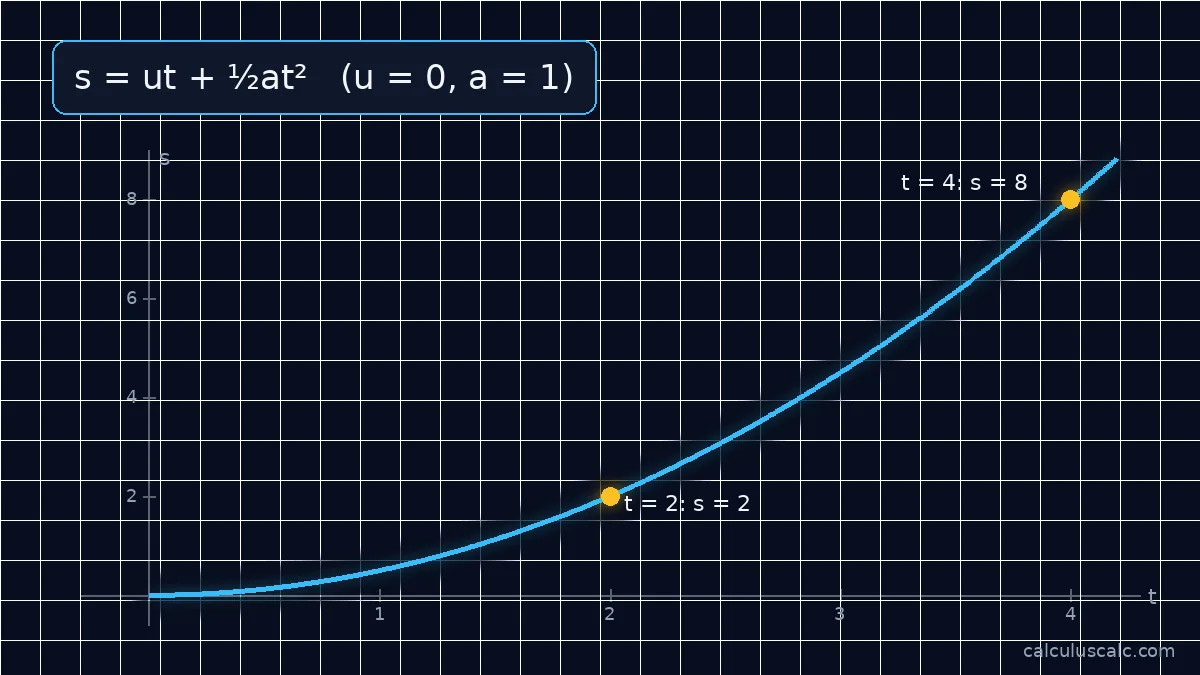
How to use the kinematic equations calculator
- Pick a positive direction (for example, down for a dropped object or forward for a car) and keep to it.
- Enter exactly three known values in metres, metres per second and seconds. Use a negative number for anything pointing the other way, such as braking acceleration.
- Leave the two unknowns blank.
- Press Solve. The table shows all five values. Also, the note lists the equations used.
The five kinematic equations
For motion in a straight line with constant acceleration:
$$v = u + at$$
$$s = ut + tfrac12at^2$$
$$v^2 = u^2 + 2as$$
$$s = tfrac12(u + v)t$$
$$s = vt - tfrac12at^2$$
Each equation leaves out one of the five quantities, so you choose the one missing the quantity you neither know nor want.
| Equation | Doesn’t contain |
|---|---|
| ( v = u + at ) | ( s ) |
| ( s = ut + frac12at^2 ) | ( v ) |
| ( v^2 = u^2 + 2as ) | ( t ) |
| ( s = frac12(u + v)t ) | ( a ) |
| ( s = vt – frac12at^2 ) | ( u ) |
Worked example: free fall
A stone is dropped from rest. How far does it fall in 3 seconds, and how fast is it going? Take down as positive, so ( u = 0 ), ( a = 9.81 ) m/s², ( t = 3 ) s.

$$v = 0 + 9.81 cdot 3 = 29.43 text{ m/s}$$
$$s = 0 + tfrac12(9.81)(3^2) = 44.145 text{ m}$$
These are the values in the calculator above.
Worked example: braking distance
A car brakes from some speed to a stop in 50 m with acceleration ( -4 ) m/s². What was its initial speed, and how long did braking take? Known: ( s = 50 ), ( v = 0 ), ( a = -4 ).

Initial speed. ( v^2 = u^2 + 2as ) gives ( 0 = u^2 – 400 ), so ( u = 20 ) m/s (72 km/h).
Time. ( t = frac{v – u}{a} = frac{0 – 20}{-4} = 5 ) s.
Worked example: finding acceleration
A cyclist speeds up from 5 m/s to 15 m/s in 4 s. Then ( a = frac{15 – 5}{4} = 2.5 ) m/s² and ( s = frac12(5 + 15)(4) = 40 ) m.
Tips and common mistakes
- Constant acceleration only. If the acceleration changes, these equations don’t apply. Use ( v(t) = int a(t),dt ) instead (see the position, velocity and acceleration calculator).
- Sign errors. Gravity is ( -9.81 ) if up is positive and ( +9.81 ) if down is positive.
- Mixed units. Convert km/h to m/s by dividing by 3.6 before you start.
- Two square roots. ( v^2 = u^2 + 2as ) gives ( pm ); choose the sign that matches the direction of motion. The calculator picks the one with non-negative time and says so.
Where the equations come from
They are calculus in disguise. Constant acceleration integrates to ( v(t) = u + at ). Integrating again gives ( s(t) = ut + frac12at^2 ). If you eliminate t between them, you get ( v^2 = u^2 + 2as ). The kinematic equations guide walks through each derivation. Also, the fundamental theorem of calculus explains why integrating velocity gives displacement.

Choosing the right equation
Each kinematic equation leaves out one of the five quantities. Pick the one without the quantity you neither know nor need:
| Equation | Missing |
|---|---|
| \( v = u + at \) | displacement \( s \) |
| \( s = ut + \frac{1}{2}at^2 \) | final velocity \( v \) |
| \( v^2 = u^2 + 2as \) | time \( t \) |
| \( s = \frac{u + v}{2}t \) | acceleration \( a \) |
| \( s = vt - \frac{1}{2}at^2 \) | initial velocity \( u \) |
Worked example: a ball thrown upward
A ball is thrown straight up at 15 m/s. Taking up as positive, \( a = -9.81 \) m/s².
- Maximum height (where \( v = 0 \)): \( 0 = 15^2 - 2 \times 9.81 \times s \), so \( s \approx 11.47 \) m.
- Time to the top: \( 0 = 15 - 9.81t \), so \( t \approx 1.53 \) s.
- Time back to the hand: twice that, about 3.06 s.
Worked example: total stopping distance
A car travels at 20 m/s (72 km/h). The driver reacts after 1.5 s, then brakes at 7 m/s².
- Reaction distance: \( 20 \times 1.5 = 30 \) m (no braking yet).
- Braking distance: \( 0 = 20^2 - 2 \times 7 \times s \), so \( s \approx 28.6 \) m.
- Total: about 58.6 m. Doubling the speed roughly quadruples the braking part.
Signs and units
Choose a positive direction and stick to it: velocities and accelerations in the opposite direction are negative. Convert km/h to m/s by dividing by 3.6. The equations only hold for constant acceleration; for changing acceleration, use calculus (see velocity and acceleration).
Common mistakes
- Using \( g = 9.81 \) as positive when up is positive (it should be −9.81).
- Mixing km/h and m/s in the same equation.
Free-fall quick facts
Ignoring air resistance, any object falls 4.9 m in the first second, 19.6 m in two seconds and 44.1 m in three.
Practice problems
- A car accelerates from rest at 3 m/s² for 6 s. How far does it go?
- A stone dropped from a bridge hits the water after 2.5 s. How high is the bridge?
- A cyclist slows from 12 m/s to 4 m/s over 32 m. What is the deceleration?
Answers: 1. \( \frac{1}{2} \times 3 \times 36 = 54 \) m. 2. \( \frac{1}{2} \times 9.81 \times 6.25 \approx 30.7 \) m. 3. \( (16 - 144)/(2 \times 32) = -2 \) m/s².
Step-by-Step Usage Guide
First, carefully read the problem. Identify what quantities you know and what you need to find. Remember the five SUVAT variables: displacement (s), initial velocity (u), final velocity (v), acceleration (a), and time (t).
Next, establish a consistent positive direction. For example, if an object falls, you might choose down as positive. If a car moves forward, forward is positive. All velocities, displacements, and accelerations must align with this chosen direction.
Then, convert all units to a consistent set, usually meters, seconds, and meters per second. Enter exactly three known values into the kinematic equations calculator. Use negative signs for quantities pointing opposite to your chosen positive direction. Leave the two unknown values blank. Finally, press the 'Solve' button.
The calculator will display all five values. It also lists the specific kinematic equations used to derive the unknowns. Review these equations to understand the calculation path. This structured approach helps prevent errors and ensures accurate results.
When a Different Method Fits Better
The kinematic equations are powerful, but they only apply when acceleration is constant. If acceleration changes over time, these equations are not suitable. In such cases, calculus provides the correct tools. You would integrate the acceleration function to find velocity, then integrate the velocity function to find displacement.
Sometimes, a problem involves multiple phases, each with constant but different acceleration. For example, a car accelerating, then cruising, then braking. You must solve each phase separately using the kinematic equations. The final velocity of one phase becomes the initial velocity for the next.
Furthermore, for motion in two or three dimensions (like projectile motion at an angle), you often need to resolve the motion into perpendicular components. Each component (horizontal and vertical) can then be analyzed using the kinematic equations independently, assuming constant acceleration within each dimension.
Related guides
- Kinematic Equations: The 5 SUVAT Formulas
- Projectile Motion
- Related Rates
- Fundamental Theorem of Calculus
Further reading
- 3.4 Motion with Constant Acceleration (OpenStax University Physics Volume 1) — the kinematic equations with worked problems.
- Equations of motion (Wikipedia) — the SUVAT equations and their calculus derivation.
FAQ
What are the kinematic equations?
( v = u + at ), ( s = ut + frac12at^2 ), ( v^2 = u^2 + 2as ), ( s = frac12(u + v)t ) and ( s = vt – frac12at^2 ), valid for constant acceleration.
How many values do I need?
Three. With any three of s, u, v, a and t, the other two are determined.
What does SUVAT stand for?
The five variables: s for displacement, u for initial velocity, v for final velocity, a for acceleration and t for time.
Can I use it for objects thrown upward?
Yes. For example, take up as positive, enter ( a = -9.81 ), and the launch speed as u. At the highest point ( v = 0 ).