


The unit circle (also called the trig circle) is the circle of radius 1 centered at the origin. The point at angle ( theta ) on it is ( (costheta, sintheta) ), and ( tantheta = frac{sintheta}{costheta} ) is the slope of that radius. Key points: ( frac{pi}{6} to left( frac{sqrt3}{2}, frac12 right) ), ( frac{pi}{4} to left( frac{sqrt2}{2}, frac{sqrt2}{2} right) ), ( frac{pi}{3} to left( frac12, frac{sqrt3}{2} right) ).
The unit circle is the circle of radius 1 centered at the origin, ( x^2 + y^2 = 1 ). It’s the single most useful picture in trigonometry, because it turns every angle into a point, and that point’s coordinates are the angle’s cosine and sine:
$$(x, y) = (costheta, sintheta)$$
Here ( theta ) is measured counterclockwise from the positive x-axis. Clockwise angles are negative.
Why the coordinates are cos and sin
Pick an angle ( theta ) in Quadrant I and drop a vertical line from the point on the circle to the x-axis. As a result, you get a right triangle with hypotenuse 1 (the radius), horizontal leg x and vertical leg y. By SOH-CAH-TOA,

$$costheta = frac{x}{1} = x, qquad sintheta = frac{y}{1} = y$$
For angles beyond ( 90^circ ) we simply define cosine and sine as the coordinates. That extends the trigonometric functions to every angle and gives the right signs automatically.
The special angles
The unit circle is usually drawn with 16 marked angles: the four axes plus three angles in each quadrant, based on ( 30^circ ), ( 45^circ ) and ( 60^circ ).
Quadrant I
| Degrees | Radians | Point ( (costheta, sintheta) ) |
|---|---|---|
| ( 0^circ ) | 0 | ( (1, 0) ) |
| ( 30^circ ) | ( frac{pi}{6} ) | ( left( frac{sqrt3}{2}, frac12 right) ) |
| ( 45^circ ) | ( frac{pi}{4} ) | ( left( frac{sqrt2}{2}, frac{sqrt2}{2} right) ) |
| ( 60^circ ) | ( frac{pi}{3} ) | ( left( frac12, frac{sqrt3}{2} right) ) |
| ( 90^circ ) | ( frac{pi}{2} ) | ( (0, 1) ) |
The other quadrants
Every other special angle has one of the Quadrant I angles as its reference angle, so its coordinates are the same numbers with signs changed.
| Quadrant II | Quadrant III | Quadrant IV |
|---|---|---|
| ( 120^circ = frac{2pi}{3} ): ( left( -frac12, frac{sqrt3}{2} right) ) | ( 210^circ = frac{7pi}{6} ): ( left( -frac{sqrt3}{2}, -frac12 right) ) | ( 300^circ = frac{5pi}{3} ): ( left( frac12, -frac{sqrt3}{2} right) ) |
| ( 135^circ = frac{3pi}{4} ): ( left( -frac{sqrt2}{2}, frac{sqrt2}{2} right) ) | ( 225^circ = frac{5pi}{4} ): ( left( -frac{sqrt2}{2}, -frac{sqrt2}{2} right) ) | ( 315^circ = frac{7pi}{4} ): ( left( frac{sqrt2}{2}, -frac{sqrt2}{2} right) ) |
| ( 150^circ = frac{5pi}{6} ): ( left( -frac{sqrt3}{2}, frac12 right) ) | ( 240^circ = frac{4pi}{3} ): ( left( -frac12, -frac{sqrt3}{2} right) ) | ( 330^circ = frac{11pi}{6} ): ( left( frac{sqrt3}{2}, -frac12 right) ) |
| ( 180^circ = pi ): ( (-1, 0) ) | ( 270^circ = frac{3pi}{2} ): ( (0, -1) ) | ( 360^circ = 2pi ): ( (1, 0) ) |
How to memorize the unit circle
- Learn only Quadrant I. Everything else is a reflection.
- Use the root pattern. Going from ( 0^circ ) to ( 90^circ ), the y-coordinates are ( frac{sqrt0}{2}, frac{sqrt1}{2}, frac{sqrt2}{2}, frac{sqrt3}{2}, frac{sqrt4}{2} ), and the x-coordinates are the same list in reverse.
- Remember the shape. At ( 30^circ ) the point is low and wide, so x is the big one, ( frac{sqrt3}{2} ). At ( 60^circ ) it’s tall and narrow, so y is the big one.
- Signs by quadrant. x is negative on the left, y is negative at the bottom.
- Count radians by denominator. Angles with denominator 6 are ( 30^circ )-family, denominator 4 are ( 45^circ )-family, and denominator 3 are ( 60^circ )-family.
Tangent on the unit circle
Since ( tantheta = frac{sintheta}{costheta} ), tangent is ( frac{y}{x} ), the slope of the radius drawn at angle ( theta ).
There’s also a geometric picture behind the name: draw the vertical line ( x = 1 ), which is tangent to the circle at ( (1, 0) ). Extend the radius until it meets that line. The height of the meeting point is exactly ( tantheta ). That’s why tangent blows up near ( 90^circ ): the radius becomes nearly vertical and never reaches the tangent line.
| Angle | ( tantheta = frac{y}{x} ) |
|---|---|
| ( 0 ) | 0 |
| ( frac{pi}{6} ) | ( frac{1/2}{sqrt3/2} = frac{sqrt3}{3} ) |
| ( frac{pi}{4} ) | 1 |
| ( frac{pi}{3} ) | ( sqrt3 ) |
| ( frac{pi}{2} ) | undefined (( x = 0 )) |
Worked examples
Example 1: ( sinfrac{5pi}{6} ). ( frac{5pi}{6} = 150^circ ), Quadrant II, reference angle ( 30^circ ). The point is ( left( -frac{sqrt3}{2}, frac12 right) ), so ( sinfrac{5pi}{6} = frac12 ).

Example 2: ( cosfrac{4pi}{3} ). ( 240^circ ), Quadrant III, reference angle ( 60^circ ). The point is ( left( -frac12, -frac{sqrt3}{2} right) ), so ( cosfrac{4pi}{3} = -frac12 ).
Example 3: ( tanfrac{7pi}{4} ). ( 315^circ ), Quadrant IV: ( frac{-sqrt2/2}{sqrt2/2} = -1 ).
Example 4: negative and large angles. ( -frac{pi}{3} ) is ( 60^circ ) clockwise, the same point as ( frac{5pi}{3} ), so ( sinleft(-frac{pi}{3}right) = -frac{sqrt3}{2} ). And ( frac{13pi}{6} = 2pi + frac{pi}{6} ) lands where ( frac{pi}{6} ) does, so ( cosfrac{13pi}{6} = frac{sqrt3}{2} ). Adding or subtracting full turns of ( 2pi ) never changes the point.
Example 5: solving an equation. Solve ( costheta = -frac{sqrt2}{2} ) for ( 0 le theta < 2pi ). Look for points with x-coordinate ( -frac{sqrt2}{2} ): ( theta = frac{3pi}{4} ) and ( theta = frac{5pi}{4} ).
Unit circle calculator
Enter any angle in degrees or radians to see its point on the unit circle, quadrant, reference angle and all six trig values.
The full trig calculator has more examples.
What the unit circle explains
- The Pythagorean identity. Every point satisfies ( x^2 + y^2 = 1 ), so ( cos^2theta + sin^2theta = 1 ). See trig identities.
- Ranges. Coordinates on the circle never exceed 1 in size, so ( -1 le sintheta le 1 ) and ( -1 le costheta le 1 ).
- Periodicity. After ( 2pi ) you’re back where you started, so sine and cosine repeat every ( 2pi ).
- Symmetry. Reflecting across the x-axis gives ( cos(-theta) = costheta ) and ( sin(-theta) = -sintheta ).
- Radians. An angle of 1 radian cuts off an arc of length 1 on the unit circle, so the full circumference ( 2pi ) corresponds to ( 360^circ ).
The unit circle in calculus
Calculus works in radians because of the unit circle. The arc of angle ( theta ) has length ( theta ), which is why ( sintheta approx theta ) for small angles and ( lim_{thetato0}frac{sintheta}{theta} = 1 ) (see the limit of sin x / x). That limit is what makes the derivative of sin x equal ( cos x ).
Common mistakes
- Swapping x and y. Cosine is the x-coordinate; sine is the y-coordinate. Alphabetical order helps: (c, s) like (x, y).
- Mixing ( 30^circ ) and ( 60^circ ) values. At ( 30^circ ), sine is the small one, ( frac12 ).
- Forgetting signs. Find the reference value, then fix the sign by quadrant.
- Measuring clockwise. Positive angles go counterclockwise.
Printable formula sheet
Print the whole unit circle on one page to keep beside your notes.
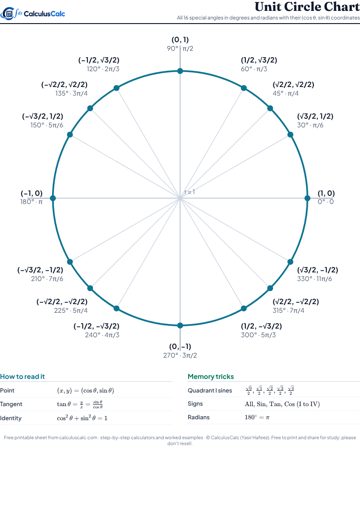
Unit Circle Chart
All 16 special angles in degrees and radians with their coordinates.
Download the Unit Circle Chart (PDF) Open in browserPractice problems
- Find ( cosfrac{2pi}{3} ).
- Find ( sinfrac{7pi}{6} ).
- Find ( tanfrac{5pi}{3} ).
- Find the point on the unit circle at ( 225^circ ).
- Solve ( sintheta = frac{sqrt3}{2} ) for ( 0 le theta < 2pi ).
- Find ( cosleft(-frac{3pi}{4}right) ).
Answers: (1) ( -frac12 ); (2) ( -frac12 ); (3) ( -sqrt3 ); (4) ( left( -frac{sqrt2}{2}, -frac{sqrt2}{2} right) ); (5) ( frac{pi}{3}, frac{2pi}{3} ); (6) ( -frac{sqrt2}{2} ).
FAQ
What is the unit circle?
The circle of radius 1 centered at the origin. The point at angle ( theta ) on it has coordinates ( (costheta, sintheta) ).
How do you find tangent on the unit circle?
Divide the y-coordinate by the x-coordinate: ( tantheta = frac{y}{x} ). Also, it’s the slope of the radius at that angle.
Why is it called the unit circle?
Because its radius is one unit. That makes the hypotenuse 1, so the coordinates equal cosine and sine directly.
How many angles are on the unit circle?
Infinitely many, but the standard diagram shows 16 special angles whose trig values are exact.
Do I need to memorize the unit circle?
Memorize Quadrant I and the sign pattern; the rest follows by symmetry. It’s worth it, because calculus uses these values constantly.
Further reading
- Unit circle (Wikipedia) — definitions, trigonometric functions on the circle and complex numbers.
- Calculus I Review chapter (Paul’s Online Math Notes) — using the unit circle to evaluate trig functions.
Calculators for this topic
Keep learning
Trigonometric Functions: Sin, Cos, Tan, Table and Graphs
The six trig functions with SOH-CAH-TOA and the unit circle, a table of exact values (sin 30, cos 180, sec 45), graphs, period and amplitude.

Trig Identities: Full List with Double Angle Formulas
Every trig identity you need: Pythagorean, reciprocal, sum and difference, double angle and half angle formulas, with proofs and worked examples.