


The most important trig identities are the Pythagorean identity ( sin^2theta + cos^2theta = 1 ) (and ( 1 + tan^2theta = sec^2theta )), the sum formulas ( sin(A pm B) = sin Acos B pm cos Asin B ) and ( cos(A pm B) = cos Acos B mp sin Asin B ), and the double angle formulas ( sin 2theta = 2sinthetacostheta ) and ( cos 2theta = cos^2theta – sin^2theta = 1 – 2sin^2theta = 2cos^2theta – 1 ).
A trig identity is an equation involving trigonometric functions that is true for every angle where both sides are defined. Identities let you rewrite an expression in a more useful form: to simplify it, to solve an equation, or, in calculus, to turn an integral you can’t do into one you can.
This page lists the identities you need, shows where the most important ones come from, and works through examples.
Reciprocal and quotient identities
$$csctheta = frac{1}{sintheta}, qquad sectheta = frac{1}{costheta}, qquad cottheta = frac{1}{tantheta}$$
$$tantheta = frac{sintheta}{costheta}, qquad cottheta = frac{costheta}{sintheta}$$
Pythagorean identities
$$sin^2theta + cos^2theta = 1$$
$$1 + tan^2theta = sec^2theta$$
$$1 + cot^2theta = csc^2theta$$
Proof. On the unit circle, the point at angle ( theta ) is ( (costheta, sintheta) ) and satisfies ( x^2 + y^2 = 1 ). That’s the first identity. Divide it by ( cos^2theta ) to get the second, and by ( sin^2theta ) to get the third.
Even-odd identities
$$sin(-theta) = -sintheta, qquad cos(-theta) = costheta, qquad tan(-theta) = -tantheta$$
Cosine is even (its graph is symmetric about the y-axis); sine and tangent are odd.
Cofunction identities
$$sinleft( tfrac{pi}{2} - theta right) = costheta, qquad cosleft( tfrac{pi}{2} - theta right) = sintheta, qquad tanleft( tfrac{pi}{2} - theta right) = cottheta$$
In a right triangle, the two acute angles add to ( 90^circ ), and the side opposite one is adjacent to the other. That’s where the “co” in cosine comes from: the sine of the complementary angle.
Sum and difference formulas
$$sin(A pm B) = sin Acos B pm cos Asin B$$
$$cos(A pm B) = cos Acos B mp sin Asin B$$
$$tan(A pm B) = frac{tan A pm tan B}{1 mp tan Atan B}$$
Note the sign flip in the cosine formula: ( cos(A + B) ) has a minus.
Example 1: exact value of ( sin 75^circ ). Write ( 75^circ = 45^circ + 30^circ ):
$$sin 75^circ = frac{sqrt2}{2}cdotfrac{sqrt3}{2} + frac{sqrt2}{2}cdotfrac12 = frac{sqrt6 + sqrt2}{4} approx 0.9659$$
Example 2: ( cos 15^circ ). ( 15^circ = 45^circ – 30^circ ):
$$cos 15^circ = frac{sqrt2}{2}cdotfrac{sqrt3}{2} + frac{sqrt2}{2}cdotfrac12 = frac{sqrt6 + sqrt2}{4}$$
the same number as ( sin 75^circ ), as the cofunction identity predicts.
Double angle identities
Set ( A = B = theta ) in the sum formulas:
$$sin 2theta = 2sinthetacostheta$$
$$cos 2theta = cos^2theta - sin^2theta = 2cos^2theta - 1 = 1 - 2sin^2theta$$
$$tan 2theta = frac{2tantheta}{1 - tan^2theta}$$
The three forms of ( cos 2theta ) come from replacing ( sin^2theta ) or ( cos^2theta ) using the Pythagorean identity. Choose whichever form fits the problem.
Example 3. If ( sintheta = frac35 ) and ( theta ) is in Quadrant I, then ( costheta = frac45 ), so
$$sin 2theta = 2cdotfrac35cdotfrac45 = frac{24}{25}, qquad cos 2theta = frac{16}{25} - frac{9}{25} = frac{7}{25}$$
Power-reducing (half-angle) identities
Solve the last two forms of ( cos 2theta ) for the squares:
$$sin^2theta = frac{1 - cos 2theta}{2}, qquad cos^2theta = frac{1 + cos 2theta}{2}$$
Replacing ( theta ) by ( frac{theta}{2} ) gives the half-angle formulas:
$$sinfrac{theta}{2} = pmsqrt{frac{1 - costheta}{2}}, qquad cosfrac{theta}{2} = pmsqrt{frac{1 + costheta}{2}}$$
with the sign set by the quadrant of ( frac{theta}{2} ).
Product-to-sum identities
$$sin Acos B = tfrac12left[ sin(A + B) + sin(A - B) right]$$
$$cos Acos B = tfrac12left[ cos(A - B) + cos(A + B) right]$$
$$sin Asin B = tfrac12left[ cos(A - B) - cos(A + B) right]$$
Check any angle
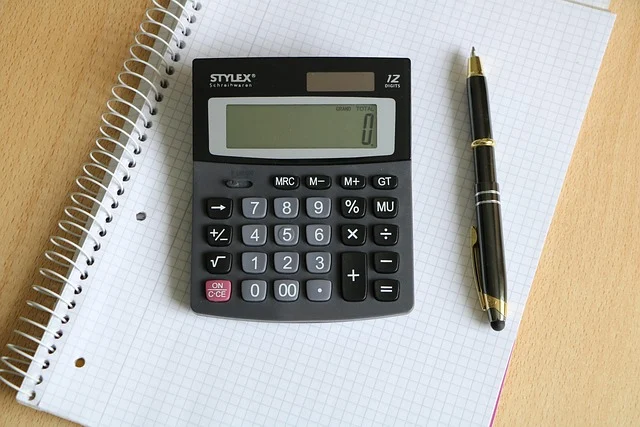
Use the calculator to confirm an identity numerically. It’s set to ( 75^circ ): the sine it shows, 0.96592583, matches ( frac{sqrt6 + sqrt2}{4} ) from Example 1. Try ( 15^circ ) to check that ( cos 15^circ ) is the same number.
The full trig calculator shows all six functions for any angle.
How to prove an identity
- Work on one side only, usually the more complicated one.
- Rewrite everything in terms of sine and cosine.
- Combine fractions, factor, and look for ( sin^2 + cos^2 ).
- Stop when that side matches the other.
Example 4. Prove ( tantheta + cottheta = secthetacsctheta ).

$$frac{sintheta}{costheta} + frac{costheta}{sintheta} = frac{sin^2theta + cos^2theta}{sinthetacostheta} = frac{1}{sinthetacostheta} = secthetacsctheta$$
Example 5. Prove ( frac{1 – cos 2x}{sin 2x} = tan x ).
$$frac{1 - (1 - 2sin^2 x)}{2sin xcos x} = frac{2sin^2 x}{2sin xcos x} = frac{sin x}{cos x} = tan x$$
Solving equations with identities
Example 6. Solve ( sin 2x = sin x ) for ( 0 le x < 2pi ).
Use the double angle identity: ( 2sin xcos x – sin x = 0 ), so ( sin x(2cos x – 1) = 0 ). Either ( sin x = 0 ), giving ( x = 0, pi ), or ( cos x = frac12 ), giving ( x = frac{pi}{3}, frac{5pi}{3} ). Don’t divide by ( sin x ); you’d lose the solutions ( 0 ) and ( pi ).
Trig identities in calculus
- Integrals of powers. ( int sin^2 x,dx ) is impossible as written but easy after power reduction: ( int frac{1 – cos 2x}{2},dx = frac{x}{2} – frac{sin 2x}{4} + C ). See the integral of sin²x.
- Derivatives. The proof that the derivative of sin x is ( cos x ) starts with the sum formula. The derivative of cos²x simplifies to ( -sin 2x ).
- Trig substitution. ( 1 – sin^2theta = cos^2theta ) removes square roots, as in the integral of √(1 − x²).
- ( tan^2 x ) integrals. Rewrite as ( sec^2 x – 1 ); see the integral of sec²x.
Common mistakes
- ( sin 2x neq 2sin x ). The double angle formula is ( 2sin xcos x ).
- ( sin(A + B) neq sin A + sin B ). Use the sum formula.
- Sign in ( cos(A + B) ). It’s ( cos Acos B – sin Asin B ).
- Working on both sides at once when proving an identity. That assumes what you’re trying to prove.
- Dividing by a trig function when solving. Factor instead.
Printable formula sheet
Every identity on this page, plus the exact-value table, fits on one printable page.
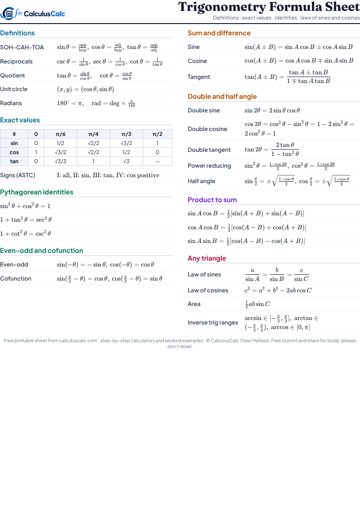
Trig Identities Formula Sheet
Pythagorean, sum and difference, double-angle, half-angle and product identities, exact values and the laws of sines and cosines.
Download the Trig Identities Formula Sheet (PDF) Open in browserPractice problems
- Simplify ( sin^2 x + cos^2 x + tan^2 x ).
- Find the exact value of ( cos 75^circ ).
- If ( costheta = frac{5}{13} ) in Quadrant I, find ( sin 2theta ).
- Simplify ( frac{sin 2x}{sin x} ).
- Write ( cos^2 x ) without a square.
- Solve ( cos 2x = cos x ) for ( 0 le x < 2pi ).
Answers: (1) ( sec^2 x ); (2) ( frac{sqrt6 – sqrt2}{4} ); (3) ( frac{120}{169} ); (4) ( 2cos x ); (5) ( frac{1 + cos 2x}{2} ); (6) ( x = 0, frac{2pi}{3}, frac{4pi}{3} ).
FAQ
What are the basic trig identities?
The reciprocal identities, the quotient identities ( tan = frac{sin}{cos} ), and the Pythagorean identity ( sin^2theta + cos^2theta = 1 ).
What is the double angle formula?
( sin 2theta = 2sinthetacostheta ) and ( cos 2theta = cos^2theta – sin^2theta ), which can also be written ( 2cos^2theta – 1 ) or ( 1 – 2sin^2theta ).
How many trig identities are there?
Infinitely many can be derived, but about 20 core identities, the ones on this page, cover almost every problem.
Which trig identities should I memorize?
( sin^2theta + cos^2theta = 1 ), the sum formulas for sine and cosine, and the double angle formulas. Almost everything else can be derived from those in a line or two.
Why are trig identities important in calculus?
They turn integrals and limits into forms the standard rules can handle, especially integrals of powers of sine and cosine.
Further reading
- List of trigonometric identities (Wikipedia) — an exhaustive reference with proofs.
- Cheat Sheets and Tables (Paul’s Online Math Notes) — a printable trig cheat sheet of definitions, values and identities.
Calculators for this topic
Keep learning

The Unit Circle: Angles, Coordinates and Trig Values
The unit circle explained: why the coordinates are cos and sin, every special angle in degrees and radians, tangent on the unit circle, and memory tricks.
Trigonometric Functions: Sin, Cos, Tan, Table and Graphs
The six trig functions with SOH-CAH-TOA and the unit circle, a table of exact values (sin 30, cos 180, sec 45), graphs, period and amplitude.