
Increasing and Decreasing Intervals Calculator
- Free
- No sign-up
- Works on phones
- Shows the working
 By Yasir Hafeez · Updated
This increasing and decreasing intervals calculator tells you where a function rises and where it falls, using the sign of its derivative. It also finds where the graph is concave up or concave down from the second derivative. Enter the function and the window of x-values to look at; the result is a sign chart with the intervals written in interval notation.
It’s free and needs no sign-up.
How to use it
- Type the function, for example
x^3 - 3x,x*e^(-x)or1/x. - Enter the window: from x = a to x = b. Pick a window wide enough to include the interesting behaviour.
- Press Find intervals.
The calculator splits the window at critical points (where ( f'(x) = 0 )) and at any points where f is undefined, then tests the sign of ( f’ ) on each piece.
The rule
- If ( f'(x) > 0 ) on an interval, f is increasing there.
- Next, if ( f'(x) < 0 ) on an interval, f is decreasing there.
- If ( f”(x) > 0 ), the graph is concave up (shaped like a cup); if ( f”(x) < 0 ), it is concave down.
The sign of ( f’ ) can only change at a critical point or where f or ( f’ ) is undefined. So you find those points, then test one value in each interval between them.
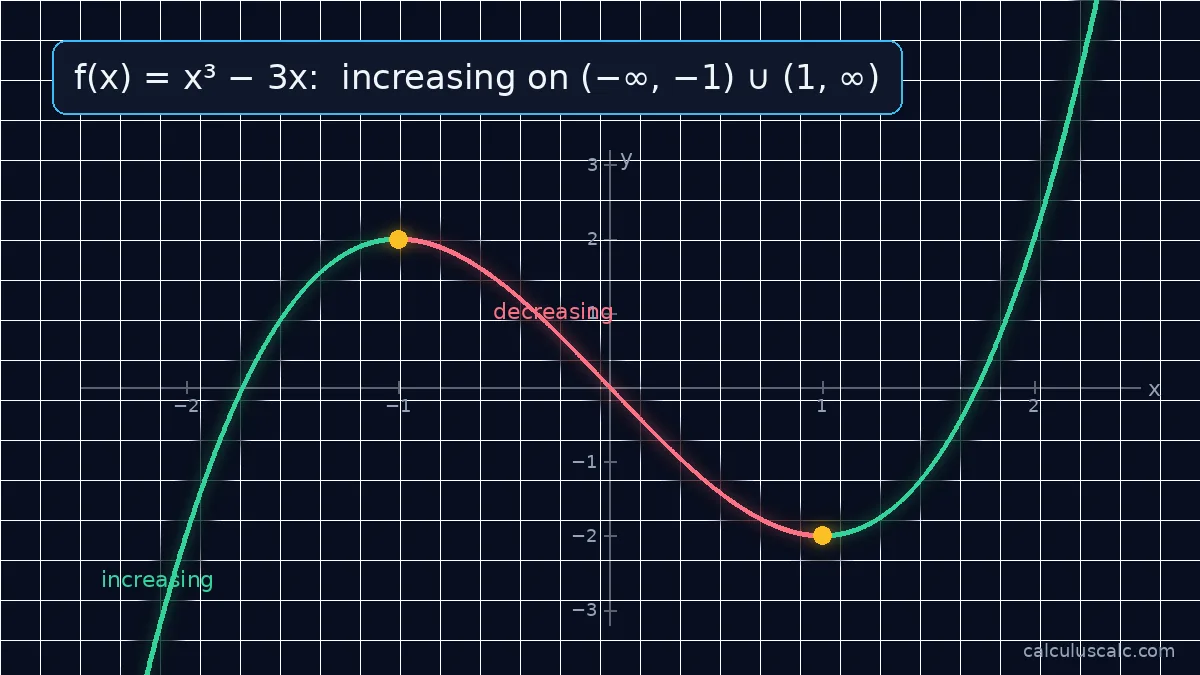
Worked example: f(x) = x³ − 3x
Step 1. Differentiate: ( f'(x) = 3x^2 – 3 = 3(x – 1)(x + 1) ).
Step 2. Solve ( f'(x) = 0 ): the critical points are ( x = -1 ) and ( x = 1 ).
Step 3. Test one point in each interval:
| Interval | Test x | Sign of ( f'(x) ) | f is |
|---|---|---|---|
| ( (-infty, -1) ) | −2 | ( 3(4) – 3 = 9 > 0 ) | increasing |
| ( (-1, 1) ) | 0 | ( -3 < 0 ) | decreasing |
| ( (1, infty) ) | 2 | ( 9 > 0 ) | increasing |
So f is increasing on ( (-infty, -1) cup (1, infty) ) and decreasing on ( (-1, 1) ). That makes ( x = -1 ) a local maximum and ( x = 1 ) a local minimum.
Concavity. ( f”(x) = 6x ), negative for ( x < 0 ) and positive for ( x > 0 ). The graph is concave down on ( (-infty, 0) ) and concave up on ( (0, infty) ), with an inflection point at the origin.
Worked example: f(x) = 1/x
( f'(x) = -frac{1}{x^2} ) is negative everywhere it exists. The function is decreasing on ( (-infty, 0) ) and on ( (0, infty) ), but you must write these as two separate intervals: ( f(-1) = -1 ) is less than ( f(1) = 1 ), so f is not decreasing across 0. The calculator keeps the intervals separate at every point where f is undefined.

Worked example: x·e^(−x)
( f'(x) = e^{-x} – xe^{-x} = (1 – x)e^{-x} ). Since ( e^{-x} > 0 ), the sign is the sign of ( 1 – x ): increasing on ( (-infty, 1) ), decreasing on ( (1, infty) ), with a maximum at ( x = 1 ). And ( f”(x) = (x – 2)e^{-x} ) gives concave down on ( (-infty, 2) ) and concave up on ( (2, infty) ).
using an increasing and decreasing intervals calculator
Most textbooks write increasing and decreasing intervals with open brackets, because the derivative is zero at the endpoints. Some courses accept closed brackets at critical points where f is defined. Never include a point where f itself is undefined.

Common mistakes
- Joining intervals across a break in the domain, as in the 1/x example.
- Testing the sign of f instead of f′. A function can be negative and increasing at the same time.
- Only checking where f′ = 0. Points where ( f’ ) is undefined (corners, cusps, vertical asymptotes) also split the intervals.
Step-by-step method
- Find the domain of f, noting any points where it is undefined.
- Compute ( f'(x) ).
- Find the critical points: where ( f'(x) = 0 ) and where ( f'(x) ) is undefined but f is defined.
- Mark these points (and any domain breaks) on a number line, splitting it into intervals.
- Pick a test value in each interval and find the sign of ( f'(x) ).
- Write the intervals where ( f’ > 0 ) (increasing) and ( f’ < 0 ) (decreasing).
- Repeat with ( f”(x) ) for concavity.
Worked example: f(x) = x⁴ − 2x²
( f'(x) = 4x^3 – 4x = 4x(x – 1)(x + 1) ), so the critical points are ( -1 ), 0 and 1.
| Interval | Test x | Sign of ( f’ ) | f is |
|---|---|---|---|
| ( (-infty, -1) ) | −2 | − | decreasing |
| ( (-1, 0) ) | −0.5 | + | increasing |
| ( (0, 1) ) | 0.5 | − | decreasing |
| ( (1, infty) ) | 2 | + | increasing |
So f has local minima at ( x = pm 1 ) (value −1) and a local maximum at ( x = 0 ) (value 0). For concavity, ( f”(x) = 12x^2 – 4 = 0 ) at ( x = pmfrac{1}{sqrt{3}} = pmfrac{sqrt{3}}{3} ): concave up outside these points, concave down between them.
Worked example: a cusp
( f(x) = x^{2/3} ) has ( f'(x) = frac{2}{3x^{1/3}} ), which is undefined at ( x = 0 ) even though ( f(0) = 0 ) is defined. So 0 is a critical point: f decreases on ( (-infty, 0) ) and increases on ( (0, infty) ), with a sharp minimum (a cusp) at the origin. The calculator detects critical points like this as well as the ones where ( f’ = 0 ).

The first and second derivative tests
- First derivative test: if ( f’ ) changes from + to − at a critical point, it is a local maximum; from − to +, a local minimum; no change, neither.
- Second derivative test: at a critical point with ( f'(c) = 0 ), if ( f”(c) > 0 ) it is a local minimum and if ( f”(c) < 0 ) a local maximum. If ( f”(c) = 0 ), the test is inconclusive; use the first derivative test.
Practice problems
- ( f(x) = x^2 – 6x + 5 ).
- ( f(x) = x^3 ).
- ( f(x) = ln x ).
Answers: 1. ( f'(x) = 2x – 6 ): decreasing on ( (-infty, 3) ), increasing on ( (3, infty) ). 2. ( f'(x) = 3x^2 ge 0 ): increasing on ( (-infty, infty) ); ( x = 0 ) is a critical point but not a turning point. 3. ( f'(x) = frac{1}{x} > 0 ) on the domain ( (0, infty) ), so increasing there; ( f”(x) = -frac{1}{x^2} < 0 ), so concave down.
Related guides
Further reading
- Monotonic function (Wikipedia) — increasing and decreasing functions and the derivative test.
FAQ
How do you find where a function is increasing?
Find ( f'(x) ), solve ( f'(x) = 0 ) and note where ( f’ ) is undefined, then test a point in each interval. Wherever ( f’ > 0 ), the function is increasing.
What does concave up mean?
The graph bends upward like a cup, and its slope is increasing. It happens where ( f”(x) > 0 ).
Can a function be increasing and concave down?
Yes. ( sqrt{x} ) is increasing for ( x > 0 ) but its slope keeps getting smaller, so it is concave down.
Is a function increasing at a critical point?
At a single point the derivative is zero, so most courses exclude it. Use open intervals unless your teacher says otherwise.
What is a critical point?
A point in the domain of f where ( f'(x) = 0 ) or ( f'(x) ) does not exist. Local maxima and minima can only occur at critical points.
What is an inflection point?
A point where the concavity changes, from up to down or down to up. It happens where ( f” ) changes sign; see how to find inflection points.