
Implicit Differentiation Calculator (dy/dx with Steps)
- Free
- No sign-up
- Works on phones
- Shows the working
 By Yasir Hafeez · Updated
This implicit differentiation calculator finds ( frac{dy}{dx} ) for curves that are not written as ( y = f(x) ), such as circles, ellipses and the folium of Descartes. Type the equation with both x and y in it. The calculator gives the derivative as a formula in x and y and, if you enter a point, the slope of the curve there and the equation of the tangent line.
It’s free and needs no sign-up.
How to use it
- Type the equation, for example
x^2 + y^2 = 25orx^3 + y^3 = 6xy. Use*or a space for multiplication if you like;xyalso works. - Optionally enter a point ( (x_0, y_0) ) on the curve.
- Press Differentiate.
If the point you enter is not on the curve, the implicit differentiation calculator warns you and gives the slope of the level curve through that point instead.
The formula it uses
Move everything to one side so the equation reads ( F(x, y) = 0 ). Then

$$frac{dy}{dx} = -frac{F_x}{F_y}$$
where ( F_x ) is the partial derivative with respect to x (treating y as a constant) and ( F_y ) is the partial derivative with respect to y. This gives exactly the same answer as differentiating both sides term by term with the chain rule and solving for ( frac{dy}{dx} ), which is the method most textbooks teach and what an implicit differentiation calculator would typically perform. The formula is just the shortcut.
Worked example: a circle
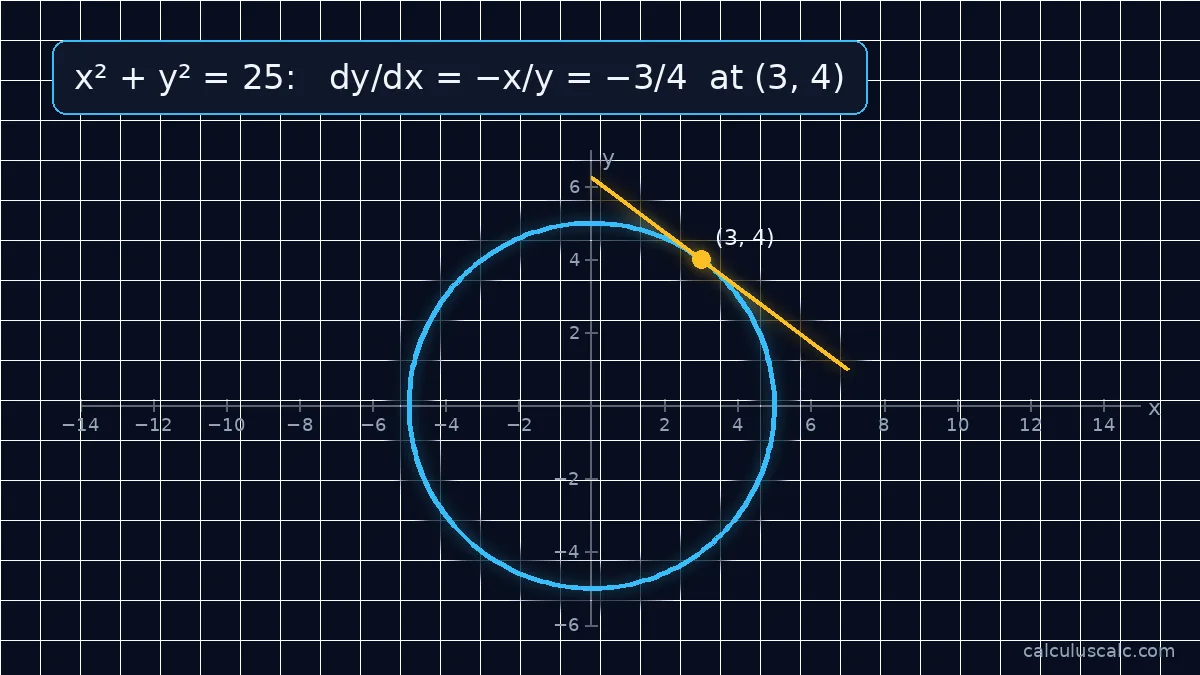
Find ( frac{dy}{dx} ) for ( x^2 + y^2 = 25 ) and the tangent line at ( (3, 4) ) (as loaded above).
Differentiate both sides with respect to x. The derivative of ( y^2 ) is ( 2yfrac{dy}{dx} ) by the chain rule, because y depends on x:
$$2x + 2yfrac{dy}{dx} = 0 quadRightarrowquad frac{dy}{dx} = -frac{x}{y}$$
At ( (3, 4) ) the slope is ( -frac{3}{4} ). The tangent line is ( y – 4 = -frac{3}{4}(x – 3) ), which simplifies to
$$y = -frac{3}{4}x + frac{25}{4}$$
Check: the radius from the origin to ( (3, 4) ) has slope ( frac{4}{3} ), and a tangent to a circle is perpendicular to the radius, so its slope should be ( -frac{3}{4} ). It is.
Worked example: the folium of Descartes
For ( x^3 + y^3 = 6xy ), differentiating term by term gives
$$3x^2 + 3y^2frac{dy}{dx} = 6y + 6xfrac{dy}{dx}$$
Collect the ( frac{dy}{dx} ) terms on one side:
$$frac{dy}{dx} = frac{6y - 3x^2}{3y^2 - 6x} = frac{2y - x^2}{y^2 - 2x}$$
The point ( (3, 3) ) is on the curve, since ( 27 + 27 = 54 = 6 cdot 9 ). There the slope is ( frac{6 – 9}{9 – 6} = -1 ), and the tangent line is ( y = -x + 6 ). Enter x^3 + y^3 = 6xy with the point (3, 3) to see the same result.
Vertical tangents
When ( F_y = 0 ) at a point, the formula would divide by zero. That means the tangent line is vertical there, and the calculator says so. On the circle ( x^2 + y^2 = 25 ) this happens at ( (5, 0) ) and ( (-5, 0) ), the far left and right of the circle.
Common mistakes
- Forgetting the chain rule on y terms. The derivative of ( y^3 ) is ( 3y^2frac{dy}{dx} ), not ( 3y^2 ).
- Missing the product rule. A term like ( xy ) differentiates to ( y + xfrac{dy}{dx} ).
- Plugging in a point that isn’t on the curve. Always check the point satisfies the original equation first.
when to use the implicit differentiation calculator
Use it whenever solving for y is hard or impossible, and whenever you need ( frac{dy}{dx} ) for both branches of a curve at once (a circle is two functions, top and bottom, but one implicit equation). It is also the method behind related rates problems and the derivatives of inverse trig functions. For a full explanation with more examples, read the guide to implicit differentiation.

Step-by-step method
- Differentiate every term on both sides with respect to x.
- Each time you differentiate a term containing y, multiply by ( frac{dy}{dx} ) (the chain rule).
- Use the product rule on terms like ( xy ) or ( x^2y ).
- Move every ( frac{dy}{dx} ) term to one side and everything else to the other.
- Factor out ( frac{dy}{dx} ) and divide.
- To get a slope, substitute both coordinates of a point on the curve.
Worked example: a rotated ellipse
Find the tangent line to ( x^2 + xy + y^2 = 7 ) at ( (1, 2) ). The point is on the curve, since ( 1 + 2 + 4 = 7 ).
$$2x + left(y + xfrac{dy}{dx}right) + 2yfrac{dy}{dx} = 0$$
The middle bracket is the product rule applied to ( xy ). Collecting terms:
$$(x + 2y)frac{dy}{dx} = -(2x + y) quadRightarrowquad frac{dy}{dx} = -frac{2x + y}{x + 2y}$$
At ( (1, 2) ) the slope is ( -frac{4}{5} ), so the tangent line is ( y = -frac{4}{5}x + frac{14}{5} ).
Worked example: checking against the explicit answer
The hyperbola ( xy = 1 ) can also be written ( y = frac{1}{x} ), so we can check the implicit method. Implicitly, ( y + xfrac{dy}{dx} = 0 ), so ( frac{dy}{dx} = -frac{y}{x} ). Substituting ( y = frac{1}{x} ) gives ( -frac{1}{x^2} ), which is exactly the derivative of ( frac{1}{x} ). The two methods always agree when y can be isolated; implicit differentiation simply saves you from having to isolate it.

Applications
- Related rates. If a 5 m ladder slides down a wall, ( x^2 + y^2 = 25 ) links the foot and the top. Differentiating with respect to time gives ( 2xfrac{dx}{dt} + 2yfrac{dy}{dt} = 0 ), the starting point of every ladder problem.
- Inverse functions. Writing ( y = arcsin x ) as ( sin y = x ) and differentiating implicitly gives ( frac{dy}{dx} = frac{1}{sqrt{1 – x^2}} ).
- Economics. Along an indifference curve ( U(x, y) = c ), the slope ( -frac{U_x}{U_y} ) is the marginal rate of substitution, the same ( -frac{F_x}{F_y} ) formula this calculator uses.
Practice problems
- Find ( frac{dy}{dx} ) for ( x^2 – y^2 = 9 ).
- Next, find the slope of ( y^3 + 3y = x ) at ( (4, 1) ).
- Find the slope of ( x^2y + y^2 = 6 ) at ( (1, 2) ).
Answers: 1. ( frac{x}{y} ). 2. ( 3y^2frac{dy}{dx} + 3frac{dy}{dx} = 1 ), so ( frac{dy}{dx} = frac{1}{3y^2 + 3} = frac{1}{6} ). 3. ( 2xy + x^2frac{dy}{dx} + 2yfrac{dy}{dx} = 0 ), so ( frac{dy}{dx} = -frac{2xy}{x^2 + 2y} = -frac{4}{5} ). Check each one with the calculator.
Related guides
Further reading
- Implicit function (Wikipedia) — when an equation defines y as a function of x, and the implicit function theorem.
FAQ
What is implicit differentiation?
A way to find ( frac{dy}{dx} ) when x and y are mixed together in an equation. You differentiate both sides with respect to x, treating y as a function of x, then solve for ( frac{dy}{dx} ).
Why does the answer contain y?
Because the slope depends on which point of the curve you are at, and for curves like a circle one x-value matches two points. Substitute both coordinates of the point to get a number.
How do I find the second derivative implicitly?
Differentiate ( frac{dy}{dx} ) again with the quotient rule, then replace every ( frac{dy}{dx} ) with the first-derivative formula. For the circle this gives ( frac{d^2y}{dx^2} = -frac{25}{y^3} ).
Is −Fx/Fy always correct?
Yes, wherever ( F_y neq 0 ). It follows from the multivariable chain rule and gives the same result as term-by-term differentiation.
Do I need to solve for y first?
No. That is the point of implicit differentiation: it works even when y cannot be isolated, as in ( x^3 + y^3 = 6xy ).
How do I find horizontal tangents?
Set the numerator of ( frac{dy}{dx} ) equal to zero and solve it together with the original equation. For the circle, ( x = 0 ) gives the points ( (0, 5) ) and ( (0, -5) ).