
Absolute Extrema Calculator (Closed Interval Method)
- Free
- No sign-up
- Works on phones
- Shows the working
 By Yasir Hafeez · Updated
This absolute extrema calculator finds the largest and smallest values of a function on a closed interval ( [a, b] ), using the closed interval method taught in every calculus course. Also, it lists every candidate (the two endpoints and each critical point inside the interval), evaluates the function at each one, and marks the absolute maximum and minimum.
It’s free and needs no sign-up.
How to use it
- Type the function, for example
x^3 - 3x^2 + 1orsin(x) + cos(x). - Enter the endpoints a and b.
- Press Find extrema.
If the function is not continuous on the interval (for example ( frac{1}{x} ) on ( [-1, 1] )), the calculator tells you, because then an absolute maximum or minimum may not exist.
The closed interval method
The Extreme Value Theorem guarantees that a function continuous on a closed interval ( [a, b] ) has an absolute maximum and an absolute minimum there. They can only occur at an endpoint or at a critical point. So:
- First, find the critical points: solve ( f'(x) = 0 ) and note where ( f'(x) ) is undefined. Keep only those inside ( (a, b) ).
- Evaluate f at each critical point and at both endpoints.
- The largest value is the absolute maximum; the smallest is the absolute minimum.
Worked example: a cubic on [−1, 4]
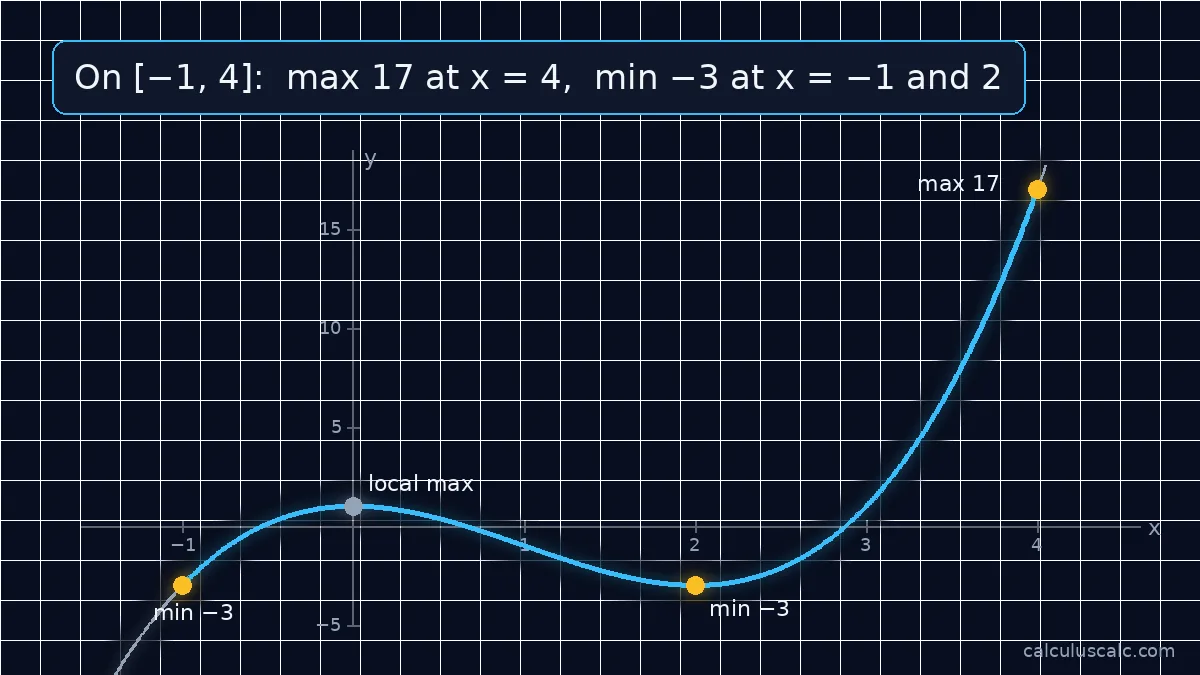
For ( f(x) = x^3 – 3x^2 + 1 ) (as loaded above):
Step 1. ( f'(x) = 3x^2 – 6x = 3x(x – 2) ), so the critical points are ( x = 0 ) and ( x = 2 ). Both are inside ( [-1, 4] ).
Step 2. Evaluate:
| x | Why | f(x) |
|---|---|---|
| −1 | endpoint | ( -1 – 3 + 1 = -3 ) |
| 0 | critical point | 1 |
| 2 | critical point | ( 8 – 12 + 1 = -3 ) |
| 4 | endpoint | ( 64 – 48 + 1 = 17 ) |
Step 3. The absolute maximum is 17 at x = 4. However, the absolute minimum is −3, reached twice: at ( x = -1 ) and at ( x = 2 ).
Notice that the local maximum at ( x = 0 ) (value 1) is not the absolute maximum. Instead, on this interval the endpoint wins.
Worked example: sin x on [0, 2π]
( f'(x) = cos x = 0 ) at ( x = frac{pi}{2} ) and ( x = frac{3pi}{2} ). The values are ( f(0) = 0 ), ( f(frac{pi}{2}) = 1 ), ( f(frac{3pi}{2}) = -1 ), ( f(2pi) = 0 ). As a result, the absolute maximum is 1 at ( frac{pi}{2} ) and the absolute minimum is −1 at ( frac{3pi}{2} ).
Worked example: an optimization problem
A farmer has 100 m of fencing for a rectangular pen against a wall, so only three sides need fencing. With width x, the length is ( 100 – 2x ) and the area is ( A(x) = x(100 – 2x) ) for ( 0 le x le 50 ). Then ( A'(x) = 100 – 4x = 0 ) gives ( x = 25 ). Checking: ( A(0) = 0 ), ( A(25) = 1250 ), ( A(50) = 0 ). The largest area is 1250 m², with a 25 m by 50 m pen. More problems like this are in optimization problems.
Local vs absolute extrema calculator
A local maximum is higher than the points right next to it. An absolute maximum is the highest point on the whole interval. Every absolute extremum inside the interval is also a local one, but endpoints can be absolute extrema without being critical points, as in the cubic example.
Common mistakes
- Forgetting the endpoints. They are often where the answer is.
- Including critical points outside [a, b]. Only points inside the interval count.
- Reporting the x-value as the maximum. The absolute maximum is the function value (17); it occurs at ( x = 4 ).
- Using the method on an open interval or a discontinuous function. The Extreme Value Theorem needs continuity on a closed interval.
Worked example: a cusp at a critical point
Find the absolute extrema of ( f(x) = x^{2/3} ) on ( [-1, 8] ). Here ( f'(x) = frac{2}{3x^{1/3}} ) is never zero, but it is undefined at ( x = 0 ), where f itself is defined. So ( x = 0 ) is a critical point.
| x | Why | f(x) |
|---|---|---|
| −1 | endpoint | 1 |
| 0 | ( f’ ) undefined | 0 |
| 8 | endpoint | 4 |
The absolute maximum is 4 at ( x = 8 ) and the absolute minimum is 0 at ( x = 0 ). However, forgetting the points where ( f’ ) is undefined would give the wrong minimum.
Worked example: a function with three candidates
For ( f(x) = 2x^3 – 3x^2 – 12x ) on ( [-2, 3] ): ( f'(x) = 6x^2 – 6x – 12 = 6(x – 2)(x + 1) ), so the critical points are ( -1 ) and 2.
| x | f(x) |
|---|---|
| −2 | ( -16 – 12 + 24 = -4 ) |
| −1 | ( -2 – 3 + 12 = 7 ) |
| 2 | ( 16 – 12 – 24 = -20 ) |
| 3 | ( 54 – 27 – 36 = -9 ) |
Absolute maximum 7 at ( x = -1 ); absolute minimum −20 at ( x = 2 ).
Step-by-step checklist
- Check that f is continuous on ( [a, b] ).
- Differentiate and solve ( f'(x) = 0 ).
- Find where ( f'(x) ) is undefined.
- Discard any critical points outside ( [a, b] ).
- Make a table of f at the critical points and both endpoints.
- Read off the largest and smallest values, and state where they occur.
Applications
Absolute extrema answer “best possible” questions on a fixed range: the largest area for a given perimeter, the lowest cost for a production level between limits, the highest point of a projectile during a set time, or the strongest beam that can be cut from a log. The closed interval method guarantees you have checked every possibility, which is why it is the final step of most optimization problems.

Practice problems
- ( f(x) = x^2 – 4x + 1 ) on ( [0, 5] ).
- ( f(x) = x e^{-x} ) on ( [0, 3] ).
- ( f(x) = sin x + cos x ) on ( [0, pi] ).
Answers: 1. Critical point 2: ( f(0) = 1 ), ( f(2) = -3 ), ( f(5) = 6 ). So, max 6 at ( x = 5 ), min −3 at ( x = 2 ). 2. ( f'(x) = (1 – x)e^{-x} ), critical point 1: max ( frac{1}{e} approx 0.368 ) at ( x = 1 ), min 0 at ( x = 0 ). 3. ( f'(x) = cos x – sin x = 0 ) at ( frac{pi}{4} ): max ( sqrt{2} ) at ( frac{pi}{4} ), min −1 at ( x = pi ).
Related guides
- How to Find Critical Points
- Optimization Problems
- Increasing and Decreasing Intervals Calculator
- Intermediate Value Theorem
Further reading
- Extreme value theorem (Wikipedia) — why continuous functions on closed intervals have a maximum and minimum.
FAQ
What is an absolute extremum?
The absolute maximum or absolute minimum of a function: its largest or smallest value over the whole interval being considered.
How do you find absolute extrema on a closed interval?
Find the critical points inside the interval, evaluate the function at them and at both endpoints, and pick the largest and smallest values.
Can there be two absolute minimums?
The minimum value is unique, but it can be reached at more than one x-value, as with −3 at ( x = -1 ) and ( x = 2 ) above.
Does every function have an absolute maximum?
No. ( frac{1}{x} ) on ( (0, 1] ) grows without bound. However, a continuous function on a closed interval always has both an absolute maximum and minimum.
What if the interval is open?
The closed interval method no longer applies, and an absolute maximum or minimum may not exist. Study the function’s behaviour near the open ends, or use the first derivative test if there is a single critical point.
Does a critical point have to be a maximum or minimum?
No. ( x^3 ) has a critical point at 0 that is neither. In the closed interval method that doesn’t matter: you just compare the values.