
Average Rate of Change Calculator
- Free
- No sign-up
- Works on phones
- Shows the working
 By Yasir Hafeez · Updated
This average rate of change calculator finds how fast a function changes, on average, between two x-values. Simply enter the function and the interval ( [a, b] ). As a result, you get ( f(a) ), ( f(b) ), the average rate of change with the substitution shown, and the equation of the secant line through the two points.
It’s free and needs no sign-up.
How to use it
- Type the function, for example
x^2,sqrt(x)or100*e^(0.05x). - Enter the start of the interval a and the end b.
- Press Calculate.
Formula
$$text{Average rate of change} = frac{f(b) - f(a)}{b - a}$$
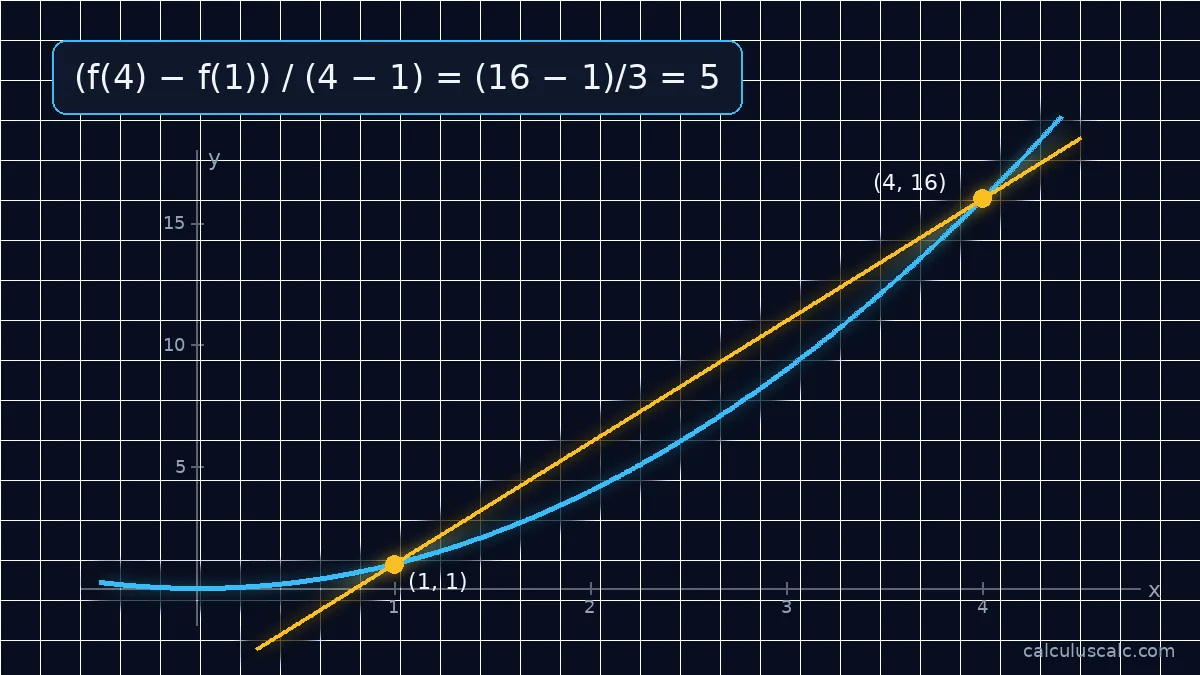
It is the change in output divided by the change in input: “rise over run” between the points ( (a, f(a)) ) and ( (b, f(b)) ). Geometrically it is the slope of the secant line joining those two points on the graph.
Worked example: a parabola
For ( f(x) = x^2 ) on ( [1, 4] ) (as loaded above): ( f(1) = 1 ) and ( f(4) = 16 ), so

$$frac{16 - 1}{4 - 1} = frac{15}{3} = 5$$
On average, the function rises 5 units for every unit increase in x over this interval. The secant line through ( (1, 1) ) and ( (4, 16) ) is ( y = 5x – 4 ).
Worked example: average velocity
A ball’s height in metres after t seconds is ( h(t) = 20t – 4.9t^2 ). Its average velocity between ( t = 1 ) and ( t = 3 ) is
$$frac{h(3) - h(1)}{3 - 1} = frac{15.9 - 15.1}{2} = 0.4 text{ m/s}$$
The ball rose for part of that time and fell for the rest, so its average velocity is small, though its speed was not. Enter 20x - 4.9x^2 with a = 1 and b = 3 to check. Velocity, acceleration and how they connect to derivatives are covered in velocity and acceleration.
Worked example: a table of values
The average rate of change does not need a formula. For example, if a town’s population was 12,400 in 2015 and 14,200 in 2023, the average rate of change is
$$frac{14{,}200 - 12{,}400}{2023 - 2015} = frac{1800}{8} = 225 text{ people per year}$$
Using an average rate of change calculator
The average rate uses two points. However, the instantaneous rate is what you get as the two points move together, ( b to a ); that limit is the derivative ( f'(a) ). For ( f(x) = x^2 ), the instantaneous rate at ( x = 1 ) is 2 and at ( x = 4 ) is 8; the average over ( [1, 4] ) is 5, in between. See the instantaneous rate of change calculator for that limit.

The Mean Value Theorem says that for a smooth function there is always at least one point in the interval where the instantaneous rate equals the average rate. For ( x^2 ) on ( [1, 4] ) that point is ( x = 2.5 ), since ( f'(2.5) = 5 ). The Mean Value Theorem calculator finds those points for you.
Units
The units of the answer are output units per input unit: metres per second, dollars per year, degrees per hour. Including them is the easiest way to make sure the number is interpreted correctly.
Common mistakes
- Subtracting in different orders. Use ( f(b) – f(a) ) on top and ( b – a ) on the bottom, in the same order.
- Using x-values instead of function values on top. The numerator is the change in f, not the change in x.
- Averaging the endpoint slopes. The average rate of change is not ( frac{f'(a) + f'(b)}{2} ) in general.
Step-by-step method
- Evaluate the function at the start of the interval: ( f(a) ).
- Evaluate it at the end: ( f(b) ).
- Subtract: ( f(b) – f(a) ), the change in output.
- Subtract the inputs: ( b – a ), the change in input.
- Divide, and attach units (output units per input unit).
Worked example: money in a savings account
( $1000 ) grows at 5% a year, so the balance after t years is ( A(t) = 1000(1.05)^t ). Over the first ten years:
$$frac{A(10) - A(0)}{10 - 0} = frac{1628.89 - 1000}{10} approx $62.89 text{ per year}$$
The account earns ( $50 ) in the first year but much more later, because interest compounds; the average rate smooths that out. See the compound interest calculator for the year-by-year balance.
Worked example: a trig function
For ( f(x) = sin x ) on ( left[0, frac{pi}{2}right] ):
$$frac{sinfrac{pi}{2} - sin 0}{frac{pi}{2} - 0} = frac{1}{pi/2} = frac{2}{pi} approx 0.6366$$
The sine curve starts with slope 1 and ends with slope 0; on average it rises about 0.64 units per radian.
Where the average rate of change is used
| Field | Function | Average rate of change means |
|---|---|---|
| Physics | position s(t) | average velocity |
| Physics | velocity v(t) | average acceleration |
| Economics | cost C(q) | average cost per extra unit over a range |
| Biology | population P(t) | average growth per year |
| Chemistry | concentration c(t) | average reaction rate |
In every case the units tell the story: metres per second, dollars per unit, people per year.
Practice problems
- ( f(x) = 3x^2 – 2x ) on ( [-1, 2] ).
- ( f(x) = sqrt{x} ) on ( [1, 9] ).
- ( f(x) = frac{1}{x} ) on ( [1, 4] ).
Answers: 1. ( f(2) = 8 ) and ( f(-1) = 5 ), so ( frac{8 – 5}{3} = 1 ). 2. ( frac{3 – 1}{8} = frac{1}{4} ). 3. ( frac{0.25 – 1}{3} = -frac{1}{4} ): negative, because ( frac{1}{x} ) is decreasing.

Average rate of change vs average value
Don’t confuse the two. The average rate of change ( frac{f(b) – f(a)}{b – a} ) measures how fast f changes. The average value ( frac{1}{b – a}int_a^b f(x),dx ) measures the typical height of f. For ( f(x) = x^2 ) on ( [0, 3] ), the average rate of change is 3 but the average value is also 3 only by coincidence; on ( [1, 4] ) they are 5 and 7. See the average value of a function.
Related guides
Further reading
- Secant line (Wikipedia) — the line through two points of a curve, and how it approaches the tangent.
FAQ
What is the average rate of change?
The change in a function’s value divided by the change in x over an interval: ( frac{f(b) – f(a)}{b – a} ). It is the slope of the line through the two endpoints.
Can the average rate of change be negative?
Yes. A negative value means the function decreased overall between a and b.
Is the average rate of change the same as slope?
It is the slope of the secant line. For a straight line it equals the slope everywhere; however, for a curve it depends on the interval you choose.
How is it different from the derivative?
The derivative is the instantaneous rate at a single point: the limit of the average rate as the interval shrinks to zero width.
What are the units of the average rate of change?
Units of the function’s output divided by units of the input, such as metres per second or dollars per year.
How do I find it from a graph?
Read the y-values at the two x-values and divide the vertical change by the horizontal change. Also, it is the slope of the line joining the two points.