
Instantaneous Rate of Change Calculator
- Free
- No sign-up
- Works on phones
- Shows the working
 By Yasir Hafeez · Updated
This instantaneous rate of change calculator finds how fast a function is changing at one exact point. Enter the function and the point ( x_0 ). The calculator differentiates the function, evaluates the derivative at ( x_0 ), writes the tangent line, and shows a table of secant slopes from both sides so you can watch them approach the answer.
It’s free and needs no sign-up.
how to use our instantaneous rate of change calculator
- Type the function, for example
x^3,sin(x)or16t^2written as16x^2. - Enter the point ( x_0 ).
- Press Calculate.
Definition
The instantaneous rate of change of f at ( x_0 ) is the derivative
$$f'(x_0) = lim_{h to 0} frac{f(x_0 + h) - f(x_0)}{h}$$
Each fraction inside the limit is an average rate of change over a tiny interval of width h. As h shrinks toward 0, these secant slopes approach the slope of the tangent line, and that limiting value is the instantaneous rate.
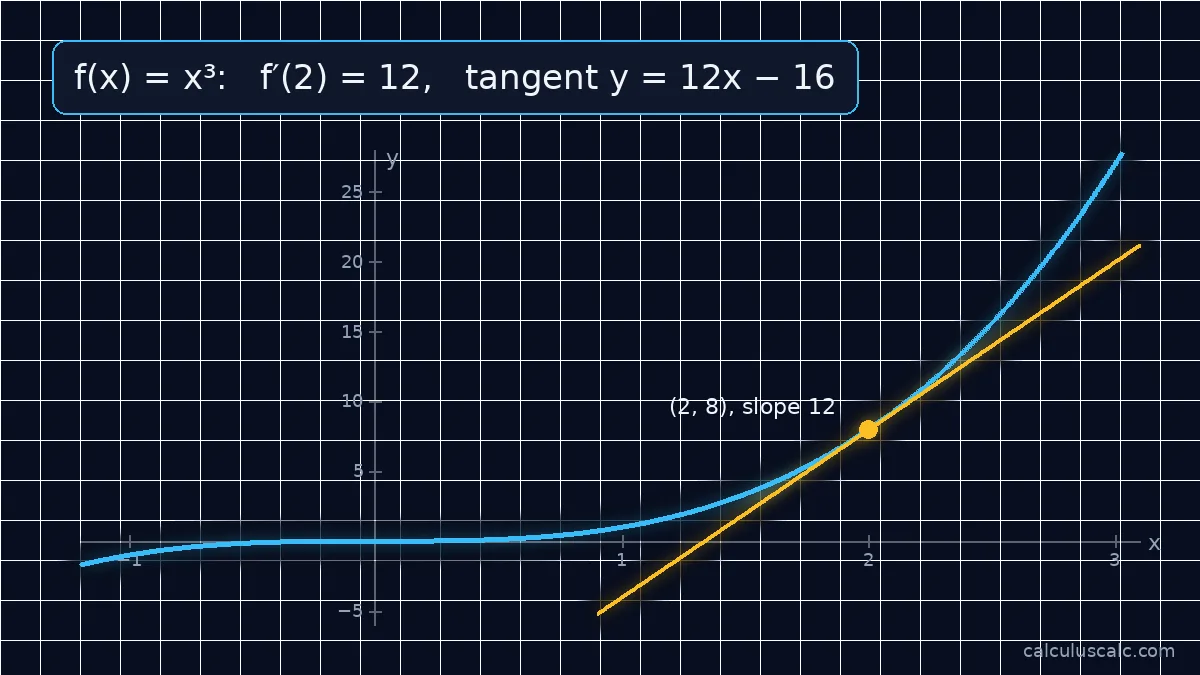
Worked example: f(x) = x³ at x = 2
The power rule gives ( f'(x) = 3x^2 ), so

$$f'(2) = 3 cdot 2^2 = 12$$
At ( x = 2 ) the function is increasing at 12 units of output per unit of x. The tangent line passes through ( (2, 8) ) with slope 12. So, ( y = 12x – 16 ).
The secant table shows the limit happening:
| h | Secant slope ( frac{f(2 + h) – f(2)}{h} ) |
|---|---|
| 1 | 19 |
| 0.1 | 12.61 |
| 0.01 | 12.0601 |
| 0.001 | 12.006001 |
From the left (using ( 2 – h )) the slopes are 7, 11.41, 11.9401, 11.994001. As a result, both sides close in on 12.
Worked example: velocity
A stone dropped from a cliff has fallen ( s(t) = 4.9t^2 ) metres after t seconds. Its velocity at ( t = 3 ) is the instantaneous rate of change of position:
$$s'(t) = 9.8t, qquad s'(3) = 29.4 text{ m/s}$$
Its average velocity over the first 3 seconds is only ( frac{44.1}{3} = 14.7 ) m/s, because it started from rest. Velocity and acceleration covers this in depth.
Worked example: a trig function
For ( f(x) = sin x ) at ( x = 0 ): ( f'(x) = cos x ) and ( f'(0) = 1 ). Near the origin the sine curve rises at 45°, the same as the line ( y = x ). However, this only works with x in radians; see the limit of sin x over x for why.
When it does not exist
The instantaneous rate of change does not exist where the function has a corner, a cusp, a vertical tangent or a break. For ( f(x) = |x| ) at ( x = 0 ), the secant slopes are 1 from the right and −1 from the left, so there is no single limit. The calculator reports when f is not differentiable at your point.
Common mistakes
- Finding the average rate instead. Two points give an average; the instantaneous rate needs the derivative or the limit.
- Plugging ( x_0 ) into f instead of f′. ( f(2) = 8 ) is the height of the curve, not its slope.
- Degrees in trig functions. The derivative formulas for sin and cos assume radians.
Step-by-step method
- Differentiate the function using the derivative rules (or the limit definition).
- Substitute ( x_0 ) into ( f'(x) ). That number is the instantaneous rate of change.
- For the tangent line, find ( y_0 = f(x_0) ) and use ( y – y_0 = f'(x_0)(x – x_0) ).
- Interpret the sign and the units: positive means increasing, negative means decreasing.
Worked example: an exponential
For ( f(x) = e^{2x} ) at ( x = 0 ): by the chain rule ( f'(x) = 2e^{2x} ), so ( f'(0) = 2 ). The function is growing twice as fast as its own value at that moment, which is the defining feature of exponential growth with rate constant 2.
Worked example: a rational function
For ( f(x) = frac{1}{x} ) at ( x = 2 ): ( f'(x) = -frac{1}{x^2} ), so ( f'(2) = -frac{1}{4} ). The negative sign says the function is decreasing; at ( x = 2 ) it falls a quarter of a unit for each unit increase in x.
What it means in different subjects
| Function | Instantaneous rate of change | Typical units |
|---|---|---|
| Position s(t) | velocity | m/s |
| Velocity v(t) | acceleration | m/s² |
| Cost C(q) | marginal cost | dollars per item |
| Population P(t) | growth rate | individuals per year |
| Temperature T(t) | heating or cooling rate | °C per minute |
| Volume V(r) | rate of change with radius | cm³ per cm |
Using the secant table
The table in the calculator shows the difference quotient for shrinking values of h, from both sides. If the two columns approach the same number, the derivative exists and equals that number. However, if they approach different numbers (as for ( |x| ) at 0), the function is not differentiable there. This is exactly how the limit definition is introduced in limits and derivatives.
Practice problems
- ( f(x) = x^2 – 4x ) at ( x = 3 ).
- ( f(x) = sqrt{x} ) at ( x = 9 ).
- ( f(x) = ln x ) at ( x = e ).
Answers: 1. ( f'(x) = 2x – 4 ), so ( f'(3) = 2 ). 2. ( f'(x) = frac{1}{2sqrt{x}} ), so ( f'(9) = frac{1}{6} ). 3. ( f'(x) = frac{1}{x} ), so ( f'(e) = frac{1}{e} approx 0.368 ).
Worked example: marginal cost
A factory’s cost to make q items is ( C(q) = 500 + 10q + 0.02q^2 ) dollars. The instantaneous rate of change ( C'(q) = 10 + 0.04q ) is the marginal cost. At ( q = 100 ), ( C'(100) = 14 ): the 101st item costs about $14 to make, more than the $10 base cost because of the rising ( 0.02q^2 ) term.
Reading it from a graph
Draw the tangent line at the point and measure its slope with two points on the tangent, rise over run. The steeper the tangent, the larger the rate of change; however, a horizontal tangent means the rate is zero, which happens at peaks and troughs.
Related guides
Further reading
- Derivative (Wikipedia) — the limit definition, notation and interpretation as a rate of change.
FAQ
What is the instantaneous rate of change?
The rate at which a function is changing at one specific point. It equals the derivative ( f'(x_0) ), the slope of the tangent line there.
How do you find the instantaneous rate of change?
Differentiate the function and substitute the point, or evaluate the limit of the difference quotient as ( h to 0 ). Both give the same number.
Is the instantaneous rate of change the same as the derivative?
Yes. “Instantaneous rate of change at ( x_0 )” and “( f'(x_0) )” mean the same thing.
What does a negative instantaneous rate mean?
The function is decreasing at that point: its graph slopes downward.
What is the difference between average and instantaneous rate of change?
The average rate uses two points and measures the overall change; the instantaneous rate is the limit as the two points merge, measuring the change at a single moment.
How do I find the instantaneous rate of change from a table of data?
Use a symmetric difference: ( frac{f(x + h) – f(x – h)}{2h} ) with the closest data points on either side. It estimates the derivative well when the data are close together.