

The main log rules are: product ( log_b(MN) = log_b M + log_b N ); quotient ( log_bfrac{M}{N} = log_b M – log_b N ); power ( log_b M^p = plog_b M ); and change of base ( log_b M = frac{ln M}{ln b} ). Also ( log_b 1 = 0 ) and ( log_b b = 1 ), so ( log 10 = 1 ) and ( log 1 = 0 ). A logarithm is an exponent: ( log_b x = y ) means ( b^y = x ).
A logarithm is an exponent. The statement ( log_b x = y ) means exactly the same thing as ( b^y = x ): “the power you raise b to, to get x”. So ( log_2 8 = 3 ) because ( 2^3 = 8 ), and ( log_{10} 0.01 = -2 ) because ( 10^{-2} = 0.01 ).
$$log_b x = y iff b^y = x qquad (b > 0, b neq 1, x > 0)$$
Two bases have their own notation: ( log x ) usually means ( log_{10} x ) (the common log), and ( ln x ) means ( log_e x ) (the natural log, base ( e approx 2.71828 )).
The logarithm rules
| Rule | Formula | Example |
|---|---|---|
| Product | ( log_b(MN) = log_b M + log_b N ) | ( log 20 = log 4 + log 5 ) |
| Quotient | ( log_bfrac{M}{N} = log_b M – log_b N ) | ( lnfrac{x}{3} = ln x – ln 3 ) |
| Power | ( log_b(M^p) = plog_b M ) | ( log_2 8^5 = 5log_2 8 = 15 ) |
| Change of base | ( log_b M = frac{ln M}{ln b} ) | ( log_3 50 = frac{ln 50}{ln 3} approx 3.561 ) |
| Log of 1 | ( log_b 1 = 0 ) | ( ln 1 = 0 ) |
| Log of the base | ( log_b b = 1 ) | ( log 10 = 1 ) |
| Inverse | ( log_b(b^x) = x ), ( b^{log_b x} = x ) | ( e^{ln 7} = 7 ) |
Why the rules work
Each log rule is an exponent rule in disguise.

Product rule. Let ( log_b M = m ) and ( log_b N = n ), so ( M = b^m ) and ( N = b^n ). Then ( MN = b^m b^n = b^{m+n} ), so ( log_b(MN) = m + n ).
Quotient rule. ( frac{M}{N} = frac{b^m}{b^n} = b^{m-n} ).
Power rule. ( M^p = (b^m)^p = b^{mp} ), so ( log_b(M^p) = pm = plog_b M ).
Change of base. If ( y = log_b M ), then ( b^y = M ). Take ln of both sides: ( yln b = ln M ), so ( y = frac{ln M}{ln b} ).
Expanding and condensing logs
Example 1: expand. Write ( logfrac{x^3sqrt{y}}{z^2} ) as a sum and difference of simple logs.
$$log x^3 + log y^{1/2} - log z^2 = 3log x + tfrac12log y - 2log z$$
Example 2: condense. Write ( 2ln x + ln(x + 1) – ln 5 ) as a single log.
$$ln x^2 + ln(x + 1) - ln 5 = lnfrac{x^2(x + 1)}{5}$$
Example 3: evaluate without a calculator. ( log_6 4 + log_6 9 = log_6 36 = 2 ).
Log 10, log 1 and other values to know
| Expression | Value | Reason |
|---|---|---|
| ( log 10 ) (base 10) | 1 | ( 10^1 = 10 ) |
| ( log 1 ) (any base) | 0 | ( b^0 = 1 ) |
| ( log 100 ) | 2 | ( 10^2 = 100 ) |
| ( log 0.1 ) | ( -1 ) | ( 10^{-1} = 0.1 ) |
| ( log 2 ) | ( approx 0.30103 ) | |
| ( log 3 ) | ( approx 0.47712 ) | |
| ( log 5 ) | ( approx 0.69897 ) | ( log 5 = log 10 – log 2 ) |
| ( ln 10 ) | ( approx 2.302585 ) | natural log, base ( e ) |
| ( ln e ) | 1 | ( e^1 = e ) |
| ( log 0 ) | undefined | no power of 10 equals 0 |
( log_{10} ) is often written log10 on calculators and in spreadsheets, while ( ln ) is the natural log. The table shows how far the rules take you: knowing ( log 2 ) and ( log 3 ) gives ( log 6 = log 2 + log 3 approx 0.77815 ) and ( log 8 = 3log 2 approx 0.90309 ).
Logarithm calculator
Enter x and any base (use <code>e</code> for ln). You get the exact value when there is one, the exponential form and the change-of-base working.
The full-page logarithm calculator has more examples.
Solving exponential equations
To get a variable out of an exponent, take a log of both sides.
Example 4. Solve ( 3^x = 50 ).
$$x = log_3 50 = frac{ln 50}{ln 3} approx 3.561$$
Example 5. Solve ( 5e^{2t} = 40 ). Divide by 5: ( e^{2t} = 8 ). Take ln: ( 2t = ln 8 ), so ( t = frac{ln 8}{2} approx 1.040 ).
Example 6: money. How long does $1000 take to double at 6% interest compounded yearly? Solve ( 1000(1.06)^t = 2000 ): ( t = frac{ln 2}{ln 1.06} approx 11.9 ) years.
Solving log equations
To undo a log, rewrite it in exponential form. Always check that the answers keep every log’s input positive.
Example 7. Solve ( log_2(x + 3) = 5 ). Exponential form: ( x + 3 = 2^5 = 32 ), so ( x = 29 ).
Example 8. Solve ( log x + log(x – 3) = 1 ). Condense: ( log[x(x – 3)] = 1 ), so ( x^2 – 3x = 10 ), ( (x – 5)(x + 2) = 0 ). The root ( x = -2 ) would need ( log(-2) ), so reject it. Therefore, the answer is ( x = 5 ).
Graphing a log function
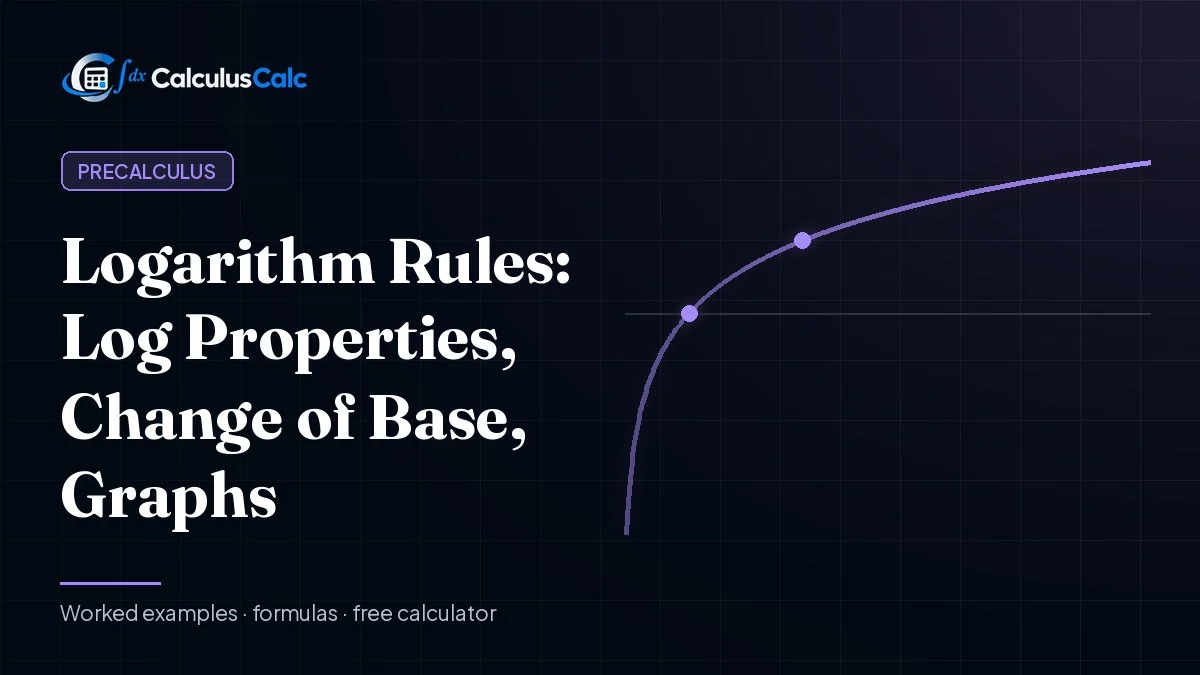
The graph of ( y = log_b x ) (with ( b > 1 )) has a recognizable shape:
- It passes through ( (1, 0) ) and ( (b, 1) ).
- It’s defined only for ( x > 0 ), with a vertical asymptote at ( x = 0 ).
- It increases forever, but more and more slowly.
- Its range is all real numbers.
It’s the reflection of ( y = b^x ) across the line ( y = x ), since logs and exponentials are inverses (see exponential functions).
| x | ( frac14 ) | ( frac12 ) | 1 | 2 | 4 | 8 |
|---|---|---|---|---|---|---|
| ( log_2 x ) | ( -2 ) | ( -1 ) | 0 | 1 | 2 | 3 |
Transformations. ( y = ln(x – 2) + 1 ) shifts ( ln x ) right 2 and up 1. As a result, the asymptote moves to ( x = 2 ), and the domain becomes ( x > 2 ). For more on domains, see domain and range.
Plot it yourself:
Where logs are used
- Scales for huge ranges. The decibel scale, the pH scale and earthquake magnitudes are logarithmic: each step is a factor of 10.
- Solving for time in growth and decay models, like the half-life calculations in the exponential growth calculator.
- Calculus. ( frac{d}{dx}ln x = frac1x ) (see the derivative of ln x) and ( int frac{dx}{x} = ln|x| + C ) (see the integral of 1/x). Log rules also power logarithmic differentiation, which is how the derivative of x^x is found.
Common mistakes
- ( log(M + N) neq log M + log N ). There’s no rule for the log of a sum.
- ( frac{log M}{log N} neq log M – log N ). The quotient rule is for the log of a quotient, ( logfrac{M}{N} ).
- ( (log x)^2 neq 2log x ). The power rule only applies to a power inside the log: ( log(x^2) = 2log x ).
- Logs of negatives. ( log_b x ) is undefined for ( x le 0 ). Therefore, check solutions of log equations.
- Mixing up log and ln. Know which base your course and calculator use.
Printable formula sheet
The logarithm and exponent rules, factoring patterns and the quadratic formula are on one printable page.
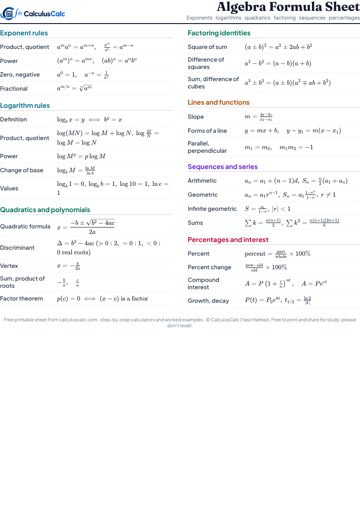
Algebra Formula Sheet
Exponents, logarithms, factoring, the quadratic formula, lines and sequences.
Download the Algebra Formula Sheet (PDF) Open in browserPractice problems
- Evaluate ( log_5 125 ).
- Evaluate ( log_4 2 ).
- Expand ( ln(x^2y^3) ).
- Condense ( log 8 – log 2 + log 25 ) and evaluate.
- Solve ( 2^{x+1} = 64 ).
- Solve ( ln(3x) = 2 ).
Answers: (1) 3; (2) ( frac12 ); (3) ( 2ln x + 3ln y ); (4) ( log 100 = 2 ); (5) ( x = 5 ); (6) ( x = frac{e^2}{3} approx 2.463 ).
FAQ
What are the log rules?
The product rule ( log(MN) = log M + log N ), the quotient rule ( logfrac{M}{N} = log M – log N ), the power rule ( log M^p = plog M ), and the change of base formula ( log_b M = frac{ln M}{ln b} ).
What is a logarithm in simple terms?
The exponent you need. ( log_{10} 1000 = 3 ) because 10 to the 3rd power is 1000.
What is the difference between log and ln?
( ln ) is the natural log, base ( e ). ( log ) without a base usually means base 10 in school math, though many calculus and computing texts use it for ln.
Why can’t you take the log of a negative number?
A positive base raised to any real power is positive, so no real exponent produces a negative result.
What does a log graph look like?
It rises steeply just to the right of its vertical asymptote at ( x = 0 ), crosses the x-axis at ( (1, 0) ), then keeps rising more and more slowly.
Further reading
- Exponential and Logarithm Functions (Paul’s Online Math Notes) — definitions, properties and graphs with examples.
- Solving Logarithm Equations (Paul’s Online Math Notes) — worked examples, including checking for invalid solutions.
- Logarithm (Wikipedia) — history, properties and applications.
Calculators for this topic
Keep learning

The Unit Circle: Angles, Coordinates and Trig Values
The unit circle explained: why the coordinates are cos and sin, every special angle in degrees and radians, tangent on the unit circle, and memory tricks.
Trigonometric Functions: Sin, Cos, Tan, Table and Graphs
The six trig functions with SOH-CAH-TOA and the unit circle, a table of exact values (sin 30, cos 180, sec 45), graphs, period and amplitude.