
Significant Figures Calculator (Count and Round)
- Free
- No sign-up
- Works on phones
- Shows the working
 By Yasir Hafeez · Updated
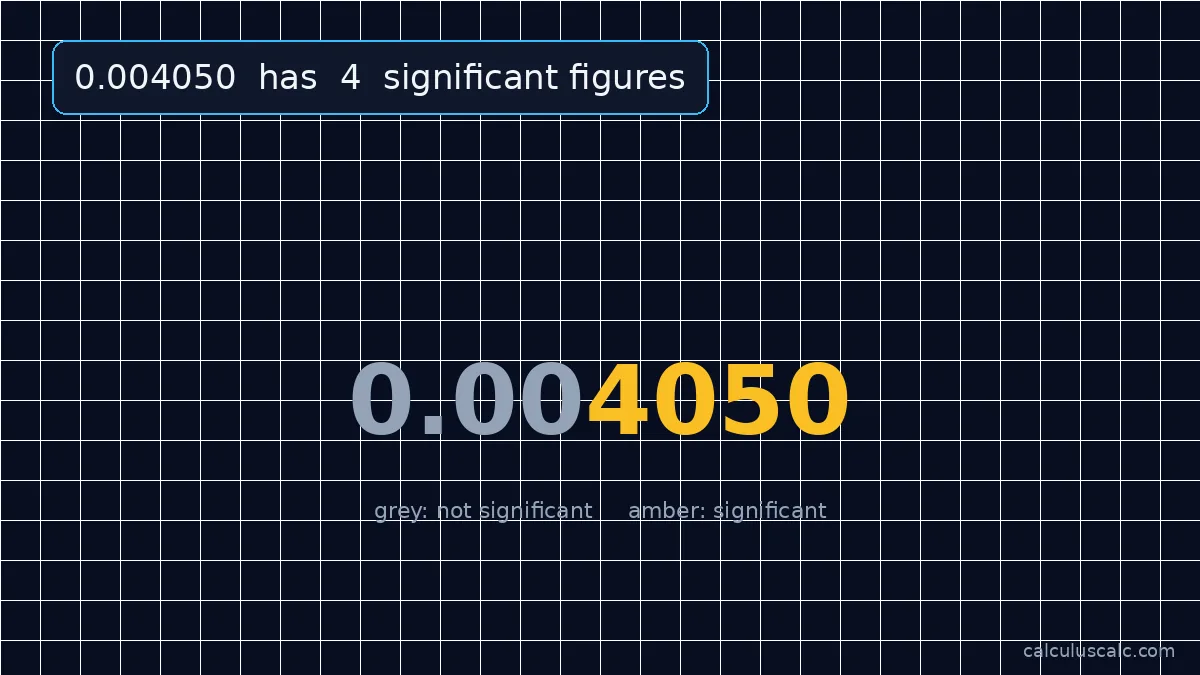
This significant figures calculator counts the significant figures (sig figs) in a number and highlights which digits count, with the rule that applies. Enter a number of sig figs to round to and it gives the rounded value in ordinary and scientific notation. It warns you when trailing zeros make a number ambiguous.
It’s free and needs no sign-up.
How to use it
- Type the number exactly as written, including trailing zeros and the decimal point:
0.004050,45000,1.20e3. - Optionally enter how many significant figures to round to.
- Press Count.
The rules
- Non-zero digits always count. 4.52 has 3 sig figs.
- Zeros between non-zero digits count. 1002 has 4.
- Leading zeros never count. They only place the decimal point: 0.0045 has 2.
- Trailing zeros count if there is a decimal point. 4.500 has 4, and so does 45.00.
- Trailing zeros in a whole number without a decimal point are ambiguous. For example, 45000 could have 2, 3, 4 or 5. By convention it is usually read as 2. Write it as ( 4.50 times 10^{4} ) (3 sig figs) or “45000.” to be clear.
Worked examples
| Number | Sig figs | Why |
|---|---|---|
| 0.004050 | 4 | leading zeros don’t count; the zero between 4 and 5 and the trailing zero after the decimal point do |
| 45000 | 2 | trailing zeros without a decimal point (ambiguous) |
| 1002 | 4 | zeros between non-zero digits count |
| 1.20 × 10³ | 3 | the trailing zero in the coefficient counts |
| 100.0 | 4 | the decimal point makes every zero count |
Using a significant figures calculator for rounding
Count from the first non-zero digit, then round the last kept digit as usual:
- 3.14159 to 3 sig figs: 3.14.
- 0.004050 to 2 sig figs: 0.0041 (the next digit, 5, rounds up).
- 45,678 to 2 sig figs: 46,000, better written ( 4.6 times 10^{4} ).
Sig figs in calculations
Multiplying and dividing: the answer has as many significant figures as the measurement with the fewest.
$$2.5 times 3.42 = 8.55 ;rightarrow; 8.6 quad (text{2 sig figs, from } 2.5)$$
Adding and subtracting: the answer has as many decimal places as the measurement with the fewest decimal places.
$$12.11 + 0.3 = 12.41 ;rightarrow; 12.4 quad (text{1 decimal place, from } 0.3)$$
Round only the final answer, not intermediate steps, to avoid building up rounding errors.
Exact numbers
Counted quantities (12 eggs) and defined values (100 cm in 1 m) are exact and have unlimited significant figures. They never limit the precision of an answer.
Why significant figures matter
They show how precise a measurement is. A length of 2.0 m means it was measured to the nearest tenth of a metre; 2.000 m means to the nearest millimetre. Reporting 8.5546 when your data only support 8.6 claims more precision than you have. Scientific notation is the cleanest way to show exactly how many digits are significant.

Common mistakes
- Counting leading zeros. 0.007 has one sig fig, not four.
- Dropping significant trailing zeros. 2.50 is not the same measurement as 2.5.
- Applying the multiplication rule to addition. Addition uses decimal places, not sig figs.
Step-by-step: counting sig figs
- Ignore any minus sign and any leading zeros.
- Count from the first non-zero digit to the last non-zero digit, including all zeros in between.
- If there is a decimal point, also count the trailing zeros after the last non-zero digit.
- If there is no decimal point and the number ends in zeros, the zeros are ambiguous; most courses don’t count them.
Worked example: a mixed calculation
Calculate ( (2.50 + 1.234) times 2.0 ) with correct sig figs.
- Addition first: ( 2.50 + 1.234 = 3.734 ). The least precise value, 2.50, has 2 decimal places, so the sum is 3.73 (3 sig figs). Keep the extra digit while working, but note the precision.
- Then multiplication: ( 3.734 times 2.0 = 7.468 ). 2.0 has 2 sig figs, so the answer is 7.5.
Precision vs accuracy
Significant figures describe precision: how finely a quantity was measured. Accuracy is how close it is to the true value. A scale reading 2.503 kg is precise to the gram, but if it is miscalibrated by 100 g it is not accurate. Sig figs can’t fix a biased instrument; they only stop you from claiming more precision than you have.

Sig figs and percent error
When you compare a measured value with a true value using the percentage calculator, report the percent error with no more sig figs than your measurements support: a length measured as 9.8 cm against a true 10.0 cm gives a 2% error, not 2.000%.
Practice problems
How many significant figures?
- 0.0305
- 2500
- ( 2.500 times 10^{3} )
- ( 6.022 times 10^{23} )
Calculate with correct sig figs:
- ( 4.56 times 1.4 )
- ( 12.0 + 3.456 )
Answers: 1. 3. 2. 2 (ambiguous). 3. 4. 4. 4. 5. 6.384 → 6.4. 6. 15.456 → 15.5 (one decimal place, from 12.0).
Worked example: density
A sample has a mass of 12.35 g (4 sig figs) and a volume of 4.2 mL (2 sig figs). Its density is

$$frac{12.35}{4.2} = 2.9404ldots ;rightarrow; 2.9 text{ g/mL}$$
The answer keeps 2 significant figures, matching the less precise measurement.
Sig figs in logarithms
For a logarithm, the number of decimal places in the answer equals the number of significant figures in the original number. If ( [text{H}^+] = 2.5 times 10^{-4} ) mol/L (2 sig figs), then
$$text{pH} = -log_{10}(2.5 times 10^{-4}) = 3.60$$
with two decimal places. The digit before the decimal point (3) only reflects the power of ten.
Rounding rules in detail
- If the first dropped digit is less than 5, round down: 3.142 → 3.14.
- If it is 5 or more, round up: 3.146 → 3.15, and 0.00405 → 0.0041.
- Some scientific and financial settings use “round half to even” (banker’s rounding), which sends an exact 5 to the nearest even digit: 2.25 → 2.2 but 2.35 → 2.4. This calculator uses ordinary round-half-up, as taught in schools.
Writing a number with a chosen number of sig figs
| Number | 1 s.f. | 2 s.f. | 3 s.f. |
|---|---|---|---|
| 4728 | 5000 (( 5 times 10^3 )) | 4700 (( 4.7 times 10^3 )) | 4730 (( 4.73 times 10^3 )) |
| 0.06049 | 0.06 | 0.060 | 0.0605 |
| 2.996 | 3 | 3.0 | 3.00 |
Notice that 3.0 and 3.00 are different answers: the trailing zeros record the precision.
Sig figs and calculators
Calculators show as many digits as fit on the screen, not as many as are meaningful. Dividing 10.0 by 3.0 shows 3.333333333, but with 2 significant figures in the least precise value the answer is 3.3. Always round the calculator’s result at the end using the rules above.

Related guides
Further reading
- Significant figures (Wikipedia) — the rules, rounding and arithmetic conventions.
FAQ
How many significant figures does 0.0040 have?
Two: the 4 and the trailing zero after it. The leading zeros don’t count.
Do zeros count as significant figures?
Zeros between non-zero digits always count, leading zeros never count, and trailing zeros count only when there is a decimal point.
How many sig figs in 100?
One by the usual convention, because the trailing zeros have no decimal point. Write 100. or ( 1.00 times 10^{2} ) to show three.
How do you round to 3 significant figures?
Keep the first three digits starting from the first non-zero digit and round the third: 0.012345 becomes 0.0123.
Are sig figs used in maths class?
Mostly in science and engineering, where numbers come from measurements. In pure maths, numbers are usually exact, and you round only when a question asks.
How many sig figs should my final answer have?
As many as the least precise measurement allows: by sig figs for multiplication and division, by decimal places for addition and subtraction.