
Scientific Notation Calculator (Convert and Calculate)
- Free
- No sign-up
- Works on phones
- Shows the working
 By Yasir Hafeez · Updated
This scientific notation calculator converts any number to scientific notation, E notation and engineering notation, and back to ordinary decimal form. It keeps the significant figures you typed. You can also add, subtract, multiply or divide two numbers and get the result in scientific notation.
It’s free and needs no sign-up.
How to use it
- Type a number:
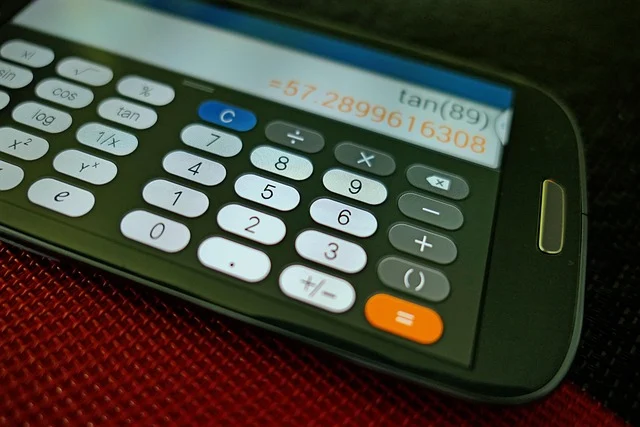
0.000452,45000000,6.02e23or6.02 × 10^23all work. - To calculate, choose an operation and enter a second number.
- Press Convert.
What scientific notation is
A number in scientific notation is written as
$$a \times 10^{n}, \qquad 1 \le |a| < 10$$
where n is a whole number. The coefficient a carries the significant digits and the exponent n says how many places to move the decimal point. Large numbers have positive exponents and small numbers have negative ones.
Converting to scientific notation
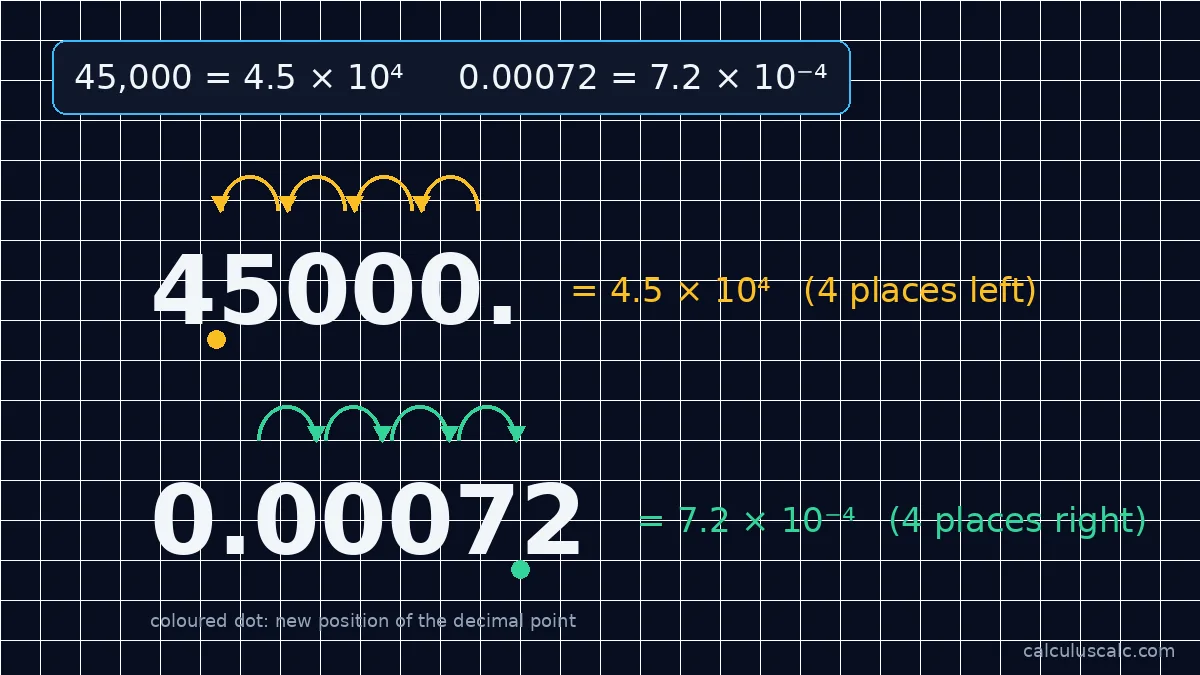
Move the decimal point until exactly one non-zero digit is in front of it. Count the moves:
- 0.000452: move the point 4 places right to get 4.52, so the exponent is −4: \( 4.52 \times 10^{-4} \) (as loaded above).
- 45,000,000: move it 7 places left to get 4.5: \( 4.5 \times 10^{7} \).
- 299,792,458 (the speed of light in m/s): \( 2.99792458 \times 10^{8} \).
Converting back
The exponent tells you which way to move: positive means right (a bigger number), negative means left. \( 3.1 \times 10^{-3} = 0.0031 \) and \( 7.25 \times 10^{5} = 725{,}000 \).
Calculating in scientific notation
Multiplying: multiply the coefficients and add the exponents.
$$(3 \times 10^{4})(2 \times 10^{5}) = 6 \times 10^{9}$$
Dividing: divide the coefficients and subtract the exponents.
$$\frac{8 \times 10^{6}}{2 \times 10^{2}} = 4 \times 10^{4}$$
Adding or subtracting: first rewrite the numbers with the same exponent.
$$3.2 \times 10^{4} + 5 \times 10^{3} = 3.2 \times 10^{4} + 0.5 \times 10^{4} = 3.7 \times 10^{4}$$
If the coefficient ends up outside 1 to 10, adjust it: \( (6.02 \times 10^{23}) \times 2 = 12.04 \times 10^{23} = 1.204 \times 10^{24} \). These rules come straight from the exponent rules.
E notation and engineering notation
- E notation replaces “× 10^” with “e” or “E”: \( 4.52 \times 10^{-4} \) is
4.52e-4. Calculators, spreadsheets and programming languages use it. - Engineering notation uses exponents that are multiples of 3, matching the metric prefixes: \( 0.000452 = 452 \times 10^{-6} \), that is, 452 micro-units.
| Power | Prefix | Example |
|---|---|---|
| \( 10^{9} \) | giga (G) | 3 GHz |
| \( 10^{6} \) | mega (M) | 5 MW |
| \( 10^{3} \) | kilo (k) | 2 km |
| \( 10^{-3} \) | milli (m) | 7 mm |
| \( 10^{-6} \) | micro (µ) | 452 µg |
| \( 10^{-9} \) | nano (n) | 650 nm |
Significant figures
The digits in the coefficient are the significant figures: \( 4.52 \times 10^{-4} \) has three. Scientific notation removes the ambiguity of trailing zeros: \( 4.5 \times 10^{7} \) has two significant figures, \( 4.500 \times 10^{7} \) has four. The significant figures calculator counts and rounds them for you.
Common mistakes
- Coefficient outside 1 to 10. \( 45 \times 10^{6} \) is not standard form; write \( 4.5 \times 10^{7} \).
- Wrong sign on the exponent. Small numbers (less than 1) have negative exponents.
- Adding exponents when adding numbers. Only multiplication adds exponents.
Step-by-step: converting a number
- Find the first non-zero digit and put the decimal point right after it. That is the coefficient.
- Count how many places the decimal point moved.
- If the original number was 10 or more, the exponent is positive; if it was less than 1, it is negative.
- Keep the digits you trust (the significant figures).
Very large and very small numbers
| Quantity | Value |
|---|---|
| Avogadro’s number | \( 6.022 \times 10^{23} \) per mole |
| Mass of the Earth | \( 5.972 \times 10^{24} \) kg |
| Speed of light | \( 2.998 \times 10^{8} \) m/s |
| Diameter of a hydrogen atom | about \( 1 \times 10^{-10} \) m |
| Mass of an electron | \( 9.109 \times 10^{-31} \) kg |
Written in full, the electron’s mass would need 30 zeros after the decimal point before the first 9. Scientific notation makes such numbers readable, easy to compare and easy to multiply.
Orders of magnitude
The exponent shows the order of magnitude. Earth (\( 10^{24} \) kg) is about \( 10^{54} \) times more massive than an electron (\( 10^{-30} \) kg). This is because \( 24 - (-30) = 54 \). Estimating with powers of ten helps check answers. A scientific notation calculator can quickly verify these magnitudes.
Scientific notation and logarithms
\( \log_{10} \) of a number in scientific notation is the exponent plus the log of the coefficient: \( \log_{10}(3 \times 10^{5}) = 5 + \log_{10} 3 \approx 5.477 \). This is why pH, decibels and the Richter scale, all logarithmic, are so closely tied to powers of ten (see logarithm rules).
Practice problems
- Write 0.00000072 in scientific notation.
- Write 5,600,000 in scientific notation.
- \( (4 \times 10^{3})(2.5 \times 10^{-5}) \).
- \( \frac{9 \times 10^{8}}{3 \times 10^{-2}} \).
Answers: 1. \( 7.2 \times 10^{-7} \). 2. \( 5.6 \times 10^{6} \). 3. \( 10 \times 10^{-2} = 1 \times 10^{-1} \). 4. \( 3 \times 10^{10} \) (subtracting −2 adds 2 to the exponent).
Comparing numbers in scientific notation
Compare exponents first. Only if they are equal, compare coefficients. \( 3.2 \times 10^{5} \) is larger than \( 9.9 \times 10^{4} \). This is true even though 9.9 is bigger than 3.2. \( 10^{5} \) is ten times \( 10^{4} \). For negative exponents, the less negative one is larger. Consider \( 2 \times 10^{-3} > 8 \times 10^{-4} \) for example. A scientific notation calculator can help with such comparisons.

Worked example: a light-year
Light travels \( 2.998 \times 10^{8} \) m/s, and a year has about \( 3.156 \times 10^{7} \) seconds. A light-year is therefore
$$(2.998 \times 10^{8})(3.156 \times 10^{7}) = 9.46 \times 10^{15} \text{ m}$$
Multiply the coefficients (\( 2.998 \times 3.156 \approx 9.46 \)) and add the exponents (\( 8 + 7 = 15 \)).
Negative numbers
The sign goes on the coefficient: \( -45{,}000 = -4.5 \times 10^{4} \) and \( -0.0032 = -3.2 \times 10^{-3} \). The sign of the exponent is about size, not about whether the number is negative.
Scientific notation in everyday life
You see it often. A phone’s storage of 128 GB is about \( 1.28 \times 10^{11} \) bytes. A virus is about \( 1 \times 10^{-7} \) m across. The world’s population is roughly \( 8 \times 10^{9} \) people. Writing these with powers of ten simplifies comparisons. For quick computations, a scientific notation calculator can be very helpful. The population is 80 times larger than \( 10^{8} \).
Related guides
Further reading
- Scientific notation (Wikipedia) — normalized form, E notation and engineering notation.
FAQ
How do you write a number in scientific notation?
Move the decimal point so one non-zero digit is in front of it, then multiply by 10 to the number of places you moved (positive for big numbers, negative for small ones).
What is 0.0005 in scientific notation?
\( 5 \times 10^{-4} \).
How do you multiply numbers in scientific notation?
Multiply the coefficients and add the exponents, then adjust so the coefficient is between 1 and 10.
What does e mean on a calculator?
It is E notation: 3e8 means \( 3 \times 10^{8} \). However, it is not the number e ≈ 2.718.
Is 45 × 10⁶ in scientific notation?
Not in standard form, because the coefficient must be between 1 and 10. It equals \( 4.5 \times 10^{7} \).
How do I type scientific notation on a calculator?
Use the EE or EXP key: \( 6.02 \times 10^{23} \) is entered as 6.02 EE 23. Also, in spreadsheets and this calculator you can type 6.02e23.