
Polar to Rectangular Calculator (and Back)
- Free
- No sign-up
- Works on phones
- Shows the working
 By Yasir Hafeez · Updated
This polar to rectangular calculator converts points between polar coordinates ( (r, theta) ) and rectangular (Cartesian) coordinates ( (x, y) ), in either direction. Also, angles can be in degrees or radians. Answers are exact where possible (like ( sqrt{3} ) and ( frac{3pi}{4} )), and the angle is always placed in the correct quadrant.
It’s free and needs no sign-up.
How to use it
- Choose the direction: polar → rectangular, or rectangular → polar.
- For polar → rectangular, enter r and θ and pick degrees or radians. You can also type
pi/3for radians. - For rectangular → polar, enter x and y.
- Press Convert.
Formulas
Polar to rectangular:
$$x = rcostheta, qquad y = rsintheta$$
Rectangular to polar:
$$r = sqrt{x^2 + y^2}, qquad tantheta = frac{y}{x}$$
The second pair needs care: ( tantheta = frac{y}{x} ) gives the same value in opposite quadrants, so you must look at the signs of x and y to choose θ. The calculator does this with the two-argument arctangent, atan2.
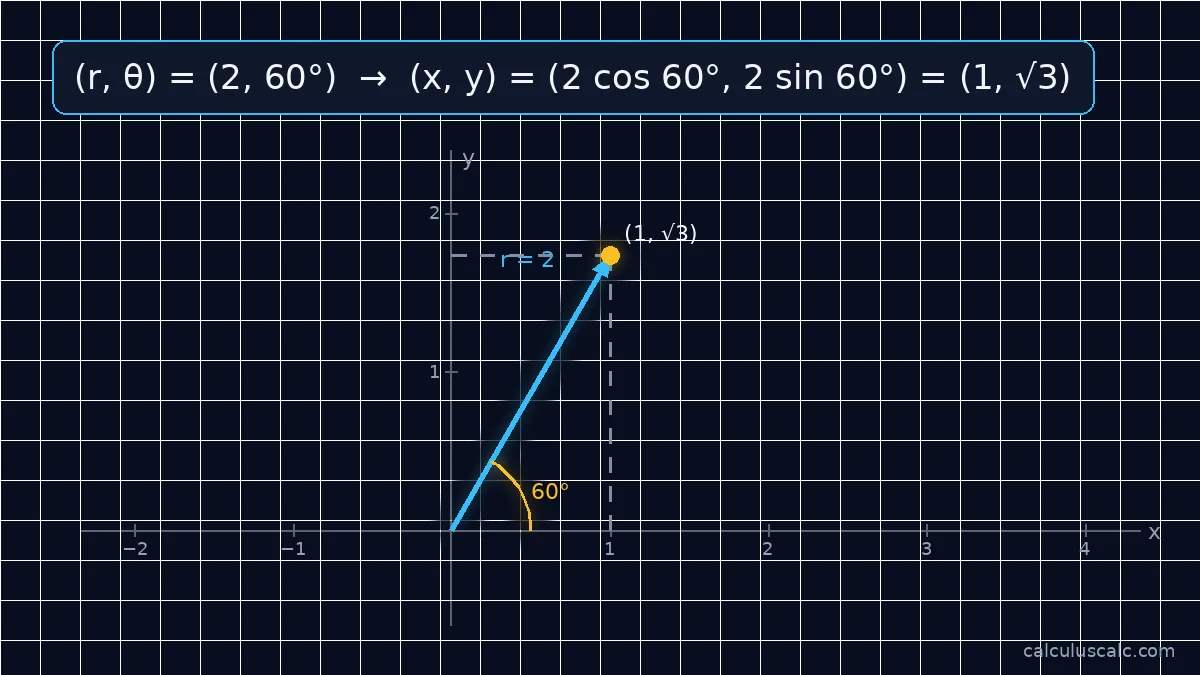
Worked example: using a polar to rectangular calculator for (2, 60°)
As loaded above:
$$x = 2cos 60^circ = 2 cdot tfrac12 = 1, qquad y = 2sin 60^circ = 2 cdot tfrac{sqrt{3}}{2} = sqrt{3}$$
So ( (2, 60^circ) ) is the point ( (1, sqrt{3}) approx (1, 1.732) ). The exact sine and cosine values come from the unit circle.
Worked example: (−1, 1) to polar
( r = sqrt{(-1)^2 + 1^2} = sqrt{2} ). Then ( tantheta = frac{1}{-1} = -1 ). A calculator’s ( tan^{-1}(-1) ) gives ( -45^circ ), but the point ( (-1, 1) ) is in Quadrant II (x negative, y positive), so add 180°:

$$theta = 135^circ = frac{3pi}{4}$$
The polar form is ( left(sqrt{2}, frac{3pi}{4}right) ).
Worked example: (−3, −3) to polar
( r = sqrt{9 + 9} = 3sqrt{2} ). Both coordinates are negative, so the point is in Quadrant III and ( theta = 225^circ = frac{5pi}{4} ), not the 45° that ( tan^{-1}(1) ) suggests.
Fixing the quadrant by hand
| Quadrant | Signs | θ from ( tan^{-1}left(frac{y}{x}right) ) |
|---|---|---|
| I | x > 0, y > 0 | use as is |
| II | x < 0, y > 0 | add 180° (π) |
| III | x < 0, y < 0 | add 180° (π) |
| IV | x > 0, y < 0 | add 360° (2π), or leave negative |
Polar coordinates are not unique
The same point has many polar names: adding 360° to θ, or using a negative r with θ + 180°, gives the same point. For example, ( (sqrt{2}, 135^circ) ), ( (sqrt{2}, 495^circ) ) and ( (-sqrt{2}, -45^circ) ) all describe ( (-1, 1) ). However, the calculator gives the standard form with ( r ge 0 ) and ( 0 le theta < 2pi ).
Converting equations
The same formulas convert whole equations. ( r = 4costheta ) becomes ( r^2 = 4rcostheta ), so ( x^2 + y^2 = 4x ), a circle with centre ( (2, 0) ) and radius 2. Curves, areas and arc length in polar form are covered in polar coordinates.
Common mistakes
- Using tan⁻¹(y/x) without checking the quadrant.
- Degrees vs radians. Make sure the angle mode matches your input. For example, see degrees to radians.
- Mixing up sin and cos. x goes with cosine, y with sine.
Worked example: radians
Convert ( left(4, frac{5pi}{6}right) ) to rectangular form:
$$x = 4cosfrac{5pi}{6} = 4left(-frac{sqrt{3}}{2}right) = -2sqrt{3}, qquad y = 4sinfrac{5pi}{6} = 4 cdot frac12 = 2$$
So the point is ( (-2sqrt{3}, 2) approx (-3.464, 2) ). Choose radians and type 5*pi/6 to check.
Worked example: Quadrant III back to polar
( (-2, -2sqrt{3}) ): ( r = sqrt{4 + 12} = 4 ). The reference angle is ( tan^{-1}sqrt{3} = 60^circ ), and the point is in Quadrant III, so ( theta = 180^circ + 60^circ = 240^circ = frac{4pi}{3} ).
Converting polar equations
Use ( x = rcostheta ), ( y = rsintheta ) and ( r^2 = x^2 + y^2 ):
| Polar | Rectangular | Shape |
|---|---|---|
| ( r = 2 ) | ( x^2 + y^2 = 4 ) | circle, radius 2 |
| ( theta = frac{pi}{4} ) | ( y = x ) | line through the origin |
| ( rsintheta = 3 ) | ( y = 3 ) | horizontal line |
| ( r = 4costheta ) | ( (x – 2)^2 + y^2 = 4 ) | circle through the origin |
| ( r = frac{1}{1 – costheta} ) | ( y^2 = 2x + 1 ) | parabola |
Complex numbers in polar form
A complex number ( a + bi ) is the point ( (a, b) ), so the same conversion gives its modulus and argument: ( 1 + i ) has ( r = sqrt{2} ) and ( theta = 45^circ ), so ( 1 + i = sqrt{2}(cos 45^circ + isin 45^circ) ). Polar form makes multiplying complex numbers easy: multiply the moduli and add the angles.
Practice problems
- ( (6, 90^circ) ) to rectangular.
- ( (3, pi) ) to rectangular.
- ( (0, -5) ) to polar.
Answers: 1. ( (0, 6) ). 2. ( (-3, 0) ). 3. ( r = 5 ), ( theta = 270^circ = frac{3pi}{2} ).
Distance between two points in polar form
You don’t have to convert to rectangular first. By the law of cosines, the distance between ( (r_1, theta_1) ) and ( (r_2, theta_2) ) is
$$d = sqrt{r_1^2 + r_2^2 - 2r_1r_2cos(theta_2 - theta_1)}$$
For ( (2, 0^circ) ) and ( (2, 90^circ) ): ( d = sqrt{4 + 4 – 8cos 90^circ} = sqrt{8} = 2sqrt{2} ), the same as the distance from ( (2, 0) ) to ( (0, 2) ).
Common polar curves
- Circle ( r = a ): radius a, centred at the origin.
- Cardioid ( r = 1 + costheta ): a heart shape.
- Rose ( r = cos(3theta) ): three petals (an odd multiplier k gives k petals, an even one 2k).
- Spiral ( r = theta ): winds outward as θ grows.
These are much simpler in polar form than in x and y.

Area in polar coordinates
The area swept out by ( r = f(theta) ) from ( theta = alpha ) to ( beta ) is
$$A = frac12int_alpha^beta r^2,dtheta$$
For the circle ( r = 2 ): ( A = frac12int_0^{2pi} 4,dtheta = 4pi ), matching ( pi r^2 ). Also, arc length and areas of polar curves are covered in polar coordinates.
Step-by-step for Polar to Rectangular
First, identify your given polar coordinates (r, θ). Make sure you know if your angle θ is in degrees or radians. This is a critical first step for accurate conversion.
Next, open the calculator. Select the 'Polar to Rectangular' conversion option. You will see input fields for 'r' and 'θ'.
Then, input your 'r' value into the corresponding field. Enter your 'θ' value into its field. Ensure the correct unit (degrees or radians) is selected from the dropdown menu.
Finally, click the 'Convert' button. The calculator will display the equivalent rectangular coordinates (x, y). Double-check your input values before pressing convert.
Checking Your Rectangular Results
After using the polar to rectangular calculator, verify your answer. The calculated (x, y) point should align with the original polar point's quadrant. For example, if r is positive and θ is between 90° and 180°, x should be negative and y positive.
Furthermore, consider the magnitude. The hypotenuse of (x, y) should equal r. Calculate sqrt(x^2 + y^2). This value must match your original r. This quick check helps catch input errors or misinterpretations.
Also, visualize the point. A rough sketch on graph paper can confirm the quadrant. Imagine r as the length from the origin and θ as the angle from the positive x-axis. This visual check often highlights obvious errors.
Related guides
Further reading
- Polar coordinate system (Wikipedia) — conversions, polar curves and uses.
FAQ
How do you convert polar to rectangular coordinates?
Use ( x = rcostheta ) and ( y = rsintheta ).
How do you convert rectangular to polar coordinates?
( r = sqrt{x^2 + y^2} ) and θ is the angle with ( tantheta = frac{y}{x} ), placed in the quadrant given by the signs of x and y.
What is (0, 0) in polar coordinates?
r = 0 with any angle. The origin has no single angle.
Why did my calculator give the wrong angle?
( tan^{-1} ) only returns angles between −90° and 90°. For points with negative x, add 180°.
Can r be negative?
Yes. A negative r means “go in the opposite direction”: ( (-2, 30^circ) ) is the same point as ( (2, 210^circ) ).
When are polar coordinates better than rectangular?
For circles, spirals, roses and anything with rotational symmetry, and for integrating over discs. However, rectangular coordinates are better for lines and boxes.