

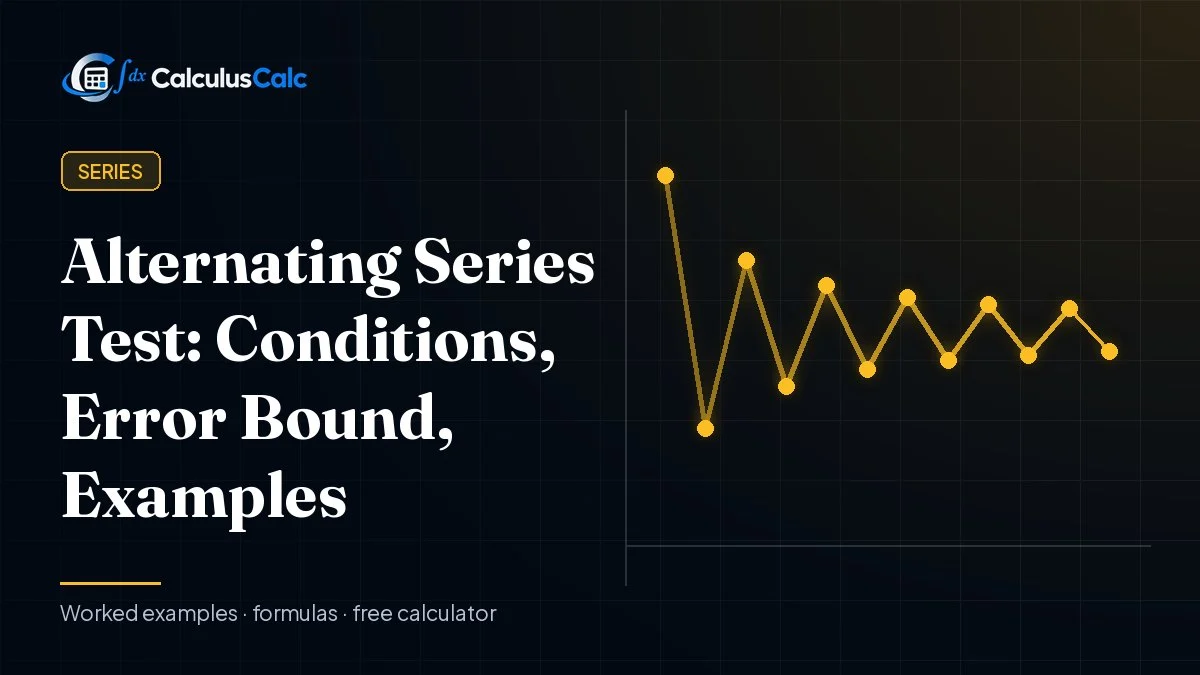
The alternating series test says that a series ( sum (-1)^{n+1}b_n ) with ( b_n > 0 ) converges if (1) the terms decrease, ( b_{n+1} le b_n ) (at least eventually), and (2) ( lim_{ntoinfty} b_n = 0 ). When it converges, the error from stopping after ( N ) terms is at most the first omitted term: ( lvert S – S_Nrvert le b_{N+1} ).
An alternating series is one whose terms switch sign: plus, minus, plus, minus. The positive and negative terms partly cancel, so an alternating series can converge even when the same series with all positive terms diverges. The alternating series test (also called the Leibniz test) is the standard way to prove it.
The test
Write the series as
$$sum_{n=1}^{infty}(-1)^{n+1}b_n = b_1 - b_2 + b_3 - b_4 + cdots, qquad b_n > 0$$
(or with ( (-1)^n ); the sign of the first term doesn’t matter). The series converges if both conditions hold:
- Decreasing: ( b_{n+1} le b_n ) for all ( n ) beyond some point.
- Limit zero: ( lim_{ntoinfty} b_n = 0 ).
If condition 2 fails, the series diverges by the divergence test. If only condition 1 fails, the test is inconclusive and you need another method.
Why it works
The partial sums bounce back and forth: ( S_1 = b_1 ), ( S_2 = b_1 – b_2 ), ( S_3 = S_2 + b_3 ), … Because each step is smaller than the one before, the odd partial sums decrease and the even ones increase, and the gap between them, ( b_{n+1} ), shrinks to zero. The two sequences squeeze together onto a single limit ( S ), the same idea as the squeeze theorem.
Example 1: the alternating harmonic series
$$sum_{n=1}^{infty}frac{(-1)^{n+1}}{n} = 1 - frac12 + frac13 - frac14 + cdots$$
Here ( b_n = frac1n ). It’s decreasing (( frac{1}{n+1} < frac1n )) and ( frac1n to 0 ), so the series converges. Its sum is ( ln 2 approx 0.6931 ).
This is remarkable because the harmonic series ( sumfrac1n ) without the signs diverges. Run it in the calculator: the partial sums settle near 0.6931.
The full series convergence calculator handles any series.
Example 2: a square root denominator
( sum_{n=1}^{infty}frac{(-1)^n}{sqrt n} ). With ( b_n = frac{1}{sqrt n} ): decreasing, and ( frac{1}{sqrt n} to 0 ). It converges.
Example 3: limit not zero
( sum_{n=1}^{infty}(-1)^nfrac{n}{n + 1} ). Here ( b_n = frac{n}{n+1} to 1 neq 0 ). The terms don’t shrink to zero, so the series diverges (the divergence test). The partial sums keep jumping by nearly 1.
Example 4: checking “decreasing” with a derivative
( sum_{n=1}^{infty}(-1)^{n+1}frac{ln n}{n} ). Let ( f(x) = frac{ln x}{x} ). Then

$$f'(x) = frac{1 - ln x}{x^2} < 0 quadtext{for } x > e$$
so ( b_n ) decreases for ( n ge 3 ). And ( frac{ln n}{n} to 0 ) (by L’Hôpital’s rule). Both conditions hold eventually, so the series converges. “Eventually decreasing” is enough, since the first few terms don’t affect convergence.
The alternating series error bound
If the test applies, the sum ( S ) lies between any two consecutive partial sums, and

$$lvert S - S_Nrvert le b_{N+1}$$
The error is at most the first term you left out, and it has the same sign as that term.
Example 5. Using 10 terms of the alternating harmonic series: ( S_{10} approx 0.6456 ), and the error is at most ( b_{11} = frac{1}{11} approx 0.0909 ). The true value ( ln 2 approx 0.6931 ) is indeed within 0.0909 of 0.6456.
Example 6: how many terms for a given accuracy? ( e^{-1} = sum_{n=0}^{infty}frac{(-1)^n}{n!} ). For an error below 0.001 we need the first omitted term ( frac{1}{n!} ) to be below 0.001. Since ( frac{1}{6!} = frac{1}{720} approx 0.00139 ) is too big but ( frac{1}{7!} = frac{1}{5040} approx 0.0002 ) is small enough, add the terms from ( n = 0 ) through ( n = 6 ). This is how Taylor series values are computed to a guaranteed accuracy.
Absolute vs conditional convergence
| Type | Meaning | Example |
|---|---|---|
| Absolutely convergent | ( sumlvert a_nrvert ) converges | ( sumfrac{(-1)^n}{n^2} ) |
| Conditionally convergent | ( sum a_n ) converges but ( sumlvert a_nrvert ) diverges | ( sumfrac{(-1)^{n+1}}{n} ) |
| Divergent | ( sum a_n ) diverges | ( sum(-1)^n ) |
Absolute convergence is stronger: an absolutely convergent series converges no matter how you rearrange its terms. A conditionally convergent series can be rearranged to add up to any number you like (the Riemann rearrangement theorem), which is why the order of terms matters for it.
To classify an alternating series: first test ( sumlvert a_nrvert ) (with the ratio test, comparison or p-series). If that converges, the series is absolutely convergent. If not, apply the alternating series test to see whether it’s conditionally convergent.
Example 7. ( sumfrac{(-1)^n}{n^2} ): ( sumfrac{1}{n^2} ) is a convergent p-series (( p = 2 > 1 )), so it’s absolutely convergent.
Common mistakes
- Forgetting to check that ( b_n to 0 ). Decreasing alone isn’t enough: ( b_n = 1 + frac1n ) decreases but tends to 1.
- Including the sign in ( b_n ). ( b_n ) is the positive part; take the absolute value of the term.
- Using the test to prove divergence. If the decreasing condition fails but ( b_n to 0 ), the test simply doesn’t decide.
- Calling every convergent alternating series absolutely convergent. Check ( sumlvert a_nrvert ) separately.
- Misusing the error bound. It applies only when both conditions of the test hold.
Practice problems
Decide whether each series converges or diverges; if it converges, say whether absolutely or conditionally.

- ( sum_{n=1}^{infty}frac{(-1)^{n+1}}{2n + 1} )
- ( sum_{n=1}^{infty}frac{(-1)^n}{n^3} )
- ( sum_{n=1}^{infty}(-1)^nfrac{2n}{n + 5} )
- ( sum_{n=1}^{infty}frac{(-1)^{n+1}}{sqrt[3]{n}} )
- How many terms of ( sumfrac{(-1)^{n+1}}{n^2} ) guarantee an error below 0.01?
Answers: (1) converges conditionally; (2) converges absolutely; (3) diverges (terms tend to 2, not 0); (4) converges conditionally; (5) 10 terms, since ( b_{11} = frac{1}{121} < 0.01 ) while ( b_{10} = frac{1}{100} ) is not below 0.01.
FAQ
What are the conditions of the alternating series test?
The positive parts ( b_n ) must eventually decrease, and ( lim b_n = 0 ). Then the alternating series converges.
Can the alternating series test prove divergence?
Not by itself. If ( b_n ) doesn’t tend to 0, the series diverges, but that’s the divergence test. If only the decreasing condition fails, the result is inconclusive.
What is the alternating series remainder?
When the test applies, the error after ( N ) terms is at most ( b_{N+1} ), the size of the first unused term.
What does conditionally convergent mean?
The series converges with its alternating signs, but the series of absolute values diverges. The alternating harmonic series is the standard example.
What does the alternating harmonic series converge to?
( ln 2 approx 0.6931 ).
Further reading
- Alternating series test (Wikipedia) — statement, proof and the remainder estimate.
- Sequences (Paul’s Online Math Notes) — the start of the series chapter, leading to the alternating series test.
Calculators for this topic
Keep learning

Arithmetic and Geometric Sequences: Formulas and Sums
Arithmetic and geometric sequence formulas for the nth term and the sum, sigma notation, infinite geometric series, and worked examples with answers.

Geometric Series Formula: Sum, Convergence and Examples
An infinite geometric series a + ar + ar² + … sums to a/(1 − r) when |r| < 1. Finite sum formula, derivation, repeating decimals and worked examples.