
Permutation and Combination Calculator (nPr and nCr)
- Free
- No sign-up
- Works on phones
- Shows the working
 By Yasir Hafeez · Updated
This permutation and combination calculator finds ( P(n, r) ) (nPr) and ( C(n, r) ) (nCr, “n choose r”) exactly, using whole-number arithmetic so even huge answers are not rounded. It also gives the counts when repetition is allowed. Enter the total number of items n and how many you choose, r.
It’s free and needs no sign-up.
How to use it
- Enter n, the number of items to choose from.
- Enter r, the number chosen.
- Press Calculate.
Using a combination calculator: permutation or combination?
Ask one question: does the order matter?
- Order matters (rankings, passwords, seating, race finishes): use a permutation.
- Order doesn’t matter (teams, committees, lottery numbers, a hand of cards): use a combination.
Formulas
$$P(n, r) = frac{n!}{(n - r)!}, qquad C(n, r) = binom{n}{r} = frac{n!}{r!,(n - r)!}$$
where ( n! = n times (n – 1) times cdots times 2 times 1 ) and ( 0! = 1 ). Since each group of r items can be arranged in ( r! ) orders, ( P(n, r) = r! times C(n, r) ).
Worked example: 10 and 3
As loaded above.
- Gold, silver and bronze among 10 runners (order matters): ( P(10, 3) = 10 times 9 times 8 = 720 ).
- Choosing a 3-person committee from 10 (order doesn’t matter): ( C(10, 3) = frac{720}{3!} = frac{720}{6} = 120 ).
Worked example: poker hands
The number of 5-card hands from a 52-card deck is
$$binom{52}{5} = frac{52 times 51 times 50 times 49 times 48}{5!} = 2{,}598{,}960$$
Worked example: a lottery
Picking 6 numbers from 49, where order doesn’t matter, gives ( binom{49}{6} = 13{,}983{,}816 ) possible tickets. As a result, one ticket’s chance of the jackpot is about 1 in 14 million.
With repetition
- Permutations with repetition: ( n^r ). For example, a 4-digit PIN using digits 0–9 has ( 10^4 = 10{,}000 ) possibilities.
- Combinations with repetition: ( binom{n + r – 1}{r} ). For example, choosing 3 scoops from 5 ice-cream flavours, repeats allowed and order ignored, gives ( binom{7}{3} = 35 ) choices.
Summary table
| Order matters | Order doesn’t matter | |
|---|---|---|
| No repetition | ( frac{n!}{(n-r)!} ) | ( frac{n!}{r!(n-r)!} ) |
| Repetition allowed | ( n^r ) | ( binom{n+r-1}{r} ) |
Where combinations appear in maths
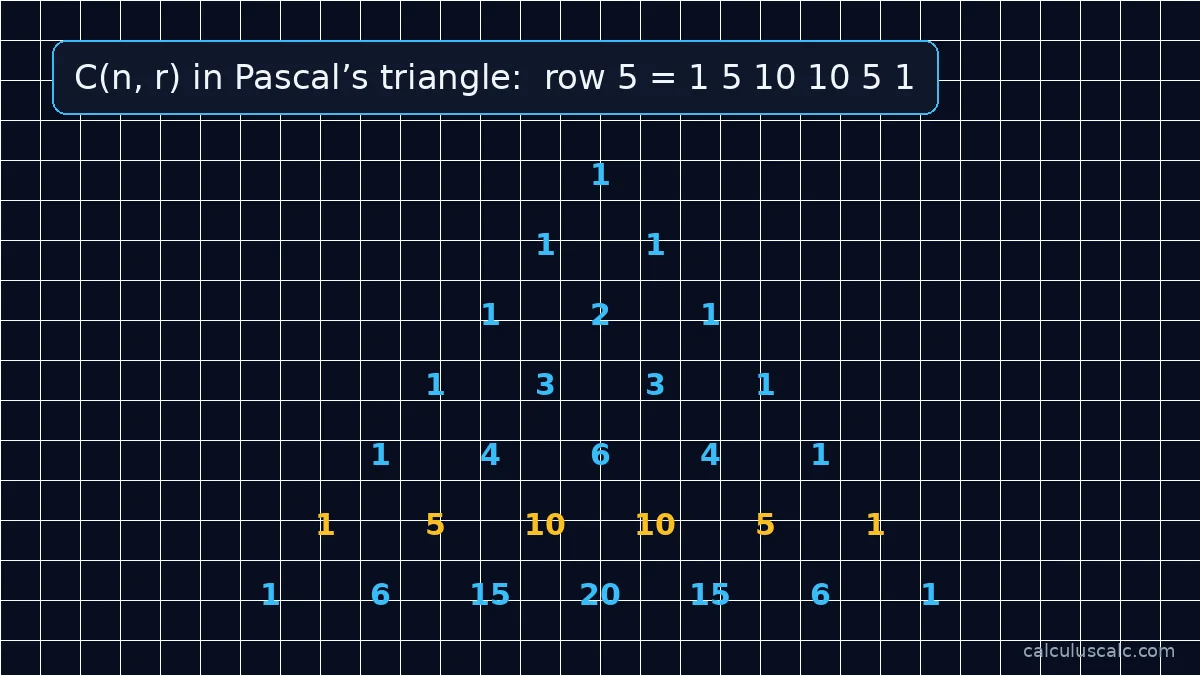
The numbers ( binom{n}{r} ) are the entries of Pascal’s triangle and the coefficients in the binomial theorem:
$$(a + b)^n = sum_{r=0}^{n} binom{n}{r} a^{n-r} b^r$$
They also give the probabilities in the binomial distribution, and the same pattern appears in the binomial series, a Taylor series.
Common mistakes
- Using permutations for a group. A committee of Ann, Ben and Cal is the same committee in any order.
- Forgetting 0! = 1. So ( C(n, n) = C(n, 0) = 1 ).
- r larger than n without repetition: there are no ways, so the answer is 0.
Step-by-step: which formula?
- Are you choosing all n items or only some (r of them)?
- Does the order matter? (Is ABC different from BCA?)
- Can items repeat? (Can you pick the same one twice?)
- Use the summary table above to pick the formula, and check the answer is reasonable: permutations are always at least as many as combinations.
Arrangements with repeated letters
The number of distinct arrangements of n objects where some are identical is ( frac{n!}{n_1!,n_2!cdots} ). For example, for the letters of MISSISSIPPI (11 letters: 1 M, 4 I, 4 S, 2 P):
$$frac{11!}{4!,4!,2!} = 34{,}650$$
Circular arrangements
Seating n people around a round table gives ( (n – 1)! ) arrangements, because rotating everyone one seat gives the same seating. Six people can sit in ( 5! = 120 ) ways.
Combinations and probability
The chance of exactly 2 aces in a 5-card poker hand is
$$frac{binom{4}{2}binom{48}{3}}{binom{52}{5}} = frac{6 times 17{,}296}{2{,}598{,}960} approx 0.0399$$
about 4%. Choose the aces (( binom{4}{2} )), choose the other three cards from the 48 non-aces, and divide by all possible hands. Most counting-based probability works this way.
Pascal’s triangle
Each entry is the sum of the two above it, and row n lists ( binom{n}{0}, binom{n}{1}, ldots, binom{n}{n} ):
| n | Row |
|---|---|
| 0 | 1 |
| 1 | 1 1 |
| 2 | 1 2 1 |
| 3 | 1 3 3 1 |
| 4 | 1 4 6 4 1 |
| 5 | 1 5 10 10 5 1 |
Practice problems
- ( P(8, 2) )
- ( C(8, 2) )
- Arrangements of the letters of BOOK.
- Committees of 2 men and 2 women from 7 men and 5 women.
Answers: 1. ( 8 times 7 = 56 ). 2. ( frac{56}{2} = 28 ). 3. ( frac{4!}{2!} = 12 ). 4. ( binom{7}{2}binom{5}{2} = 21 times 10 = 210 ).
The fundamental counting principle
One choice has ‘m’ ways. A second choice has ‘n’ ways. Together, they have (m times n) ways. Three shirts and four trousers give (3 times 4 = 12) outfits. Permutations use this principle repeatedly. A race with 10 runners offers 10 gold choices. Then, 9 silver choices exist. Next, 8 bronze choices remain. This makes (10 times 9 times 8 = 720) ways. You can use a combination calculator for such problems.
Worked example: passwords
An 8-character password using only lowercase letters has ( 26^8 = 208{,}827{,}064{,}576 ) possibilities (repetition allowed, order matters). Allowing the digits 0–9 as well raises it to ( 36^8 = 2{,}821{,}109{,}907{,}456 ), more than 13 times as many. This is why longer passwords with more kinds of character are much harder to guess.
Worked example: handshakes
If 10 people each shake hands once with everyone else, the number of handshakes is the number of pairs: ( binom{10}{2} = 45 ). Order doesn’t matter, since A shaking hands with B is the same handshake as B with A.

Worked example: pizza toppings
You have 8 toppings. Each topping is either on or off. This makes 2^8 = 256 possible pizzas. A combination calculator shows this. This total also equals the sum of row 8 of Pascal’s triangle. That is binom{8}{0} + binom{8}{1} + cdots + binom{8}{8}.
Factorials grow very fast
| n | n! |
|---|---|
| 5 | 120 |
| 10 | 3,628,800 |
| 13 | 6,227,020,800 |
| 20 | 2,432,902,008,176,640,000 |
A shuffled deck of 52 cards can be in ( 52! approx 8.07 times 10^{67} ) orders, so almost certainly no two well-shuffled decks in history have ever matched. Ordinary calculators overflow quickly; this calculator uses exact whole-number arithmetic instead.
Combinations with restrictions
How many 5-card hands have at least one ace? It is easier to count the opposite. Hands with no aces are ( binom{48}{5} = 1{,}712{,}304 ). So hands with at least one ace number ( 2{,}598{,}960 – 1{,}712{,}304 = 886{,}656 ). This is about 34% of all hands. Counting the complement is often the quickest route for “at least one” questions on a combination calculator.
Related guides
- Binomial Distribution Calculator
- Mean, Median and Mode
- Arithmetic and Geometric Sequences
- Taylor Series
Further reading
- Combination (Wikipedia) — counting subsets, with and without repetition.
- Permutation (Wikipedia) — arrangements and k-permutations of n.
FAQ
What is the difference between a permutation and a combination?
In a permutation the order matters; in a combination it doesn’t. ABC and CBA are two permutations but one combination.
What does nCr mean?
“n choose r”: the number of ways to choose r items from n when order doesn’t matter, ( frac{n!}{r!(n-r)!} ).
What is 5 choose 2?
( binom{5}{2} = frac{5 times 4}{2} = 10 ).
Why is C(n, r) equal to C(n, n − r)?
Choosing r items to take is the same as choosing the ( n – r ) items to leave behind.
What is 0! and why?
( 0! = 1 ). There is exactly one way to arrange zero objects (do nothing), and it makes formulas like ( binom{n}{0} = 1 ) work.
Why are combinations smaller than permutations?
Each combination of r items can be ordered in ( r! ) ways, so ( P(n, r) = r! times C(n, r) ).