Integration by Parts: Formula, LIATE Rule and Examples
Integration by parts: ∫u dv = uv − ∫v du. How to choose u with LIATE, 6 worked examples (x·sin x, ln x, arctan x, eˣ·cos x) and the tabular method.
Integration by parts: ∫u dv = uv − ∫v du. How to choose u with LIATE, 6 worked examples (x·sin x, ln x, arctan x, eˣ·cos x) and the tabular method.
U-substitution reverses the chain rule. A 5-step method for choosing u, 7 worked examples, definite integrals with changed limits, and common mistakes.
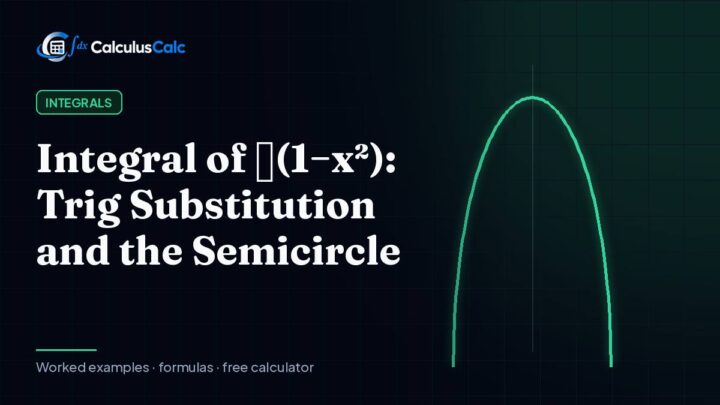
∫√(1−x²)dx = ½(x√(1−x²) + arcsin x) + C. Full trig substitution, the semicircle area π/2 shortcut, and the general √(a²−x²) formula.
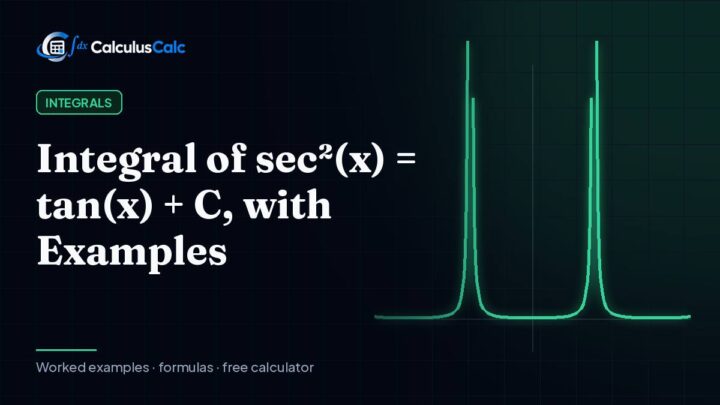
The integral of sec²(x) is tan(x) + C, because the derivative of tan x is sec²x. Examples with sec²(3x), tan²x, and definite integrals.
∫x·e^x dx = x·e^x − e^x + C. A clear integration by parts walkthrough with LIATE, x²e^x, x·e^(2x), x·e^(−x) and a definite integral.
e^(−x²) has no elementary antiderivative, but its integral over the whole real line equals √π. See the polar-coordinates proof and the erf function.
The integral of 1/x is ln|x| + C. Why the power rule fails at n = −1, why the absolute value matters, and examples like 1/(3x+2).
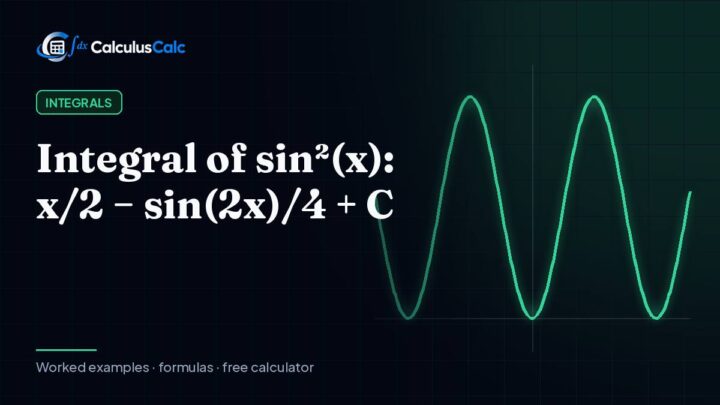
The integral of sin²(x) is x/2 − sin(2x)/4 + C. Uses the power-reduction identity; includes cos²x, sin²(3x) and definite integrals over [0, π].
The integral of sec(x) is ln|sec x + tan x| + C. See the multiply-by-(sec x + tan x) trick, a second method, csc x, and definite examples.
The integral of tan(x) is −ln|cos x| + C, or equivalently ln|sec x| + C. Step-by-step u-substitution, definite examples and tan²x.