Double Integrals: How to Evaluate Them Step by Step
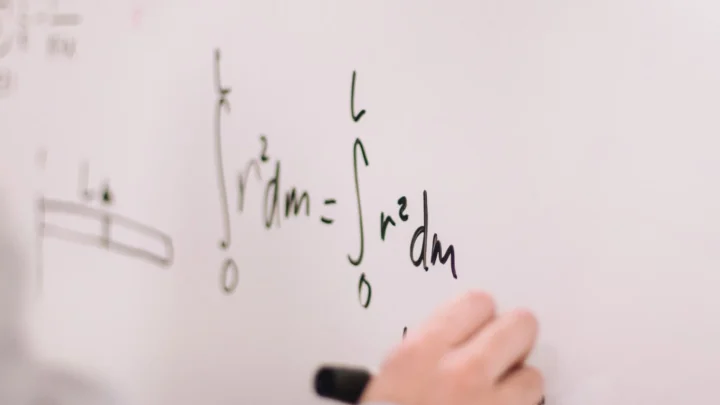
Evaluate double integrals as iterated integrals, switch the order of integration, and use polar coordinates. Step-by-step worked examples.
Evaluate double integrals as iterated integrals, switch the order of integration, and use polar coordinates. Step-by-step worked examples.
The gradient ∇f collects partial derivatives; the directional derivative D_u f = ∇f · u gives the slope in any direction. Worked example and geometric meaning.
A partial derivative differentiates in one variable, holding the others constant. Notation, examples, second partials and Clairaut’s theorem.
An infinite geometric series a + ar + ar² + … sums to a/(1 − r) when |r| < 1. Finite sum formula, derivation, repeating decimals and worked examples.
The ratio test: if lim |aₙ₊₁/aₙ| 1 it diverges, = 1 inconclusive. Worked examples with factorials, powers and radius of convergence.
The Taylor series formula, how to build Taylor polynomials step by step, a table of common Maclaurin series (eˣ, sin x, cos x, ln(1+x)), and error bounds.
The squeeze (sandwich) theorem finds limits by trapping a function between two others. Step-by-step examples with x²·sin(1/x), sin(x)/x and cos(x)/x.
How to evaluate limits as x → ∞: divide by the highest power, the three degree rules for rational functions, growth rates, and radical examples.
L’Hôpital’s rule evaluates 0/0 and ∞/∞ limits by differentiating top and bottom. Conditions, 6 worked examples, other indeterminate forms and common errors.
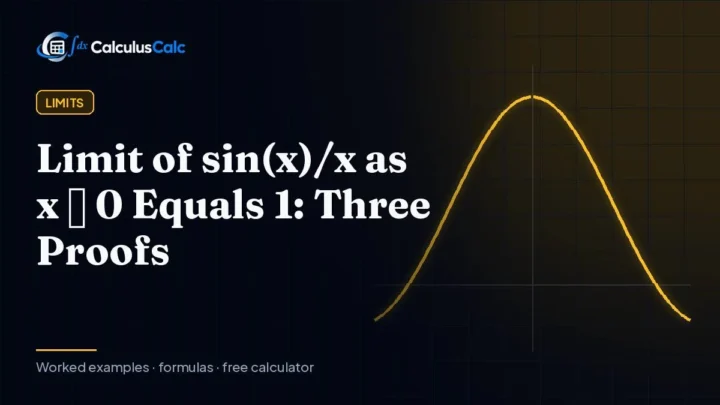
lim x→0 sin(x)/x = 1. See the squeeze theorem proof, the L’Hôpital shortcut (and why it’s circular), a numerical table and related limits.