
Surface Area of Revolution Calculator
- Free
- No sign-up
- Works on phones
- Shows the working
 By Yasir Hafeez · Updated
This surface area of revolution calculator finds the area of the surface you get by spinning a curve ( y = f(x) ), ( a le x le b ), around the x-axis or the y-axis. It shows the derivative, the integral it evaluates, and the area, recognising exact multiples of ( pi ) when they appear.
It’s free and needs no sign-up.
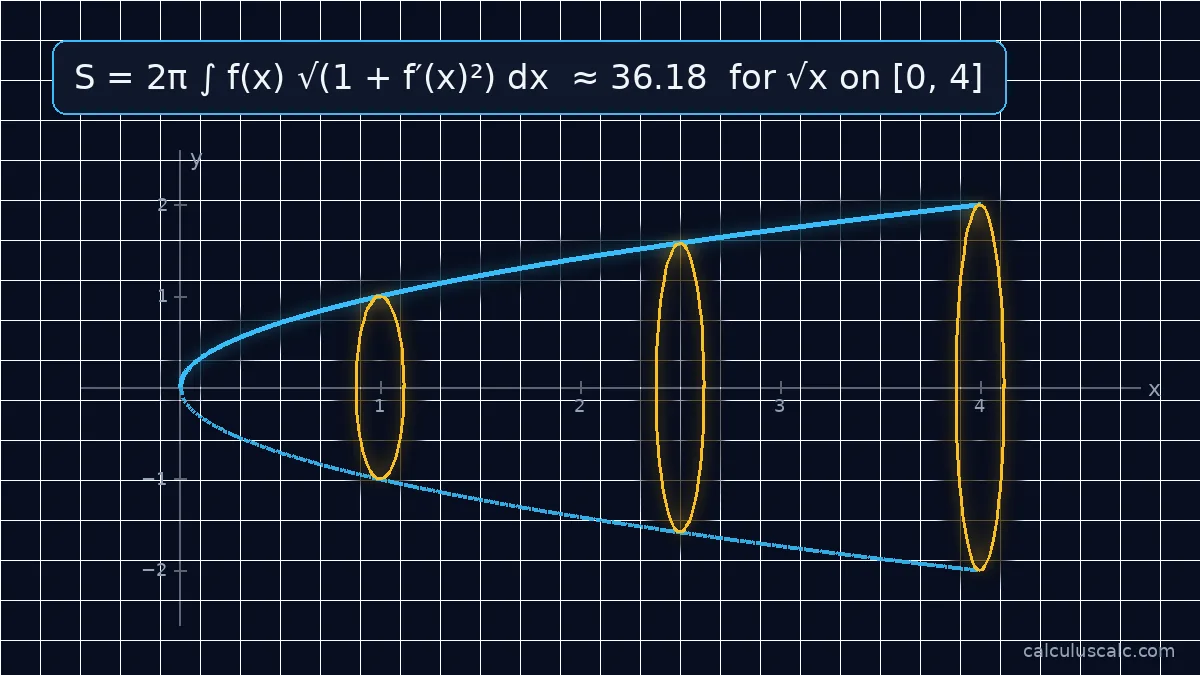
How to use it
- Type the function, for example
sqrt(x),x^3orsqrt(4 - x^2). - Enter the interval a to b.
- Choose whether to rotate about the x-axis or the y-axis.
- Press Calculate.
Formulas
Rotating about the x-axis, each point of the curve sweeps a circle of radius ( f(x) ):
$$S = 2piint_a^b f(x)sqrt{1 + [f'(x)]^2},dx$$
Rotating about the y-axis, the radius is the distance x from the axis:
$$S = 2piint_a^b xsqrt{1 + [f'(x)]^2},dx$$
The factor ( sqrt{1 + [f'(x)]^2},dx ) is the length of a tiny piece of the curve, the same element used in the arc length formula. Each piece sweeps a thin band with area (circumference) × (slant length) = ( 2pi r , ds ). The calculator uses ( |f(x)| ) and ( |x| ) as the radius, so parts of a curve below the axis still count as positive area.
Worked example: a paraboloid
Rotate ( y = sqrt{x} ), ( 0 le x le 4 ), about the x-axis (as loaded above). Here ( f'(x) = frac{1}{2sqrt{x}} ), so
$$f(x)sqrt{1 + [f'(x)]^2} = sqrt{x}sqrt{1 + frac{1}{4x}} = sqrt{x + tfrac14}$$
Then
$$S = 2piint_0^4 sqrt{x + tfrac14},dx = 2pi cdot tfrac23left[left(x + tfrac14right)^{3/2}right]_0^4 = frac{pi}{6}left(17sqrt{17} - 1right) approx 36.18$$
Worked example: checking with a sphere
Rotating the semicircle ( y = sqrt{4 – x^2} ), ( -2 le x le 2 ), about the x-axis gives a sphere of radius 2. The integrand simplifies beautifully: ( f(x)sqrt{1 + f'(x)^2} = sqrt{4 – x^2} cdot frac{2}{sqrt{4 – x^2}} = 2 ), so
$$S = 2piint_{-2}^{2} 2,dx = 16pi$$
which matches the sphere formula ( 4pi r^2 = 16pi ).
Worked example: a cone
Rotating ( y = x ), ( 0 le x le 3 ), about the x-axis gives a cone with radius 3 and slant height ( 3sqrt{2} ). The formula gives ( 2piint_0^3 xsqrt{2},dx = 9sqrt{2},pi approx 39.99 ), which is the same as the cone’s lateral area ( pi r l = pi cdot 3 cdot 3sqrt{2} ). However, the base disc is not included; surface of revolution formulas give only the curved surface.
Worked example: y = x³
Rotating ( y = x^3 ), ( 0 le x le 1 ), about the x-axis, substitute ( u = 1 + 9x^4 ):
$$S = 2piint_0^1 x^3sqrt{1 + 9x^4},dx = frac{pi}{27}left(10sqrt{10} - 1right) approx 3.563$$
surface area of revolution calculator: surface area vs volume
The disk and washer method and the shell method find the volume inside a solid of revolution, using ( pi r^2 ) or ( 2pi r h ). Surface area uses ( 2pi r ) times the slant length ( ds ), not ( dx ). Using ( dx ) instead of ( ds ) is the most common mistake and underestimates the area.
Common mistakes
- Leaving out ( sqrt{1 + f’^2} ). Without it you get the wrong answer for anything except a horizontal line.
- Using the wrong radius. About the x-axis the radius is ( f(x) ); however, about the y-axis it is x.
- Expecting the ends to be included. The formula gives only the curved surface, not the flat discs at the ends.
Step-by-step method
- Decide which axis you rotate about; that fixes the radius (( f(x) ) for the x-axis, x for the y-axis).
- Compute ( f'(x) ) and simplify ( sqrt{1 + [f'(x)]^2} ).
- Multiply by the radius and by ( 2pi ).
- Integrate from a to b, by hand if a substitution works, otherwise numerically.
Worked example: rotating about the y-axis
Rotate ( y = x^2 ), ( 0 le x le 1 ), about the y-axis. The radius is x and ( f'(x) = 2x ):
$$S = 2piint_0^1 xsqrt{1 + 4x^2},dx$$
With ( u = 1 + 4x^2 ), ( du = 8x,dx ):
$$S = 2pi cdot frac{1}{8}int_1^5 sqrt{u},du = frac{pi}{4}cdotfrac{2}{3}left[u^{3/2}right]_1^5 = frac{pi}{6}left(5sqrt{5} - 1right) approx 5.330$$
That is the area of a bowl-shaped paraboloid. Choose “The y-axis” in the calculator to check.
Worked example: a cone
Rotate ( y = 2x ), ( 0 le x le 1 ), about the x-axis. As a result, this is a cone with radius 2 and slant height ( sqrt{5} ):

$$S = 2piint_0^1 2xsqrt{5},dx = 2sqrt{5},pi approx 14.05$$
matching ( pi r l = pi cdot 2 cdot sqrt{5} ).
A famous paradox: Gabriel’s horn
Rotate ( y = frac{1}{x} ) for ( x ge 1 ) about the x-axis. Its volume is finite, ( piint_1^infty frac{dx}{x^2} = pi ), but its surface area is infinite, because ( 2piint_1^infty frac{1}{x}sqrt{1 + frac{1}{x^4}},dx ge 2piint_1^infty frac{dx}{x} ), which diverges. You could fill the horn with paint but never paint its inside surface. See improper integrals for how such integrals are handled.
Applications
The formula gives the material needed for curved containers, lampshades, satellite dishes, nose cones and vases; the area to be painted or coated on a turned part; and the surface of lenses and reflectors. Also, engineers often combine it with the volume methods: volume for capacity, surface area for material cost.
Practice problems
- Rotate ( y = 3 ), ( 0 le x le 4 ), about the x-axis.
- Next, Rotate ( y = sqrt{9 – x^2} ), ( -3 le x le 3 ), about the x-axis.
- Rotate ( y = x ), ( 0 le x le 1 ), about the y-axis.
Answers: 1. A cylinder’s side: ( 2pi(3)(4) = 24pi approx 75.4 ). 2. A sphere of radius 3: ( 36pi approx 113.1 ). 3. A cone with radius 1 and slant height ( sqrt{2} ): ( 2piint_0^1 xsqrt{2},dx = sqrt{2},pi approx 4.443 ).
Pappus’s theorem: a shortcut
The surface area swept by a curve rotating about an axis equals the curve’s length times the distance travelled by its centroid (centre of mass): ( S = L cdot 2pibar{r} ). For example, for a circle of radius 1 whose centre is 3 units from the axis, the doughnut (torus) has area ( (2pi)(2pi cdot 3) = 12pi^2 approx 118.4 ), with no integral needed.
Related guides
Further reading
- Surface of revolution (Wikipedia) — formulas, Pappus’s theorem and examples.
FAQ
What is the formula for surface area of revolution?
About the x-axis: ( S = 2piint_a^b f(x)sqrt{1 + [f'(x)]^2},dx ). However, about the y-axis: replace ( f(x) ) by x.
Why is there a square root in the formula?
It measures the slanted length of each small piece of the curve. A band on a slanted surface has more area than one on a flat cylinder of the same width.
Does it include the top and bottom?
No. Add the areas of any end discs separately if you need the total surface area of a closed solid.
Can the integral be done by hand?
Often only for special curves; for many functions the integral needs numerical methods, which the calculator uses.
How do I rotate about the y-axis when the curve is given as x = g(y)?
Integrate in y instead: ( S = 2piint_c^d g(y)sqrt{1 + [g'(y)]^2},dy ).
What units is the answer in?
Square units of whatever units x and y are in, for example cm² if lengths are in cm.