
 By
This disk method calculator finds the volume of a solid of revolution: take the region under ( y = f(x) ) from ( x = a ) to ( x = b ), spin it around the x-axis, and it tells you the volume. It shows the integral of ( [f(x)]^2 ) and the final volume, exact where it can recognize the value (such as ( 36pi )) and as a decimal.
It is a quick volume of revolution calculator for homework checks. Also, with two runs it handles washer problems too (see below). Free, no sign-up.
How to use the disk method calculator
- Enter the radius function ( f(x) ), the curve that is being rotated. Use
^for powers,sqrt(),sin(),ln()ande^(x);2xandx sqrt(x)work without*. - Enter the limits ( a ) and ( b ) along the x-axis (
piis accepted). - Press Compute volume.
- Read ( int_a^b f(x)^2,dx ) and the volume ( V ), which is ( pi ) times that integral, in cubic units.
The tool rotates about the x-axis. For rotation about the y-axis, use the shell method calculator or rewrite the curve as ( x ) in terms of ( y ).
Formula
Slice the solid perpendicular to the x-axis. Each slice is a thin disk of radius ( f(x) ) and thickness ( dx ), so its volume is ( pi [f(x)]^2,dx ). Adding the slices gives
$$V = pi int_a^b left[f(x)right]^2 dx$$
If the region has a hole, so that it lies between an outer curve ( R(x) ) and an inner curve ( r(x) ), each slice is a washer and
$$V = pi int_a^b left(R(x)^2 - r(x)^2right) dx$$
Our disk and washer method guide covers rotation about other horizontal lines and shows how to sketch the slices.
Worked examples
Example 1 (a sphere). Rotate the upper half of the circle ( x^2 + y^2 = 9 ), that is ( f(x) = sqrt{9 – x^2} ), about the x-axis for ( -3 le x le 3 ). Squaring removes the root:

$$V = pi int_{-3}^{3} (9 - x^2),dx = pi left[9x - tfrac{x^3}{3}right]_{-3}^{3} = 36pi$$
That is about 113.097 cubic units, matching the sphere formula ( frac43 pi r^3 ) with ( r = 3 ). Enter sqrt(9 - x^2), -3 and 3 in the calculator above to see ( 36pi ).
Example 2 (a horn shape). For ( f(x) = frac1x ) on ( [1, 3] ):
$$V = pi int_1^3 frac{dx}{x^2} = pileft(1 - tfrac13right) = frac{2pi}{3}$$
Washer problems with the disk calculator
Because ( piint (R^2 – r^2),dx = piint R^2,dx – piint r^2,dx ), you can find a washer volume by running the calculator twice and subtracting.
Take the region between ( y = sqrt{x} ) (outer) and ( y = frac{x}{2} ) (inner), rotated about the x-axis. The curves meet at ( x = 0 ) and ( x = 4 ).
- Disk of
sqrt(x)on [0, 4]: ( V_1 = 8pi ). - Disk of
x/2on [0, 4]: ( V_2 = frac{16pi}{3} ). - Washer volume: ( 8pi – frac{16pi}{3} = frac{8pi}{3} approx 8.37758 ).
Make sure the outer curve really is farther from the axis on the whole interval. If the curves cross, split the interval at the crossing (the area between curves calculator lists crossing points for you).
Common mistakes
- Squaring the difference instead of differencing the squares. ( (R – r)^2 ) is not ( R^2 – r^2 ). However, the two-run method above avoids this slip automatically.
- Forgetting ( pi ). The calculator shows the bare integral and the volume separately, so you can see which one your textbook answer matches.
- Wrong axis. The disk tool spins about the x-axis. Rotating about the y-axis or a line like ( y = 2 ) needs a different set-up.
Worked example: rotating around a line other than an axis
Rotate the region under \( y = \sqrt{x} \) from \( x = 0 \) to 4 around the line \( y = -1 \). Each slice is now a washer: the outer radius is the distance from \( y = -1 \) to the curve, \( R = \sqrt{x} + 1 \), and the inner radius is the distance to the x-axis, \( r = 1 \).
$$V = \pi\int_0^4 \left[(\sqrt{x} + 1)^2 - 1^2\right]dx = \pi\int_0^4 (x + 2\sqrt{x})\,dx = \pi\left(8 + \frac{32}{3}\right) = \frac{56\pi}{3} \approx 58.64$$
The key is always to measure radii from the axis of rotation, not from the x-axis.
Step-by-step method
- Sketch the region and the axis of rotation.
- Decide whether a slice perpendicular to the axis is a disk (touches the axis) or a washer (has a hole).
- Write the radius (or outer and inner radii) as distances from the axis.
- Integrate \( \pi R^2 \) (or \( \pi(R^2 - r^2) \)) across the region.
- Check the answer is positive and has cubic units.
Real-world volumes
Turning a profile curve around an axis models vases, bowls, bottles, wine barrels and machine parts. A designer who knows the radius of a bottle at each height can compute its capacity before making it.
Where the formula comes from
Each thin slice of the solid is a disk of radius \( R(x) \) and thickness \( dx \), with volume \( \pi R(x)^2\,dx \). Adding up infinitely many such slices from \( a \) to \( b \) gives the integral \( \pi\int_a^b R(x)^2\,dx \).
Practice problems
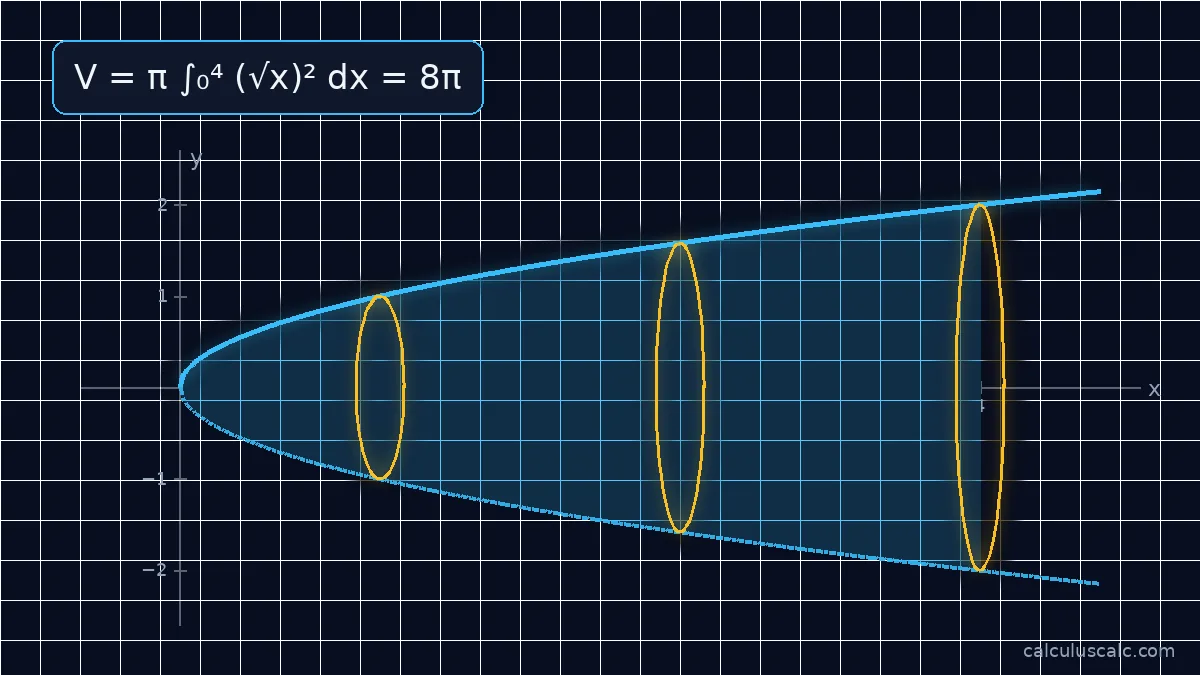
- Rotate \( y = \sqrt{x} \), \( 0 \le x \le 4 \), around the x-axis.
- Next, Rotate \( y = \sin x \), \( 0 \le x \le \pi \), around the x-axis.
- Rotate \( y = x^2 \), \( 0 \le x \le 2 \), around the x-axis.
Answers: 1. \( \pi\int_0^4 x\,dx = 8\pi \approx 25.13 \). 2. \( \pi\int_0^{\pi} \sin^2 x\,dx = \frac{\pi^2}{2} \approx 4.93 \). 3. \( \pi\int_0^2 x^4\,dx = \frac{32\pi}{5} \approx 20.11 \).
Related guides
- Disk and Washer Method: Volume of Revolution Step by Step
- Shell Method for Volume: Formula, Examples and Disk vs Shell
- Fundamental Theorem of Calculus (Parts 1 and 2) Explained
Further reading
- Volumes of Solids of Revolution / Method of Rings (Paul’s Online Math Notes) — disks and washers, including rotation about lines like ( y = 4 ).
- Volumes of Solids of Revolution / Method of Cylinders (Paul’s Online Math Notes) — the shell method, for when disks lead to a messy integral.
FAQ
What is the disk method formula?
( V = pi int_a^b [f(x)]^2,dx ) for rotation about the x-axis. Each cross-section is a circle of radius ( f(x) ).
Can this calculator do the washer method?
Not in one step, but you can run it once for the outer radius and once for the inner radius. Then subtract the two volumes, as shown above.
Does the calculator rotate around the y-axis?
No, it always rotates about the x-axis. For the y-axis, however, use the shell method with the same ( f(x) ), or rewrite the curve as a function of ( y ).
Is the volume of revolution calculator free?
Yes. It is free with no sign-up, and it works on phones as well as computers.