
Square Root Calculator (Simplest Radical Form)
- Free
- No sign-up
- Works on phones
- Shows the working
 By Yasir Hafeez · Updated
This square root calculator simplifies square roots, cube roots and any nth root to simplest radical form, and gives the decimal value. Also, it finds the largest perfect square (or cube, or nth power) factor, shows why the simplification works, recognises perfect squares, and handles roots of negative numbers, including imaginary answers like ( sqrt{-16} = 4i ).
It’s free and needs no sign-up.
How to use it
- Enter the number under the root, for example
72. - Enter the root: 2 for a square root, 3 for a cube root, and so on.
- Press Simplify.
How to simplify a square root using a square root calculator
Use the product rule for radicals:
$$sqrt{ab} = sqrt{a},sqrt{b} qquad (a, b ge 0)$$
- Find the largest perfect square that divides the number.
- Split the root into that square times what is left.
- Take the square root of the perfect square.
Worked example: √72
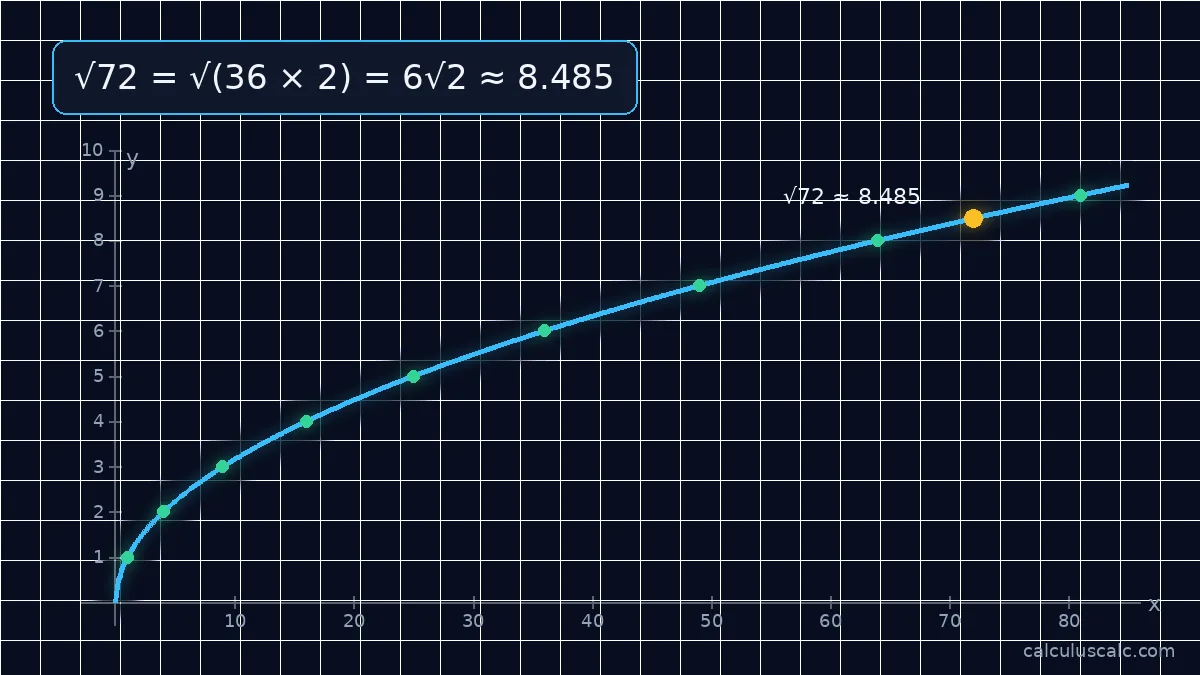
The perfect squares that divide 72 are 4, 9 and 36; the largest is 36.
$$sqrt{72} = sqrt{36 times 2} = sqrt{36},sqrt{2} = 6sqrt{2} approx 8.485$$
If you start with a smaller square, keep going: ( sqrt{72} = sqrt{4 cdot 18} = 2sqrt{18} = 2sqrt{9 cdot 2} = 6sqrt{2} ). Same answer, one more step.
Worked example: ∛54
For a cube root, look for perfect cubes (8, 27, 64, …). ( 54 = 27 times 2 ), so
$$sqrt[3]{54} = sqrt[3]{27},sqrt[3]{2} = 3sqrt[3]{2} approx 3.780$$
Worked example: adding radicals
Radicals can only be combined when the part under the root matches, so simplify first:
$$sqrt{18} + sqrt{8} = 3sqrt{2} + 2sqrt{2} = 5sqrt{2}$$
Using prime factors
For big numbers, factor into primes and pair them up. ( 360 = 2^3 cdot 3^2 cdot 5 ). Each pair comes out of a square root as one factor: ( sqrt{360} = 2 cdot 3sqrt{2 cdot 5} = 6sqrt{10} ). The prime factorization calculator does the factoring for you.
Roots of negative numbers
- Odd roots of negative numbers are real: ( sqrt[3]{-27} = -3 ), because ( (-3)^3 = -27 ).
- Even roots of negative numbers are not real numbers. Using ( i = sqrt{-1} ): ( sqrt{-16} = 4i ) and ( sqrt{-8} = 2sqrt{2},i ).
Perfect squares to know
| n | 1 | 2 | 3 | 4 | 5 | 6 | 7 | 8 | 9 | 10 | 11 | 12 |
|---|---|---|---|---|---|---|---|---|---|---|---|---|
| ( n^2 ) | 1 | 4 | 9 | 16 | 25 | 36 | 49 | 64 | 81 | 100 | 121 | 144 |
Roots as powers
A root is a fractional exponent: ( sqrt{x} = x^{1/2} ) and ( sqrt[n]{x} = x^{1/n} ). That is how roots are differentiated with the power rule: ( frac{d}{dx}sqrt{x} = frac{1}{2}x^{-1/2} = frac{1}{2sqrt{x}} ). The exponent rules guide shows how to move between the two forms.

Where simplified radicals appear
Geometry and trigonometry use exact answers. For example, the diagonal of a unit square is (\sqrt{2}). A 30-60-90 triangle has sides (1, \sqrt{3}, 2). See special right triangles for more. The quadratic formula and Pythagorean theorem often produce them. You can use a square root calculator for these values.
Common mistakes
- Splitting a sum: ( sqrt{9 + 16} = 5 ), but ( sqrt{9} + sqrt{16} = 7 ). The product rule doesn’t work for sums.
- Not using the largest square factor, leaving ( 2sqrt{18} ) instead of ( 6sqrt{2} ).
- Forgetting ±. ( sqrt{25} = 5 ), but ( x^2 = 25 ) has two solutions, ( x = pm 5 ).
Estimating a square root by hand
Find perfect squares on either side. ( sqrt{50} ) lies between ( sqrt{49} = 7 ) and ( sqrt{64} = 8 ). It is much closer to 7, about 7.07. For more accuracy, use the Babylonian method. (This is Newton’s method for square roots). Guess g, then replace it with the average of g and ( frac{n}{g} ). A square root calculator can also help.

For ( sqrt{10} ), start with 3:
$$g_1 = frac{3 + frac{10}{3}}{2} = 3.1667, qquad g_2 = frac{3.1667 + frac{10}{3.1667}}{2} = 3.16228$$
Two steps already give ( sqrt{10} approx 3.16228 ), correct to five decimal places. See Newton’s method for why it converges so quickly.
Rationalizing the denominator
Simplest radical form also means no root in the denominator. Multiply the top and bottom by the root:
$$frac{1}{sqrt{2}} = frac{sqrt{2}}{2}, qquad frac{6}{sqrt{3}} = frac{6sqrt{3}}{3} = 2sqrt{3}$$
Multiplying and dividing radicals
( sqrt{a},sqrt{b} = sqrt{ab} ) and ( frac{sqrt{a}}{sqrt{b}} = sqrt{frac{a}{b}} ) for non-negative a and b. So ( sqrt{12},sqrt{3} = sqrt{36} = 6 ) and ( frac{sqrt{50}}{sqrt{2}} = sqrt{25} = 5 ).
Simplifying with prime factors
| Number | Prime factors | Simplified root |
|---|---|---|
| 48 | ( 2^4 cdot 3 ) | ( 4sqrt{3} ) |
| 72 | ( 2^3 cdot 3^2 ) | ( 6sqrt{2} ) |
| 98 | ( 2 cdot 7^2 ) | ( 7sqrt{2} ) |
| 180 | ( 2^2 cdot 3^2 cdot 5 ) | ( 6sqrt{5} ) |
| 200 | ( 2^3 cdot 5^2 ) | ( 10sqrt{2} ) |
Practice problems
- ( sqrt{48} ).
- ( sqrt[3]{16} ).
- ( sqrt{-49} ).
- ( frac{10}{sqrt{5}} ).
Answers: 1. ( 4sqrt{3} ). 2. ( 2sqrt[3]{2} ). 3. ( 7i ). 4. ( frac{10sqrt{5}}{5} = 2sqrt{5} ).
Square roots of fractions and decimals
Take the root of the top and bottom separately: ( sqrt{frac{9}{16}} = frac{3}{4} ). Also ( sqrt{0.25} = sqrt{frac{1}{4}} = 0.5 ). When the bottom isn’t a perfect square, rationalize it. Use a square root calculator for this: ( sqrt{frac{1}{2}} = frac{1}{sqrt{2}} = frac{sqrt{2}}{2} approx 0.707 ).
Solving equations with square roots
To solve ( x^2 = 50 ), take the square root of both sides and remember both signs:
$$x = pmsqrt{50} = pm 5sqrt{2} approx pm 7.071$$
To solve ( sqrt{x + 3} = 5 ), square both sides: ( x + 3 = 25 ), so ( x = 22 ). Always check answers from squaring in the original equation, because squaring can introduce false solutions.
The square root function
The function ( f(x) = sqrt{x} ) needs ( x ge 0 ). Its outputs are never negative. The graph starts at the origin. Also, it rises ever more slowly. Its derivative ( frac{1}{2sqrt{x}} ) shrinks as x grows. See the derivative of √x for more. You can use a square root calculator for values.
Common nth roots
| Root | Value | Because |
|---|---|---|
| ( sqrt[3]{8} ) | 2 | ( 2^3 = 8 ) |
| ( sqrt[3]{27} ) | 3 | ( 3^3 = 27 ) |
| ( sqrt[3]{125} ) | 5 | ( 5^3 = 125 ) |
| ( sqrt[4]{16} ) | 2 | ( 2^4 = 16 ) |
| ( sqrt[4]{81} ) | 3 | ( 3^4 = 81 ) |
| ( sqrt[5]{32} ) | 2 | ( 2^5 = 32 ) |
Why √(a² + b²) is not a + b
A common slip is to “simplify” ( sqrt{a^2 + b^2} ) to ( a + b ). Try ( a = 3 ), ( b = 4 ): ( sqrt{9 + 16} = 5 ), not 7. The square root distributes over multiplication, ( sqrt{ab} = sqrt{a}sqrt{b} ), but never over addition. The expression ( sqrt{a^2 + b^2} ) is the hypotenuse from the Pythagorean theorem.
Related guides
Further reading
- Square root (Wikipedia) — properties, methods of computing and roots of negative numbers.
FAQ
How do you simplify a square root?
Write the number as the largest perfect square times another number, then take the square root of the perfect square: ( sqrt{50} = sqrt{25 cdot 2} = 5sqrt{2} ).
What is simplest radical form?
A radical with no perfect-square factor (other than 1) under the root and no root left in a denominator.
What is the square root of a negative number?
It is imaginary: ( sqrt{-a} = isqrt{a} ) for a > 0.
Is √x the same as x to the 1/2?
Yes, for ( x ge 0 ): ( sqrt{x} = x^{1/2} ).
What is the square root of 2?
About 1.41421356. It is irrational: its decimal never ends or repeats, so ( sqrt{2} ) is the exact form.
How do I simplify a cube root?
Look for perfect-cube factors (8, 27, 64, 125, …): ( sqrt[3]{40} = sqrt[3]{8 cdot 5} = 2sqrt[3]{5} ).