
Polynomial Long Division Calculator (with Steps)
- Free
- No sign-up
- Works on phones
- Shows the working
 By Yasir Hafeez · Updated
This polynomial long division calculator divides one polynomial by another and shows the division step by step: the next term of the quotient, what to subtract and what is left each time. It gives the quotient, the remainder and the answer written as quotient + remainder/divisor. When you divide by ( x – c ) it also checks the remainder with the remainder theorem.
It’s free and needs no sign-up.
How to use it
- Type the dividend, for example
x^3 - 2x^2 - 4. Missing powers are fine: they are treated as 0. - Type the divisor, for example
x - 3orx^2 + 1. - Press Divide.
The method
Polynomial long division works like long division with numbers:
- Divide the leading term of what is left by the leading term of the divisor. That is the next term of the quotient.
- Multiply the whole divisor by that term.
- Subtract the result from what is left.
- Repeat until what is left has a lower degree than the divisor. That is the remainder.
The result satisfies
$$P(x) = D(x),Q(x) + R(x), qquad frac{P(x)}{D(x)} = Q(x) + frac{R(x)}{D(x)}$$
Worked example: (x³ − 2x² − 4) ÷ (x − 3)
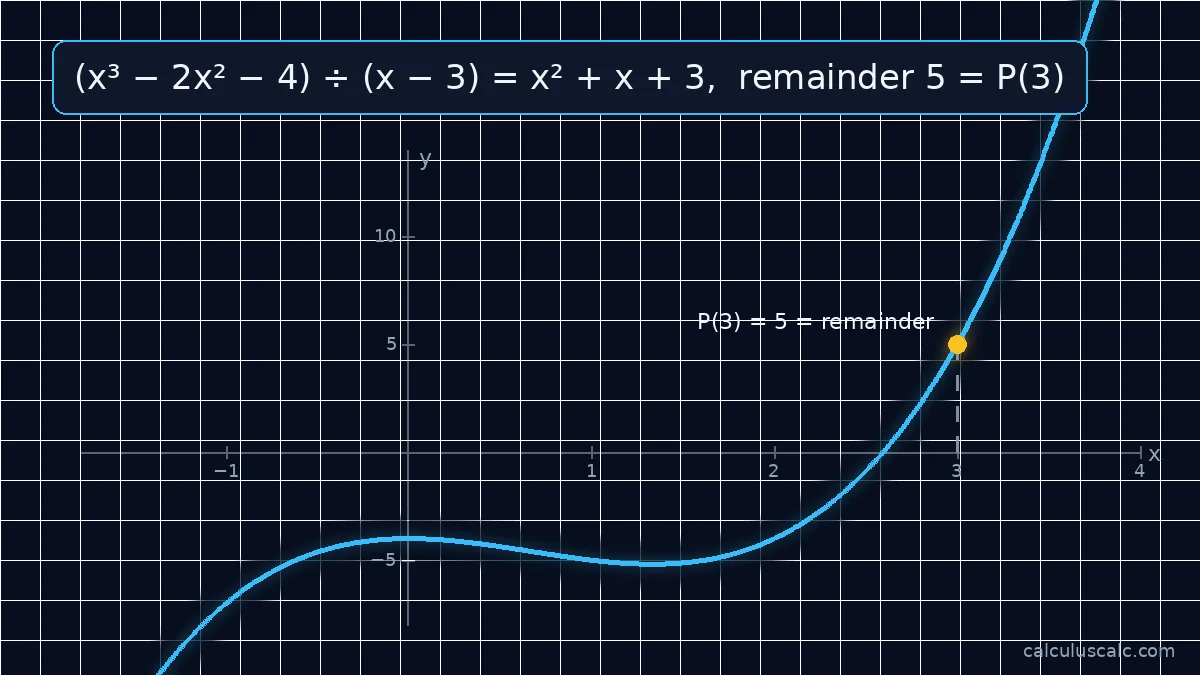
As loaded above. Write the missing x-term as ( 0x ): ( x^3 – 2x^2 + 0x – 4 ).

| Step | Quotient term | Subtract | What is left |
|---|---|---|---|
| 1 | ( x^3 div x = x^2 ) | ( x^2(x – 3) = x^3 – 3x^2 ) | ( x^2 + 0x – 4 ) |
| 2 | ( x^2 div x = x ) | ( x(x – 3) = x^2 – 3x ) | ( 3x – 4 ) |
| 3 | ( 3x div x = 3 ) | ( 3(x – 3) = 3x – 9 ) | ( 5 ) |
So the quotient is ( x^2 + x + 3 ) and the remainder is 5:
$$frac{x^3 - 2x^2 - 4}{x - 3} = x^2 + x + 3 + frac{5}{x - 3}$$
Check with the remainder theorem: ( P(3) = 27 – 18 – 4 = 5 ). Dividing by ( x – c ) always leaves remainder ( P(c) ).
Synthetic division
For a divisor ( x – c ), synthetic division is a shortcut using only the coefficients. With ( c = 3 ) and coefficients 1, −2, 0, −4: bring down 1; multiply by 3 and add: ( -2 + 3 = 1 ); again: ( 0 + 3 = 3 ); again: ( -4 + 9 = 5 ). The bottom row 1, 1, 3 | 5 is the quotient ( x^2 + x + 3 ) with remainder 5. The polynomials guide covers synthetic division in detail.
Worked example: dividing by a quadratic
( (2x^4 + 3x^3 – x + 5) div (x^2 + 1) ):

- ( 2x^4 div x^2 = 2x^2 ); subtract ( 2x^4 + 2x^2 ), leaving ( 3x^3 – 2x^2 – x + 5 ).
- ( 3x^3 div x^2 = 3x ); subtract ( 3x^3 + 3x ), leaving ( -2x^2 – 4x + 5 ).
- ( -2x^2 div x^2 = -2 ); subtract ( -2x^2 – 2 ), leaving ( -4x + 7 ).
Quotient ( 2x^2 + 3x – 2 ), remainder ( -4x + 7 ).
Worked example: a factor
( (x^2 – 1) div (x + 1) = x – 1 ) with remainder 0, so ( x + 1 ) is a factor of ( x^2 – 1 ). A zero remainder always means the divisor is a factor.
Where you need it
- Factoring polynomials: once you find one root c, divide by ( x – c ) to reduce the degree, then use the quadratic formula on what is left.
- Partial fractions: if the numerator’s degree is not lower than the denominator’s, divide first (see partial fraction decomposition).
- Slant asymptotes: for ( frac{x^2 + 1}{x – 1} = x + 1 + frac{2}{x – 1} ), the line ( y = x + 1 ) is the slant asymptote (see limits at infinity).
Common mistakes
- Skipping missing powers. Write ( 0x ) or ( 0x^2 ) as placeholders, or the columns slip.
- Subtracting only the first term. Subtract the whole product, distributing the minus sign.
- Stopping too early. Keep going until the remainder’s degree is less than the divisor’s.
Synthetic division step by step
For ( (2x^2 + 3x – 4) div (x + 3) ), the divisor is ( x – (-3) ), so use ( c = -3 ):
| 2 | 3 | −4 | |
|---|---|---|---|
| multiply by −3 | −6 | 9 | |
| add | 2 | −3 | 5 |
The bottom row gives the quotient ( 2x – 3 ) and remainder 5. Check: ( (x + 3)(2x – 3) + 5 = 2x^2 + 3x – 9 + 5 = 2x^2 + 3x – 4 ) ✔.
Worked example: a divisor with leading coefficient 2
( (4x^3 + 2x – 3) div (2x – 1) ). Long division works for any divisor:
- ( 4x^3 div 2x = 2x^2 ); subtract ( 4x^3 – 2x^2 ), leaving ( 2x^2 + 2x – 3 ).
- ( 2x^2 div 2x = x ); subtract ( 2x^2 – x ), leaving ( 3x – 3 ).
- ( 3x div 2x = frac32 ); subtract ( 3x – frac32 ), leaving ( -frac32 ).
Quotient ( 2x^2 + x + frac32 ), remainder ( -frac32 ). Synthetic division only works directly for divisors like ( x – c ), which is why long division is the general method.
Using division to find all the roots
To solve ( x^3 – 6x^2 + 11x – 6 = 0 ): try small factors of 6. ( P(1) = 1 – 6 + 11 – 6 = 0 ), so ( x – 1 ) is a factor. Dividing gives ( x^2 – 5x + 6 = (x – 2)(x – 3) ), so the roots are 1, 2 and 3. This “guess one root, divide, solve the quadratic” strategy is the standard way to factor cubics; the polynomial roots calculator finds the roots directly.
Using a polynomial long division calculator in calculus
Before integrating a rational function whose top has degree at least the bottom’s, divide first:

$$int frac{x^2 + 1}{x - 1},dx = int left(x + 1 + frac{2}{x - 1}right)dx = frac{x^2}{2} + x + 2ln|x - 1| + C$$
Practice problems
- ( (x^2 + 5x + 6) div (x + 2) ).
- ( (x^3 – 1) div (x – 1) ).
- ( (x^3 + 2x^2 – x + 4) div (x + 1) ).
Answers: 1. ( x + 3 ), remainder 0. 2. ( x^2 + x + 1 ), remainder 0 (the difference of cubes). 3. Synthetic with ( c = -1 ): coefficients 1, 1, −2 | 6, so ( x^2 + x – 2 ) with remainder 6. Check: ( P(-1) = -1 + 2 + 1 + 4 = 6 ) ✔.
Reading and Verifying the Output
After using the polynomial long division calculator, you will see the quotient, the remainder, and the final answer format. The quotient is the polynomial part of the result. The remainder is what is left over, having a lower degree than the divisor. If the remainder is zero, the divisor is an exact factor.
To verify the calculator's output, multiply the quotient by the divisor. Then, add the remainder to this product. The result should exactly match your original dividend. This check confirms the arithmetic and the division process. For example, if the calculator states that P(x) / D(x) = Q(x) + R(x)/D(x), then P(x) must equal Q(x) * D(x) + R(x).
It is important to remember that the degree of the remainder must always be less than the degree of the divisor. If it is not, the division was incomplete. This rule is fundamental to polynomial division.
Practical Tips for Success
Always arrange both the dividend and the divisor in descending order of powers. This consistent order prevents errors during the division process. If any power of the variable is missing, insert a placeholder term with a zero coefficient. For example, x^3 – 4 should be written as x^3 + 0x^2 + 0x – 4. This step keeps terms aligned properly.
Be careful with signs during subtraction. When you subtract a polynomial, distribute the negative sign to every term within that polynomial. A common error is subtracting only the first term and adding the rest. Also, take your time with each step of multiplication and subtraction. Double-check calculations as you go.
Finally, practice is key. The more you work through examples, the more intuitive the process becomes. Using a polynomial long division calculator helps you check your manual work and understand each step. It can highlight where you might be making a consistent mistake.
Related guides
Further reading
- Polynomial long division (Wikipedia) — the algorithm and its relation to synthetic division.
FAQ
How do you divide polynomials?
Divide the leading terms, multiply the divisor by the result, subtract, and repeat until the remainder has lower degree than the divisor.
What is the remainder theorem?
When ( P(x) ) is divided by ( x – c ), the remainder is ( P(c) ).
When should I use synthetic division?
Only when the divisor is linear with leading coefficient 1, like ( x – 3 ). For anything else, use long division.
How do I write the final answer?
As quotient plus remainder over divisor: ( Q(x) + frac{R(x)}{D(x)} ).
What is the difference between long division and synthetic division?
They give the same result. Synthetic division is a shortcut that only works for divisors of the form ( x – c ); long division works for any divisor.
What if the remainder is zero?
Then the divisor is a factor, and the dividend equals divisor × quotient exactly.