
Cross Product Calculator (Determinant Method, Steps)
- Free
- No sign-up
- Works on phones
- Shows the working
 By Yasir Hafeez · Updated
This cross product calculator finds ( u times v ) for two 3D vectors using the determinant method, with each of the i, j and k components worked out. It also gives the length of the cross product, which is the area of the parallelogram the two vectors span, and half of it, the area of the triangle. 2D vectors are treated as having a zero z-component.
It’s free and needs no sign-up.
How to use it
- Enter vector u as three components separated by commas, for example
1, 2, 3. - Enter vector v the same way.
- Press Calculate.
Formula
Write the vectors in a 3×3 determinant with the unit vectors i, j, k on top:
$$u times v = begin{vmatrix} mathbf{i} & mathbf{j} & mathbf{k} \ u_1 & u_2 & u_3 \ v_1 & v_2 & v_3 end{vmatrix} = langle u_2v_3 - u_3v_2, u_3v_1 - u_1v_3, u_1v_2 - u_2v_1 rangle$$
Expanding along the top row, the j component comes with a minus sign; that is the step people most often get wrong.
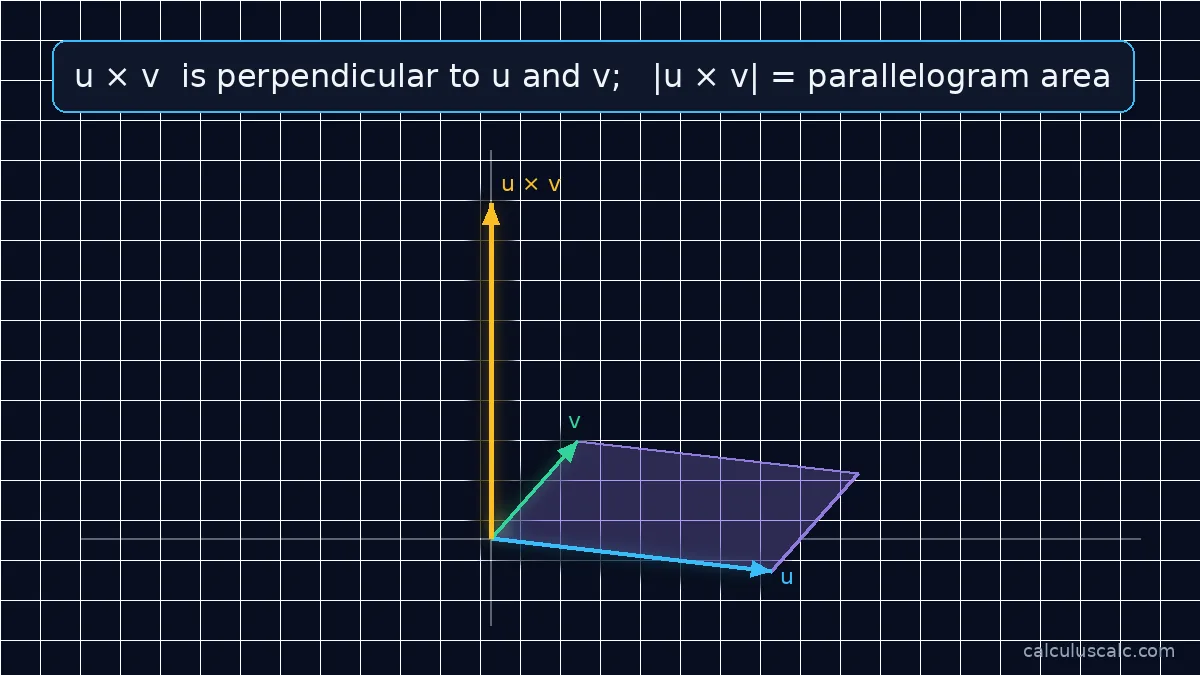
The length of the cross product is
$$|u times v| = |u||v|sintheta$$
which is the area of the parallelogram with sides u and v.
Worked example
For ( u = langle 1, 2, 3 rangle ) and ( v = langle 4, 5, 6 rangle ) (as loaded above):
- i: ( 2 cdot 6 – 3 cdot 5 = 12 – 15 = -3 )
- j: ( -(1 cdot 6 – 3 cdot 4) = -(6 – 12) = 6 )
- k: ( 1 cdot 5 – 2 cdot 4 = 5 – 8 = -3 )
So ( u times v = langle -3, 6, -3 rangle ). Its length is ( sqrt{9 + 36 + 9} = sqrt{54} = 3sqrt{6} approx 7.35 ), the area of the parallelogram.
Check: the result should be perpendicular to both vectors. ( langle -3, 6, -3 rangle cdot langle 1, 2, 3 rangle = -3 + 12 – 9 = 0 ) and ( langle -3, 6, -3 rangle cdot langle 4, 5, 6 rangle = -12 + 30 – 18 = 0 ). Both dot products are zero, as they should be.
Worked example: the area of a triangle
Find the area of the triangle with vertices ( A(0, 0, 0) ), ( B(1, 2, 0) ), ( C(3, 1, 0) ). First, take the edge vectors ( vec{AB} = langle 1, 2, 0 rangle ) and ( vec{AC} = langle 3, 1, 0 rangle ):
$$vec{AB} times vec{AC} = langle 0, 0, 1 - 6 rangle = langle 0, 0, -5 rangle$$
The triangle’s area is half the length: ( frac{5}{2} = 2.5 ).
Worked example: torque
A 10 N force in the y-direction is applied at the end of a 0.5 m wrench lying along the x-axis. The torque is ( tau = r times F = langle 0.5, 0, 0 rangle times langle 0, 10, 0 rangle = langle 0, 0, 5 rangle ) N·m: 5 N·m about the z-axis.

Direction: the right-hand rule
Point the fingers of your right hand along u and curl them toward v; your thumb points along ( u times v ). For example ( mathbf{i} times mathbf{j} = mathbf{k} ), ( mathbf{j} times mathbf{k} = mathbf{i} ) and ( mathbf{k} times mathbf{i} = mathbf{j} ). Reversing the order flips the direction: ( v times u = -(u times v) ).
Properties
- ( u times v ) is perpendicular to both u and v.
- ( u times v = mathbf{0} ) exactly when u and v are parallel (or one is zero).
- The cross product is not commutative and is only defined in three dimensions.
Common mistakes
- Forgetting the minus sign on the j component.
- Swapping the order of the vectors, which reverses the answer.
- Confusing it with the dot product. The cross product gives a vector; however, the dot product gives a number.
Step-by-step method
- Write the determinant with ( mathbf{i}, mathbf{j}, mathbf{k} ) in the top row, u in the middle row and v in the bottom row.
- i component: cover the i column and take the 2×2 determinant of what is left: ( u_2v_3 – u_3v_2 ).
- j component: cover the j column, take the 2×2 determinant, and change its sign: ( -(u_1v_3 – u_3v_1) ).
- k component: cover the k column: ( u_1v_2 – u_2v_1 ).
- Check: the result’s dot product with u and with v should both be 0.
Worked example: another pair
For ( u = langle 2, 0, 1 rangle ) and ( v = langle 1, 3, 0 rangle ):
- i: ( 0 cdot 0 – 1 cdot 3 = -3 )
- j: ( -(2 cdot 0 – 1 cdot 1) = 1 )
- k: ( 2 cdot 3 – 0 cdot 1 = 6 )
So ( u times v = langle -3, 1, 6 rangle ). Check: ( langle -3, 1, 6 rangle cdot langle 2, 0, 1 rangle = -6 + 0 + 6 = 0 ) ✔.
Worked example: the plane through three points
Find the plane through ( A(1, 0, 0) ), ( B(0, 1, 0) ) and ( C(0, 0, 1) ). Two edge vectors are ( vec{AB} = langle -1, 1, 0 rangle ) and ( vec{AC} = langle -1, 0, 1 rangle ). Their cross product ( langle 1, 1, 1 rangle ) is perpendicular to the plane (a normal vector), so the plane is ( x + y + z = d ). Substituting A gives ( d = 1 ): the plane is ( x + y + z = 1 ).
The scalar triple product: volume with a cross product calculator
( |u cdot (v times w)| ) is the volume of the box (parallelepiped) with edges u, v and w. For ( u = langle 1, 0, 0 rangle ), ( v = langle 0, 2, 0 rangle ), ( w = langle 0, 0, 3 rangle ): ( v times w = langle 6, 0, 0 rangle ) and ( u cdot langle 6, 0, 0 rangle = 6 ), the volume of a 1 × 2 × 3 box. If the triple product is 0, the three vectors lie in one plane.
Applications
The cross product gives torque and angular momentum in physics, the magnetic force ( F = qv times B ) on a moving charge, surface normals for lighting and collision detection in 3D graphics and games, and normal vectors for planes and surface integrals in multivariable calculus.

Practice problems
- ( mathbf{j} times mathbf{i} ).
- ( langle 1, 1, 0 rangle times langle 0, 1, 1 rangle ).
- The area of the parallelogram with sides ( langle 3, 0, 0 rangle ) and ( langle 0, 4, 0 rangle ).
Answers: 1. ( -mathbf{k} ) (reversing ( mathbf{i} times mathbf{j} = mathbf{k} )). 2. ( langle 1 cdot 1 – 0 cdot 1, -(1 cdot 1 – 0 cdot 0), 1 cdot 1 – 1 cdot 0 rangle = langle 1, -1, 1 rangle ). 3. ( |langle 0, 0, 12 rangle| = 12 ).
Related guides
- Dot Product Calculator
- Multivariable Calculus
- Matrix Multiplication
- Matrix Calculator (determinants)
Further reading
- Cross product (Wikipedia) — definition, right-hand rule and applications.
FAQ
What is the cross product of two vectors?
A vector perpendicular to both, with length ( |u||v|sintheta ). In components it is ( langle u_2v_3 – u_3v_2, u_3v_1 – u_1v_3, u_1v_2 – u_2v_1 rangle ).
What does the cross product tell you?
Its direction is perpendicular to both vectors (by the right-hand rule) and its length is the area of the parallelogram they span.
When is the cross product zero?
When the vectors are parallel or one of them is the zero vector, since then ( sintheta = 0 ).
Can you take the cross product of 2D vectors?
Treat them as 3D vectors with z = 0. The result points straight along the z-axis, and its z-component ( u_1v_2 – u_2v_1 ) is the signed area.
Is u × v the same as v × u?
No. ( v times u = -(u times v) ): same length, opposite direction.
What is the cross product of a vector with itself?
The zero vector, because a vector is parallel to itself.