
Unit Vector Calculator (and Vector Magnitude)
- Free
- No sign-up
- Works on phones
- Shows the working
 By Yasir Hafeez · Updated
This unit vector calculator finds the length (magnitude) of a vector and the unit vector that points the same way. Results are exact where possible: ( |v| ) in simplest radical form and each component of the unit vector as a fraction or radical, with decimals alongside. For 2D and 3D vectors it also gives the direction angles.
It’s free and needs no sign-up.
How to use it
- Enter the vector’s components separated by commas, for example
3, 4or2, -1, 2. Up to six components are accepted. - Press Calculate.
Formulas
The magnitude of ( v = langle v_1, v_2, ldots, v_n rangle ) comes from the Pythagorean theorem:
$$|v| = sqrt{v_1^2 + v_2^2 + cdots + v_n^2}$$
The unit vector divides every component by that length:
$$hat{u} = frac{v}{|v|} = leftlangle frac{v_1}{|v|}, frac{v_2}{|v|}, ldots, frac{v_n}{|v|} rightrangle$$
It has length 1 and the same direction as v. Finding it is called normalizing the vector.
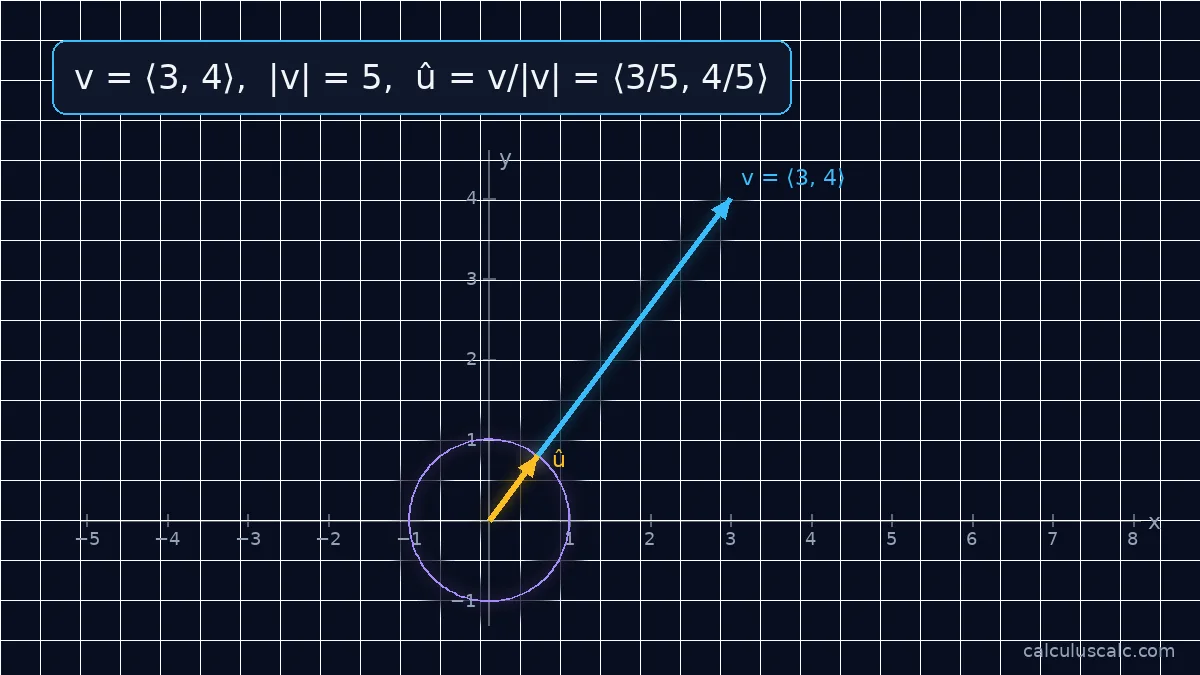
Worked example: ⟨3, 4⟩
As loaded above: ( |v| = sqrt{3^2 + 4^2} = sqrt{25} = 5 ), so
$$hat{u} = leftlangle frac{3}{5}, frac{4}{5} rightrangle = langle 0.6, 0.8 rangle$$
Check: ( 0.6^2 + 0.8^2 = 0.36 + 0.64 = 1 ).
Worked example: ⟨2, −1, 2⟩
( |v| = sqrt{4 + 1 + 4} = sqrt{9} = 3 ), so ( hat{u} = leftlangle frac{2}{3}, -frac{1}{3}, frac{2}{3} rightrangle ).
Worked example: ⟨1, 1, 1⟩
( |v| = sqrt{3} ), so each component is ( frac{1}{sqrt{3}} ). Rationalizing the denominator gives
$$hat{u} = leftlangle frac{sqrt{3}}{3}, frac{sqrt{3}}{3}, frac{sqrt{3}}{3} rightrangle approx langle 0.577, 0.577, 0.577 rangle$$
The calculator writes exact answers in this rationalized form.
Direction angles
The angles ( alpha, beta, gamma ) that v makes with the x-, y- and z-axes satisfy ( cosalpha = frac{v_1}{|v|} ), ( cosbeta = frac{v_2}{|v|} ), ( cosgamma = frac{v_3}{|v|} ). In other words, the components of the unit vector are the direction cosines. For ( langle 3, 4 rangle ), ( alpha approx 53.13^circ ) and ( beta approx 36.87^circ ).

Why a unit vector calculator is helpful
- Directional derivatives need a unit direction: ( D_{hat{u}} f = nabla f cdot hat{u} ). Using a non-unit vector scales the answer by mistake (see gradient and directional derivative).
- Physics splits a force into magnitude × direction: ( F = |F|,hat{u} ).
- Graphics and data normalize vectors so only direction matters.
To make a vector of any length L in the same direction, multiply the unit vector by L. For example, a vector of length 10 in the direction of ( langle 3, 4 rangle ) is ( 10 cdot langle 0.6, 0.8 rangle = langle 6, 8 rangle ).
Common mistakes
- Forgetting to square negative components. ( (-1)^2 = 1 ), so negative entries still add to the length.
- Dividing only some components by the length. Every component is divided.
- The zero vector. ( langle 0, 0 rangle ) has no direction and no unit vector.
Step-by-step method
- Square each component.
- Add the squares and take the square root: that is ( |v| ).
- Divide every component by ( |v| ).
- Simplify or rationalize, and check that the squares of the new components add to 1.
Worked example: ⟨−5, 12⟩
( |v| = sqrt{25 + 144} = sqrt{169} = 13 ), so ( hat{u} = leftlangle -frac{5}{13}, frac{12}{13} rightrangle ). The negative component stays negative: the unit vector points into the same quadrant as v.
Worked example: the direction from one point to another
The unit vector pointing from ( A(1, 2) ) to ( B(4, 6) ): first ( vec{AB} = langle 4 – 1, 6 – 2 rangle = langle 3, 4 rangle ), whose length is 5, so the direction is ( langle 0.6, 0.8 rangle ). Also, the length of ( vec{AB} ) is the distance between the points; see the distance formula.

Worked example: a velocity
A drone flies with velocity ( langle 6, 8, 0 rangle ) m/s. Its speed is ( |v| = 10 ) m/s and its direction is ( langle 0.6, 0.8, 0 rangle ). To fly the same direction at 25 m/s, use ( 25langle 0.6, 0.8, 0 rangle = langle 15, 20, 0 rangle ) m/s. Splitting a vector into speed × direction like this is used throughout physics.
Unit vector notation
Vectors are often written with ( mathbf{i}, mathbf{j}, mathbf{k} ): ( langle 3, 4 rangle = 3mathbf{i} + 4mathbf{j} ). Its unit vector is ( frac{3}{5}mathbf{i} + frac{4}{5}mathbf{j} ). Also, a hat (( hat{u} )) marks a unit vector.
Normal vectors
A unit normal vector is perpendicular to a line or surface and has length 1. The line ( 3x + 4y = 12 ) has normal ( langle 3, 4 rangle ), so its unit normal is ( langle 0.6, 0.8 rangle ). For a plane through three points, find the normal with the cross product and then normalize it here.
Practice problems
- ( langle 6, 8 rangle ).
- ( langle 1, 2, 2 rangle ).
- ( langle 0, -7 rangle ).
Answers: 1. Length 10, unit vector ( langle 0.6, 0.8 rangle ). 2. Length 3, unit vector ( leftlangle frac13, frac23, frac23 rightrangle ). 3. Length 7, unit vector ( langle 0, -1 rangle = -mathbf{j} ).
A unit vector from an angle
In 2D, the unit vector making an angle θ with the positive x-axis is ( langle costheta, sintheta rangle ). For ( theta = 30^circ ) it is ( leftlangle frac{sqrt{3}}{2}, frac12 rightrangle ). This is the point at angle θ on the unit circle, which is why the circle has radius 1.
The direction of a line
The line ( y = 2x + 1 ) rises 2 for every 1 across, so it has direction vector ( langle 1, 2 rangle ) and unit direction
$$leftlangle frac{1}{sqrt{5}}, frac{2}{sqrt{5}} rightrangle = leftlangle frac{sqrt{5}}{5}, frac{2sqrt{5}}{5} rightrangle$$
Higher dimensions
The same formula works in any number of dimensions. ( langle 1, 1, 1, 1 rangle ) has length ( sqrt{4} = 2 ), so its unit vector is ( leftlangle frac12, frac12, frac12, frac12 rightrangle ). In data science, normalizing long vectors like this lets you compare directions (patterns) regardless of size.

Checking your answer
A correct unit vector always passes two quick tests: its components’ squares add to 1, and each component has the same sign as the original vector’s component. For ( langle 2, -1, 2 rangle ), the answer ( leftlangle frac23, -frac13, frac23 rightrangle ) passes both: ( frac49 + frac19 + frac49 = 1 ), and the middle component is still negative.
Related guides
- Pythagorean Theorem
- Distance and Midpoint Formula
- Gradient and Directional Derivative
- Dot Product Calculator
Further reading
- Unit vector (Wikipedia) — normalization, standard basis vectors and direction cosines.
FAQ
What is a unit vector?
A vector with length 1. It shows a direction without any size.
How do you find a unit vector?
Divide the vector by its magnitude: ( hat{u} = frac{v}{|v|} ).
How do you find the magnitude of a vector?
Square each component, add them and take the square root: ( |v| = sqrt{v_1^2 + v_2^2 + v_3^2} ).
What are i, j and k?
The unit vectors along the x-, y- and z-axes: ( mathbf{i} = langle 1, 0, 0 rangle ), ( mathbf{j} = langle 0, 1, 0 rangle ), ( mathbf{k} = langle 0, 0, 1 rangle ).
Is the magnitude ever negative?
No. A length is always zero or positive. Only the zero vector has magnitude 0.
How do I find a vector of a given length in a given direction?
Multiply the unit vector in that direction by the length you want.