
Half-Life Calculator (Decay: Amount, Time or Half-Life)
- Free
- No sign-up
- Works on phones
- Shows the working
 By Yasir Hafeez · Updated
This half-life calculator solves the exponential decay formula for whichever value you don’t know: the amount remaining, the time elapsed, the half-life or the initial amount. It also gives the number of half-lives that have passed, the fraction remaining, the decay constant ( lambda ) and the mean lifetime. Use it for radioactive decay, carbon dating, drug elimination or any process that halves at a steady rate.
It’s free and needs no sign-up.
How to use it
- Choose what to find.
- Fill in the other three values: initial amount ( N_0 ), remaining amount N, half-life ( T_{1/2} ) and time t. Leave the one you’re finding blank.
- Use the same time unit for t and the half-life (years with years, hours with hours).
- Press Calculate.
Formula
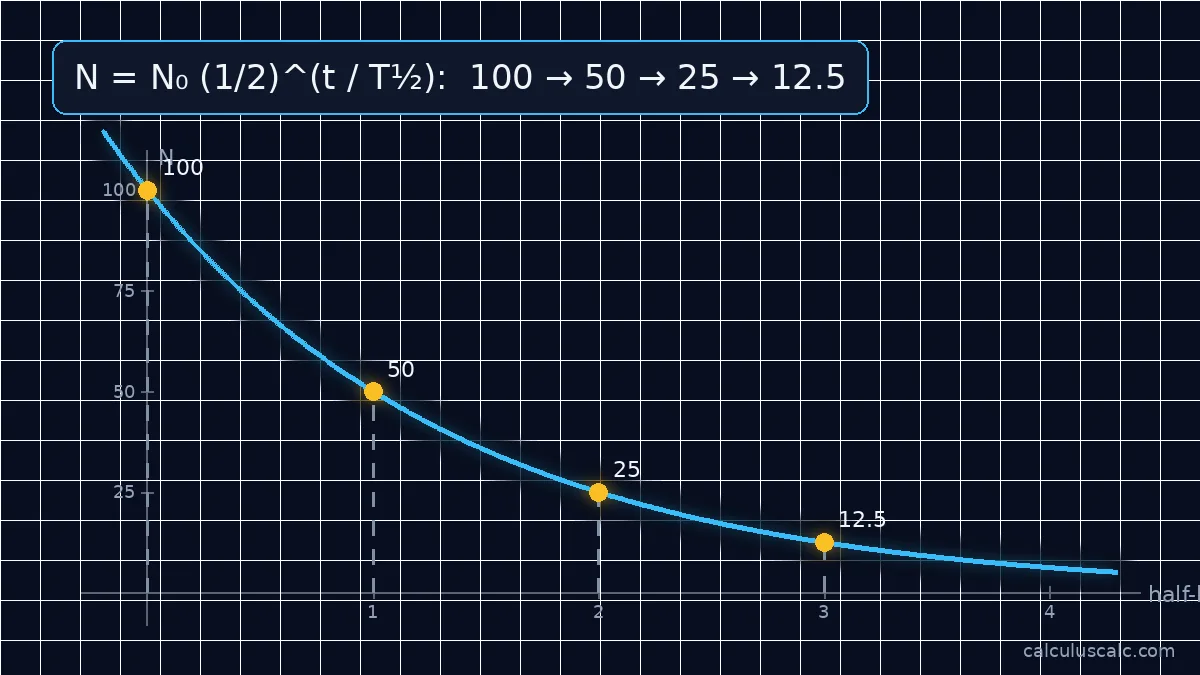
After each half-life, half of what is left remains:
$$N = N_0left(frac{1}{2}right)^{t / T_{1/2}}$$
Rearranged for the other unknowns:
$$t = T_{1/2}log_2frac{N_0}{N}, qquad T_{1/2} = frac{tln 2}{ln(N_0 / N)}, qquad N_0 = N cdot 2^{t / T_{1/2}}$$
You can write the same law as ( N = N_0 e^{-lambda t} ), with decay constant ( lambda = frac{ln 2}{T_{1/2}} ). Also, the mean lifetime is ( tau = frac{1}{lambda} approx 1.443,T_{1/2} ).
Worked example: carbon-14
Carbon-14 has a half-life of 5730 years. How much of a 100 g sample is left after 11,460 years (as loaded above)? That is exactly two half-lives:
$$N = 100left(tfrac12right)^{11460/5730} = 100 times tfrac14 = 25 text{ g}$$
Worked example: carbon dating
A bone contains 30% of the carbon-14 found in living tissue. How old is it?
$$t = 5730 log_2frac{100}{30} = 5730 times 1.737 approx 9953 text{ years}$$
Choose “Time t”, with ( N_0 = 100 ), N = 30 and half-life 5730.
Worked example: using a half life calculator
A sample decays from 200 mg to 50 mg in 10 hours. Since ( frac{50}{200} = frac14 = left(frac12right)^2 ), two half-lives took 10 hours, so ( T_{1/2} = 5 ) hours. The formula agrees: ( T_{1/2} = frac{10ln 2}{ln 4} = 5 ).
Worked example: a medicine
Iodine-131, used in thyroid treatment, has a half-life of about 8 days. Of an 80 mg dose, after 20 days (2.5 half-lives) there remains
$$80left(tfrac12right)^{2.5} approx 14.1 text{ mg}$$
and it takes 24 days (three half-lives) to fall to 10 mg.
Half-lives at a glance
| Half-lives passed | Fraction left | Percent left |
|---|---|---|
| 1 | 1/2 | 50% |
| 2 | 1/4 | 25% |
| 3 | 1/8 | 12.5% |
| 4 | 1/16 | 6.25% |
| 5 | 1/32 | 3.125% |
| 10 | 1/1024 | about 0.1% |
The calculus behind it
Radioactive decay is described by the differential equation ( frac{dN}{dt} = -lambda N ): the rate of decay is proportional to the amount present. Its solution is the exponential function ( N = N_0 e^{-lambda t} ). Solving for the time needs logarithms; see logarithm rules. For growth instead of decay (doubling time), use the exponential growth calculator.
Common mistakes
- Mixing time units, such as a half-life in years with t in days.
- Thinking everything is gone after two half-lives. After two half-lives, a quarter remains; also, decay never reaches exactly zero.
- Subtracting half the original each time. However, each half-life halves the amount left, not the starting amount.
Step-by-step
- Decide what you are solving for.
- Make sure t and the half-life are in the same units.
- Work out how many half-lives have passed: ( frac{t}{T_{1/2}} ).
- If that number is a whole number, halve the amount that many times. Otherwise use the formula (or the calculator).
- Check that the answer makes sense: the amount should go down over time, never below zero.
Half-lives of common isotopes
| Isotope | Half-life | Use |
|---|---|---|
| Technetium-99m | about 6 hours | medical imaging |
| Iodine-131 | about 8 days | thyroid treatment |
| Radon-222 | about 3.8 days | indoor air safety |
| Cobalt-60 | about 5.3 years | radiotherapy, sterilization |
| Radium-226 | about 1,600 years | historic luminous paint |
| Carbon-14 | about 5,730 years | dating organic remains |
| Uranium-238 | about 4.5 billion years | dating rocks and the Earth |
Short half-lives suit medicine (the dose disappears quickly); very long ones suit geology.
Worked example: caffeine
Caffeine’s half-life in adults is typically around 5 hours, though it varies from person to person. After a 200 mg coffee at 8 a.m., about ( 200left(tfrac12right)^{3} = 25 ) mg remains at 11 p.m., 15 hours (three half-lives) later. Drug half-lives work the same way, which is why doctors use them to plan doses.
Worked example: how much carbon-14 is left after 1000 years?
$$frac{N}{N_0} = left(tfrac12right)^{1000/5730} approx 0.886$$
About 88.6% remains. Carbon dating works well from a few hundred years up to about 50,000 years; beyond that, too little carbon-14 is left to measure.
Practice problems
- 64 g of a substance has a half-life of 3 days. How much is left after 12 days?
- A sample falls from 1000 counts to 125 counts in 9 hours. What is its half-life?
- What fraction of a substance remains after 5 half-lives?
Answers: 1. 12 days is 4 half-lives: ( 64 to 32 to 16 to 8 to 4 ) g. 2. ( frac{125}{1000} = frac18 = left(frac12right)^3 ), so 3 half-lives in 9 hours: ( T_{1/2} = 3 ) hours. 3. ( frac{1}{32} ), about 3.1%.
Where the decay constant comes from
Set the continuous form equal to half the starting amount after one half-life: ( N_0e^{-lambda T_{1/2}} = frac12 N_0 ). Cancel ( N_0 ) and take logarithms: ( lambda T_{1/2} = ln 2 ), so

$$lambda = frac{ln 2}{T_{1/2}}$$
For carbon-14, ( lambda = frac{0.6931}{5730} approx 1.21 times 10^{-4} ) per year: about 0.012% of the atoms decay each year.
Activity
The activity of a radioactive sample, the number of decays per second, is ( A = lambda N ), measured in becquerels (Bq). Because activity is proportional to N, it also halves every half-life. This is how you measure half-lives in practice: count decays with a detector over time and see how long the rate takes to halve.
Exponential vs linear decay
| Time (half-lives) | Exponential decay (halving) | Linear decay (same total in 2 steps) |
|---|---|---|
| 0 | 100 | 100 |
| 1 | 50 | 50 |
| 2 | 25 | 0 |
| 3 | 12.5 | — |
Exponential decay never quite reaches zero; it slows down as less material is left. That is the key difference from a constant-rate (linear) decrease.
Biological half-life
Half-life is not only about radioactivity. Also, the biological half-life of a medicine is the time for the body to clear half of it, and doctors use it to choose dosing intervals; you usually consider a drug essentially cleared after about five half-lives (about 3% left). You can apply the same formula and this calculator.
Related guides
Further reading
- Half-life (Wikipedia) — formulas, examples and the link to the decay constant.
- Radiocarbon dating (Wikipedia) — how carbon-14 measurements become ages.
FAQ
What is half-life?
The time it takes for half of a substance to decay. Also, it stays the same no matter how much you start with.
How do you calculate the amount remaining?
( N = N_0left(frac12right)^{t/T_{1/2}} ): divide the time by the half-life, and halve the starting amount that many times.
How many half-lives until a substance is gone?
Mathematically, it never reaches zero. However, in practice, 7 half-lives leave under 1% and 10 leave about 0.1%.
What is the decay constant?
( lambda = frac{ln 2}{T_{1/2}} ), the fraction decaying per unit time in the form ( N = N_0 e^{-lambda t} ).
Does the half-life depend on how much you start with?
No. Whether you have a gram or a tonne, half of it decays in one half-life. That constancy is what makes half-life useful.
What is the difference between half-life and mean lifetime?
The mean lifetime ( tau = frac{T_{1/2}}{ln 2} approx 1.443,T_{1/2} ) is the average time an atom survives; after one mean lifetime, about 36.8% remains.